github.com/reviewdog/reviewdog @v0.21.0
README

reviewdog - A code review dog who keeps your codebase healthy.















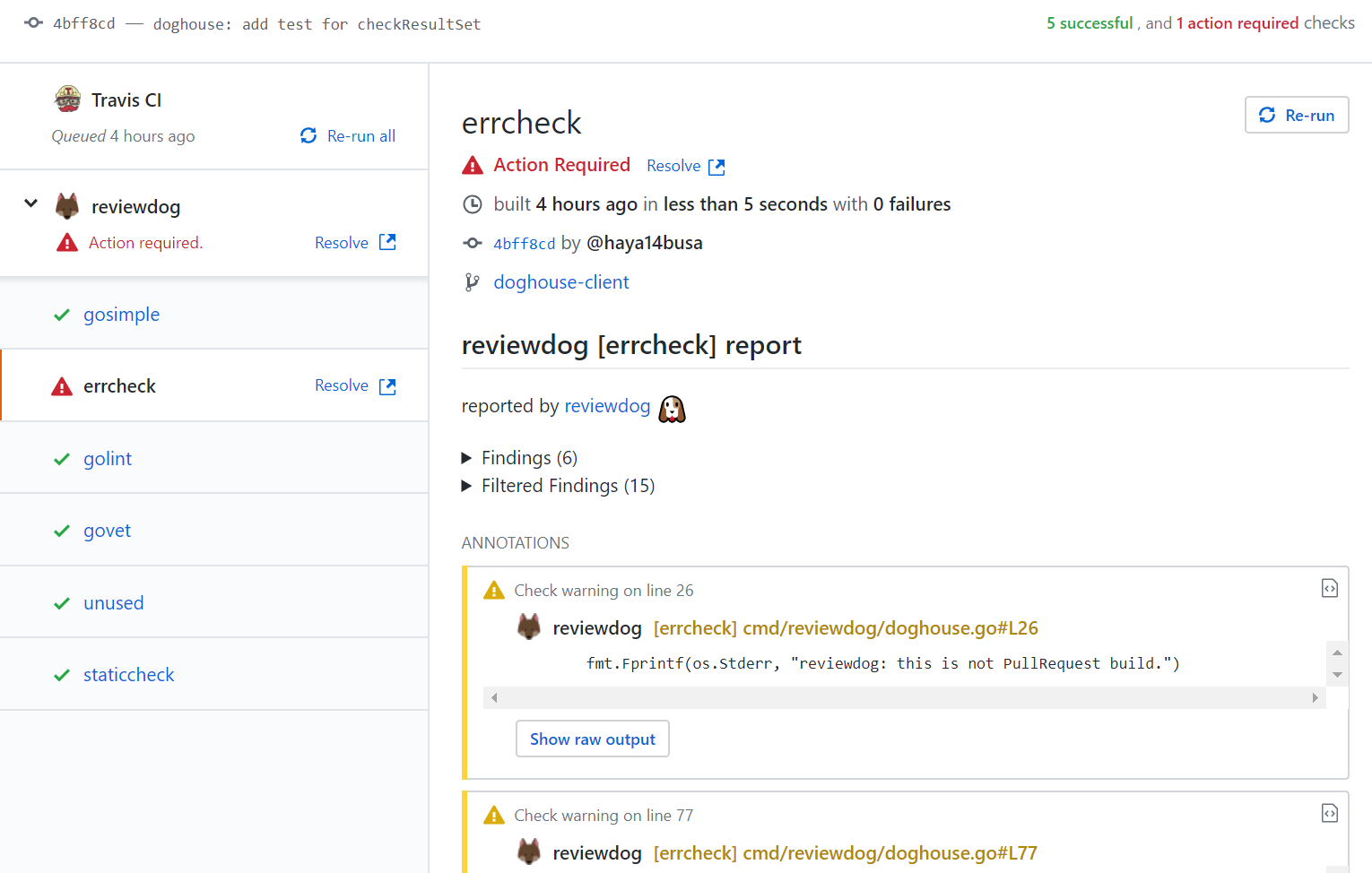
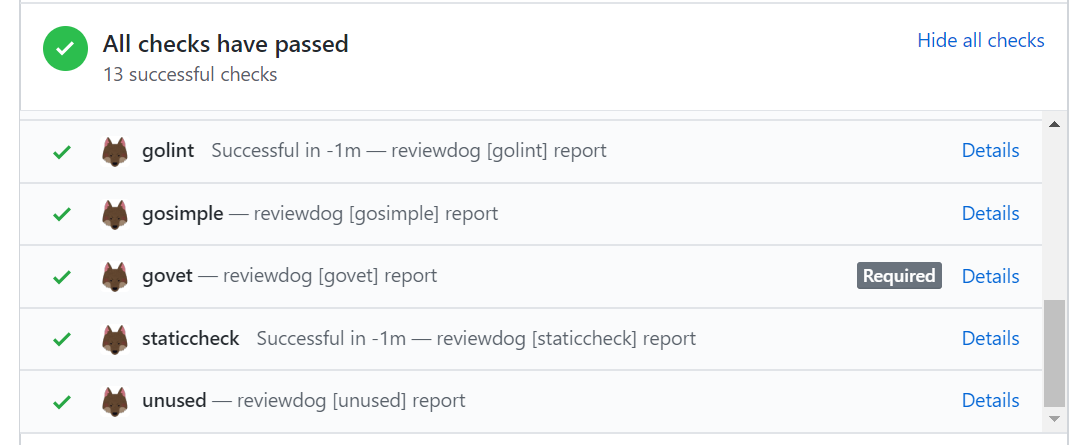
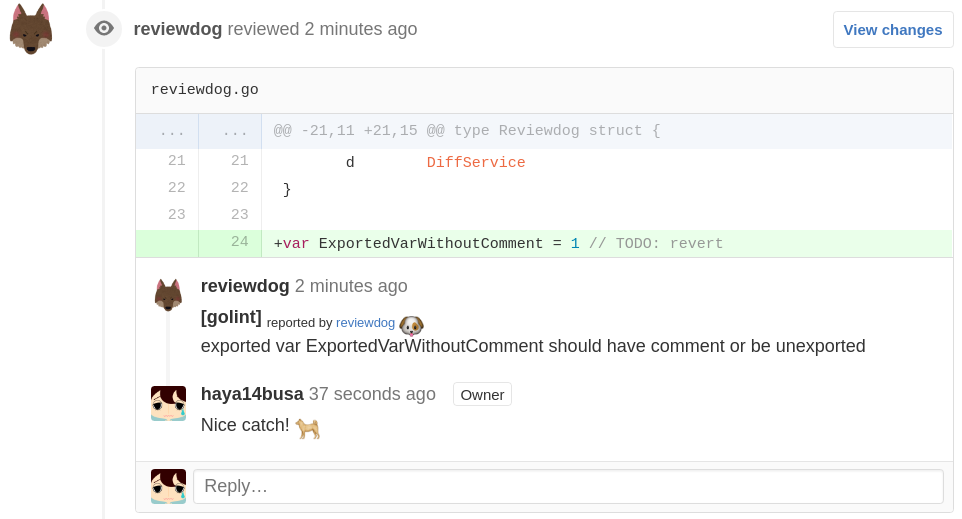
reviewdog provides a way to post review comments to code hosting services, such as GitHub, automatically by integrating with any linter tools with ease. It uses an output of lint tools and posts them as a comment if findings are in the diff of patches to review.
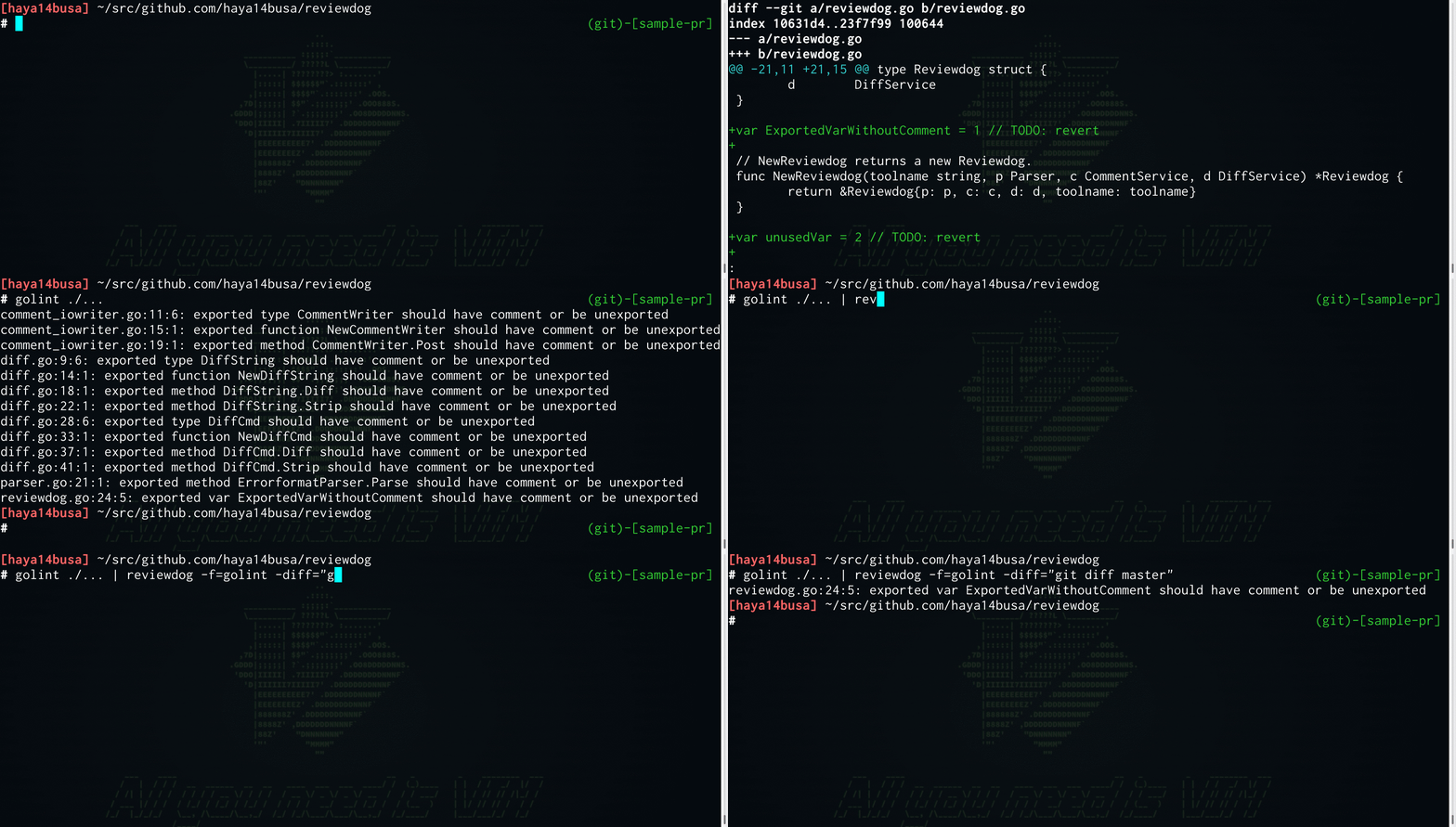
reviewdog also supports running in the local environment to filter the output of lint tools by diff.
Table of Contents
- Installation
- Input Format
- 'errorformat'
- Available pre-defined 'errorformat'
- Reviewdog Diagnostic Format (RDFormat)
- Diff
- checkstyle format
- SARIF format
- Code Suggestions
- reviewdog config file
- Reporters
- Reporter: Local (-reporter=local) [default]
- Reporter: GitHub PR Checks (-reporter=github-pr-check)
- Reporter: GitHub Checks (-reporter=github-check)
- Reporter: GitHub PullRequest review comment (-reporter=github-pr-review)
- Reporter: GitHub Annotations (-reporter=github-annotations)
- Reporter: GitHub PR Annotations (-reporter=github-pr-annotations)
- Reporter: GitLab MergeRequest discussions (-reporter=gitlab-mr-discussion)
- Reporter: GitLab MergeRequest commit (-reporter=gitlab-mr-commit)
- Reporter: Bitbucket Code Insights Reports (-reporter=bitbucket-code-report)
- Supported CI services
- GitHub Actions
- Travis CI
- Circle CI
- GitLab CI
- Bitbucket Pipelines
- Common (Jenkins, local, etc...)
- Exit codes
- Filter mode
- Articles

Installation
# Install the latest version. (Install it into ./bin/ by default).
$ curl -sfL https://raw.githubusercontent.com/reviewdog/reviewdog/fd59714416d6d9a1c0692d872e38e7f8448df4fc/install.sh | sh -s

# Specify installation directory ($(go env GOPATH)/bin/) and version.
$ curl -sfL https://raw.githubusercontent.com/reviewdog/reviewdog/fd59714416d6d9a1c0692d872e38e7f8448df4fc/install.sh | sh -s -- -b $(go env GOPATH)/bin [vX.Y.Z]

# In alpine linux (as it does not come with curl by default)
$ wget -O - -q https://raw.githubusercontent.com/reviewdog/reviewdog/fd59714416d6d9a1c0692d872e38e7f8448df4fc/install.sh | sh -s [vX.Y.Z]
Nightly releases
You can also use nightly reviewdog release to try the latest reviewdog improvements every day!
$ curl -sfL https://raw.githubusercontent.com/reviewdog/nightly/30fccfe9f47f7e6fd8b3c38aa0da11a6c9f04de7/install.sh | sh -s -- -b $(go env GOPATH)/bin
GitHub Action: reviewdog/action-setup
steps:
- uses: reviewdog/action-setup@d8edfce3dd5e1ec6978745e801f9c50b5ef80252 # v1.4.0
  with:
    reviewdog_version: latest # Optional. [latest,nightly,v.X.Y.Z]
homebrew / linuxbrew
You can also install reviewdog using brew:
$ brew install reviewdog/tap/reviewdog
$ brew upgrade reviewdog/tap/reviewdog
Scoop on Windows
> scoop install reviewdog
Build with go install
$ go install github.com/reviewdog/reviewdog/cmd/reviewdog@latest
Input Format
'errorformat'
reviewdog accepts any compiler or linter result from stdin and parses it with scan-f like 'errorformat', which is the port of Vim's errorformat feature.
For example, if the result format is {file}:{line number}:{column number}: {message},
errorformat should be %f:%l:%c: %m and you can pass it as -efm arguments.
$ golint ./...
comment_iowriter.go:11:6: exported type CommentWriter should have comment or be unexported
$ golint ./... | reviewdog -efm="%f:%l:%c: %m" -diff="git diff FETCH_HEAD"
| name | description |
|---|---|
| %f | file name |
| %l | line number |
| %c | column number |
| %m | error message |
| %% | the single '%' character |
| ... | ... |
Please see reviewdog/errorformat and :h errorformat if you want to deal with a more complex output. 'errorformat' can handle more complex output like a multi-line error message.
You can also try errorformat on the Playground!
With this 'errorformat' feature, reviewdog can support any tool output with ease.
Available pre-defined 'errorformat'
But, you don't have to write 'errorformat' in many cases. reviewdog supports pre-defined errorformat for major tools.
You can find available errorformat name by reviewdog -list and you can use it
with -f={name}.
$ reviewdog -list
golint          linter for Go source code                                       - https://github.com/golang/lint
govet           Vet examines Go source code and reports suspicious problems     - https://golang.org/cmd/vet/
sbt             the interactive build tool                                      - http://www.scala-sbt.org/
...
$ golint ./... | reviewdog -f=golint -diff="git diff FETCH_HEAD"
You can add supported pre-defined 'errorformat' by contributing to reviewdog/errorformat
Reviewdog Diagnostic Format (RDFormat)
reviewdog supports Reviewdog Diagnostic Format (RDFormat) as a generic diagnostic format and it supports both rdjson and rdjsonl formats.
This rdformat supports rich features like multiline ranged comments, severity, rule code with URL, and code suggestions.
$ <linter> | <convert-to-rdjson> | reviewdog -f=rdjson -reporter=github-pr-review
# or
$ <linter> | <convert-to-rdjsonl> | reviewdog -f=rdjsonl -reporter=github-pr-review
Example: ESLint with RDFormat

You can use eslint-formatter-rdjson
to output rdjson as eslint output format.
$ npm install --save-dev eslint-formatter-rdjson
$ eslint -f rdjson . | reviewdog -f=rdjson -reporter=github-pr-review
Or you can also use reviewdog/action-eslint for GitHub Actions.
Diff

reviewdog supports diff (unified format) as an input format especially useful for code suggestions. reviewdog can integrate with any code suggestions tools or formatters to report suggestions.
-f.diff.strip: option for -f=diff: strip NUM leading components from diff file names (equivalent to 'patch -p') (default is 1 for git diff) (default 1)
$ <any-code-fixer/formatter> # e.g. eslint --fix, gofmt
$ TMPFILE=$(mktemp)
$ git diff >"${TMPFILE}"
$ git stash -u && git stash drop
$ reviewdog -f=diff -f.diff.strip=1 -reporter=github-pr-review < "${TMPFILE}"
Or you can also use reviewdog/action-suggester for GitHub Actions.
If diagnostic tools support diff output format, you can pipe the diff directly.
$ gofmt -s -d . | reviewdog -name="gofmt" -f=diff -f.diff.strip=0 -reporter=github-pr-review
$ shellcheck -f diff $(shfmt -f .) | reviewdog -f=diff
checkstyle format
reviewdog also accepts checkstyle XML format as well. If the linter supports checkstyle format as a report format, you can use -f=checkstyle instead of using 'errorformat'.
# Local
$ eslint -f checkstyle . | reviewdog -f=checkstyle -diff="git diff"

# CI (overwrite tool name which is shown in review comment by -name arg)
$ eslint -f checkstyle . | reviewdog -f=checkstyle -name="eslint" -reporter=github-check
Also, if you want to pass other Json/XML/etc... format to reviewdog, you can write a converter.
$ <linter> | <convert-to-checkstyle> | reviewdog -f=checkstyle -name="<linter>" -reporter=github-pr-check
SARIF format
reviewdog supports SARIF 2.1.0 JSON format. You can use reviewdog with -f=sarif option.
```shell
Local
$ eslint -f @microsoft/eslint-formatter-sarif . | reviewdog -f=sarif -diff="git diff" ````
Code Suggestions
reviewdog supports code suggestions feature with [rdformat](#reviewdog-diagnostic-format-rdform
Extension points exported contracts — how you extend this code
CommentService (Interface)Core symbols most depended-on inside this repo
ErrorShape
Languages
Modules by API surface
Dependencies from manifests, versioned
For agents
$ claude mcp add reviewdog \
  -- python -m otcore.mcp_server <graph>