github.com/pyg-team/pytorch_geometric @2.8.0 sqlite
README

[![PyPI Version][pypi-image]][pypi-url] [![PyPI Download][pypi-download-image]][pypi-download-url] [![Slack][slack-image]][slack-url] [![Contributing][contributing-image]][contributing-url]
Documentation | PyG 1.0 Paper | PyG 2.0 Paper | Colab Notebooks | External Resources | OGB Examples
PyG (PyTorch Geometric) is a library built upon PyTorch to easily write and train Graph Neural Networks (GNNs) for a wide range of applications related to structured data.
It consists of various methods for deep learning on graphs and other irregular structures, also known as geometric deep learning, from a variety of published papers.
In addition, it consists of easy-to-use mini-batch loaders for operating on many small and single giant graphs, multi GPU-support, torch.compile support, DataPipe support, a large number of common benchmark datasets (based on simple interfaces to create your own), and helpful transforms, both for learning on arbitrary graphs as well as on 3D meshes or point clouds.
[Click here to join our Slack community!][slack-url]

- Library Highlights
- Quick Tour for New Users
- Architecture Overview
- Implemented GNN Models
- Installation
Library Highlights
Whether you are a machine learning researcher or first-time user of machine learning toolkits, here are some reasons to try out PyG for machine learning on graph-structured data.
- Easy-to-use and unified API: All it takes is 10-20 lines of code to get started with training a GNN model (see the next section for a quick tour). PyG is PyTorch-on-the-rocks: It utilizes a tensor-centric API and keeps design principles close to vanilla PyTorch. If you are already familiar with PyTorch, utilizing PyG is straightforward.
- Comprehensive and well-maintained GNN models: Most of the state-of-the-art Graph Neural Network architectures have been implemented by library developers or authors of research papers and are ready to be applied.
- Great flexibility: Existing PyG models can easily be extended for conducting your own research with GNNs. Making modifications to existing models or creating new architectures is simple, thanks to its easy-to-use message passing API, and a variety of operators and utility functions.
- Large-scale real-world GNN models: We focus on the need of GNN applications in challenging real-world scenarios, and support learning on diverse types of graphs, including but not limited to: scalable GNNs for graphs with millions of nodes; dynamic GNNs for node predictions over time; heterogeneous GNNs with multiple node types and edge types.
Quick Tour for New Users
In this quick tour, we highlight the ease of creating and training a GNN model with only a few lines of code.
Train your own GNN model
In the first glimpse of PyG, we implement the training of a GNN for classifying papers in a citation graph.
For this, we load the Cora dataset, and create a simple 2-layer GCN model using the pre-defined GCNConv:
import torch
from torch import Tensor
from torch_geometric.nn import GCNConv
from torch_geometric.datasets import Planetoid

dataset = Planetoid(root='.', name='Cora')

class GCN(torch.nn.Module):
    def __init__(self, in_channels, hidden_channels, out_channels):
        super().__init__()
        self.conv1 = GCNConv(in_channels, hidden_channels)
        self.conv2 = GCNConv(hidden_channels, out_channels)

    def forward(self, x: Tensor, edge_index: Tensor) -> Tensor:
        # x: Node feature matrix of shape [num_nodes, in_channels]
        # edge_index: Graph connectivity matrix of shape [2, num_edges]
        x = self.conv1(x, edge_index).relu()
        x = self.conv2(x, edge_index)
        return x

model = GCN(dataset.num_features, 16, dataset.num_classes)
We can now optimize the model in a training loop, similar to the standard PyTorch training procedure.
import torch.nn.functional as F

data = dataset[0]
optimizer = torch.optim.Adam(model.parameters(), lr=0.01)

for epoch in range(200):
    pred = model(data.x, data.edge_index)
    loss = F.cross_entropy(pred[data.train_mask], data.y[data.train_mask])

    # Backpropagation
    optimizer.zero_grad()
    loss.backward()
    optimizer.step()
More information about evaluating final model performance can be found in the corresponding example.
Create your own GNN layer
In addition to the easy application of existing GNNs, PyG makes it simple to implement custom Graph Neural Networks (see here for the accompanying tutorial). For example, this is all it takes to implement the edge convolutional layer from Wang et al.:
$$x_i^{\prime} ~ = ~ \max_{j \in \mathcal{N}(i)} ~ \textrm{MLP}_{\theta} \left( [ ~ x_i, ~ x_j - x_i ~ ] \right)$$
import torch
from torch import Tensor
from torch.nn import Sequential, Linear, ReLU
from torch_geometric.nn import MessagePassing

class EdgeConv(MessagePassing):
    def __init__(self, in_channels, out_channels):
        super().__init__(aggr="max")  # "Max" aggregation.
        self.mlp = Sequential(
            Linear(2 * in_channels, out_channels),
            ReLU(),
            Linear(out_channels, out_channels),
        )

    def forward(self, x: Tensor, edge_index: Tensor) -> Tensor:
        # x: Node feature matrix of shape [num_nodes, in_channels]
        # edge_index: Graph connectivity matrix of shape [2, num_edges]
        return self.propagate(edge_index, x=x)  # shape [num_nodes, out_channels]

    def message(self, x_j: Tensor, x_i: Tensor) -> Tensor:
        # x_j: Source node features of shape [num_edges, in_channels]
        # x_i: Target node features of shape [num_edges, in_channels]
        edge_features = torch.cat([x_i, x_j - x_i], dim=-1)
        return self.mlp(edge_features)  # shape [num_edges, out_channels]
Architecture Overview
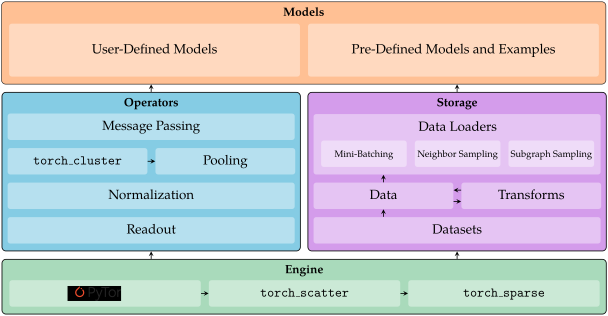
PyG provides a multi-layer framework that enables users to build Graph Neural Network solutions on both low and high levels. It comprises of the following components:
- The PyG engine utilizes the powerful PyTorch deep learning framework with full
torch.compileand TorchScript support, as well as additions of efficient CPU/CUDA libraries for operating on sparse data, e.g.,pyg-lib. - The PyG storage handles data processing, transformation and loading pipelines. It is capable of handling and processing large-scale graph datasets, and provides effective solutions for heterogeneous graphs. It further provides a variety of sampling solutions, which enable training of GNNs on large-scale graphs.
- The PyG operators bundle essential functionalities for implementing Graph Neural Networks. PyG supports important GNN building blocks that can be combined and applied to various parts of a GNN model, ensuring rich flexibility of GNN design.
- Finally, PyG provides an abundant set of GNN models, and examples that showcase GNN models on standard graph benchmarks. Thanks to its flexibility, users can easily build and modify custom GNN models to fit their specific needs.
Implemented GNN Models
We list currently supported PyG models, layers and operators according to category:
GNN layers:
All Graph Neural Network layers are implemented via the nn.MessagePassing interface.
A GNN layer specifies how to perform message passing, i.e. by designing different message, aggregation and update functions as defined here.
These GNN layers can be stacked together to create Graph Neural Network models.
- GCNConv from Kipf and Welling: Semi-Supervised Classification with Graph Convolutional Networks (ICLR 2017) [Example]
- ChebConv from Defferrard et al.: Convolutional Neural Networks on Graphs with Fast Localized Spectral Filtering (NIPS 2016) [Example]
- GATConv from Veličković et al.: Graph Attention Networks (ICLR 2018) [Example]
Expand to see all implemented GNN layers...
- GCN2Conv from Chen et al.: Simple and Deep Graph Convolutional Networks (ICML 2020) [Example1, Example2]
- SplineConv from Fey et al.: SplineCNN: Fast Geometric Deep Learning with Continuous B-Spline Kernels (CVPR 2018) [Example1, Example2]
- NNConv from Gilmer et al.: Neural Message Passing for Quantum Chemistry (ICML 2017) [Example1, Example2]
- CGConv from Xie and Grossman: Crystal Graph Convolutional Neural Networks for an Accurate and Interpretable Prediction of Material Properties (Physical Review Letters 120, 2018)
- ECConv from Simonovsky and Komodakis: Edge-Conditioned Convolution on Graphs (CVPR 2017)
- EGConv from Tailor et al.: Adaptive Filters and Aggregator Fusion for Efficient Graph Convolutions (GNNSys 2021) [Example]
- GATv2Conv from Brody et al.: How Attentive are Graph Attention Networks? (ICLR 2022)
- TransformerConv from Shi et al.: Masked Label Prediction: Unified Message Passing Model for Semi-Supervised Classification (CoRR 2020) [Example]
- SAGEConv from
Core symbols most depended-on inside this repo
sizeShape
Languages
Modules by API surface
Dependencies from manifests, versioned
For agents
$ claude mcp add pytorch_geometric \
  -- python -m otcore.mcp_server <graph>