github.com/pixlcore/xyops @v1.0.77 sqlite
README
xyOps™
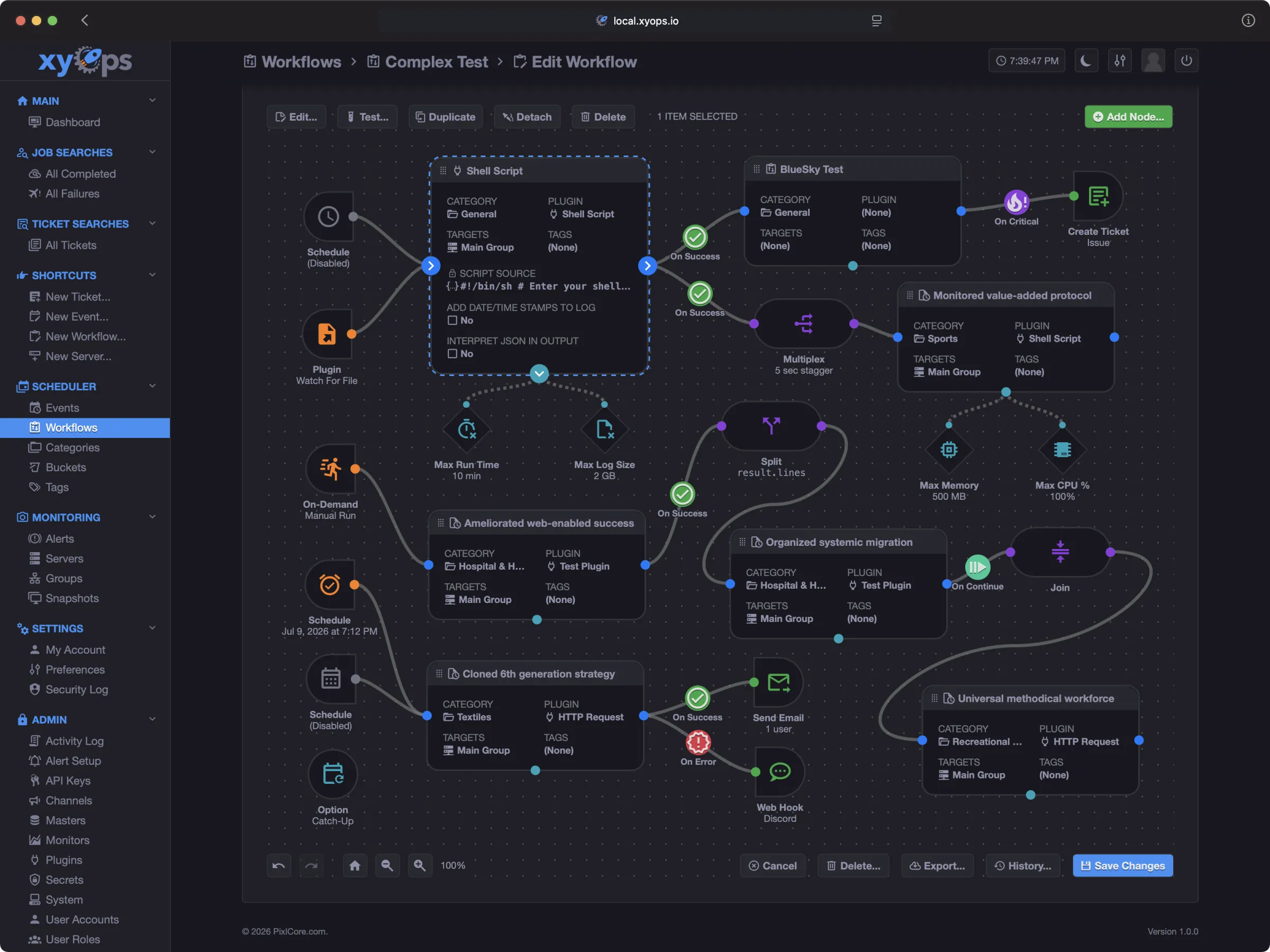
xyOps™ is a next-generation system for job scheduling, workflow automation, server monitoring, alerting, and incident response -- all combined into a single, cohesive platform. It's built for developers and operations teams who want to control their automation stack without surrendering data, freedom, or visibility. xyOps doesn't hide features behind paywalls or push telemetry back to anyone. It's open, extensible, and designed to run anywhere.
The Idea Behind xyOps
Most automation platforms focus on workflow orchestration -- they run tasks, but they don't really help you see what's happening behind them. xyOps takes it further. It doesn't just schedule jobs; it connects them to real-time monitoring, alerts, server snapshots, and ticketing, creating a single, integrated feedback loop. When an alert fires, the email includes the running jobs on that server. One click opens a snapshot showing every process, CPU load, and network connection. If a job fails, xyOps can open a ticket with full context -- logs, history, and linked metrics. Everything in xyOps talks to everything else, so you can trace an issue from detection to resolution without ever leaving the system.
Features at a Glance
- Why xyOps?
- Schedule jobs across your fleet, track performance, set alerts, and view everything live, all in one place.
- Job Scheduling Reimagined
- xyOps brings superpowers to job scheduling, way beyond cron.
- Build Workflows Visually
- Use the graphical workflow editor to connect events, triggers, actions, and monitors into meaningful pipelines.
- Monitor Everything
- Define exactly what you want to monitor, and get notified the moment things go wrong.
- Smart Alerts
- Rich alerting with full customization and complex triggers.
- Built for Fleets
- Whether you have five servers or five thousand, xyOps adapts to your needs.
- Developer-Friendly
- Designed with you in mind. Yes, you!
- Simple Setup
- From download to deployment in minutes.
- Licensing
- xyOps is BSD-licensed for maximum flexibility.
Installation
See our Self-Hosting Guide for installation details.
Pricing
Free Tier
For individuals looking to self-host xyOps:
- All app features
- Community support
- Open source forever
If you use xyOps and love it, consider becoming a sponsor here on GitHub.
Professional Tier
For production installs, we highly recommend our Professional Plan, which includes:
- All app features
- Professional support
- Private ticketing system
- 24 hour turnaround on tickets
Enterprise Tier
For larger enterprises, sign up for our Enterprise Plan, which includes:
- All app features
- Enterprise support
- SSO setup and support
- Air-gapped installation support
- Private ticketing system
- 1 hour turnaround on tickets
- Live chat with our team
Documentation
Check out our official docs site here: xyOps Documentation
Full documentation is also provided inside the xyOps app. Just click the "Documentation" link in the sidebar.
Videos
Visit our official YouTube channel for xyOps tutorials: @PixlCore-Media
Watch a quick overview of xyOps to see how the platform helps teams orchestrate workflows, monitor systems, and operate with confidence:
Community
Join our subreddit to get help from the xyOps community:
https://reddit.com/r/xyOps/
Discord
Join our Discord server to chat with community members in real-time:
https://discord.gg/FTzqmbGbdd
Social Media
Follow us on social media:
Contributing
Please read our Contributing Guide before opening a pull request.
TL;DR; we do not accept feature PRs, but there are lots of other ways you can contribute! See the guide for details.
Development
See our Development Guide for local dev setup. In short, install Node.js LTS and then:
git clone https://github.com/pixlcore/xyops.git
cd xyops
npm install
node bin/build.js dev
echo '{ "secret_key": "test" }' > conf/overrides.json
bin/debug.sh
Security
Read our Trust Guide for xyOps self-hosting, privacy, telemetry, outbound requests, and enterprise security posture.
Read our Security Guide to learn how to report security vulnerabilities to the xyOps team.
Please do not submit vulnerabilities as GitHub issues!
Governance
The xyOps project exists to empower users and developers through openness, reliability, and fairness.
Our Governance Model is designed to preserve these principles indefinitely.
Longevity
Please read our open source Longevity Pledge. The TL;DR; is:
xyOps will always be open-licensed, and always OSI-approved. No rug pulls.
License
xyOps™ is licensed under the BSD-3-Clause license.
See LICENSE.md for full license text.
Core symbols most depended-on inside this repo
doErrorShape
Languages
Modules by API surface
Dependencies from manifests, versioned
Datastores touched
For agents
$ claude mcp add xyops \
  -- python -m otcore.mcp_server <graph>