github.com/jtesta/ssh-audit @v3.3.0 sqlite
README
ssh-audit








ssh-audit is a tool for ssh server & client configuration auditing.
jtesta/ssh-audit (v2.0+) is the updated and maintained version of ssh-audit forked from arthepsy/ssh-audit (v1.x) due to inactivity.
Features
- SSH1 and SSH2 protocol server support;
- analyze SSH client configuration;
- grab banner, recognize device or software and operating system, detect compression;
- gather key-exchange, host-key, encryption and message authentication code algorithms;
- output algorithm security information (available since, removed/disabled, unsafe/weak/legacy, etc);
- output algorithm recommendations (append or remove based on recognized software version);
- analyze SSH version compatibility based on algorithm information;
- historical information from OpenSSH, Dropbear SSH and libssh;
- policy scans to ensure adherence to a hardened/standard configuration;
- runs on Linux and Windows;
- supports Python 3.8 - 3.13;
- no dependencies
Usage
usage: ssh-audit.py [options] <host>

   -h,  --help             print this help
   -1,  --ssh1             force ssh version 1 only
   -2,  --ssh2             force ssh version 2 only
   -4,  --ipv4             enable IPv4 (order of precedence)
   -6,  --ipv6             enable IPv6 (order of precedence)
   -b,  --batch            batch output
   -c,  --client-audit     starts a server on port 2222 to audit client
                               software config (use -p to change port;
                               use -t to change timeout)
        --conn-rate-test=N[:max_rate]  perform a connection rate test (useful
                                       for collecting metrics related to
                                       susceptibility of the DHEat vuln).
                                       Testing is conducted with N concurrent
                                       sockets with an optional maximum rate
                                       of connections per second.
   -d,  --debug            Enable debug output.
        --dheat=N[:kex[:e_len]]    continuously perform the DHEat DoS attack
                                   (CVE-2002-20001) against the target using N
                                   concurrent sockets.  Optionally, a specific
                                   key exchange algorithm can be specified
                                   instead of allowing it to be automatically
                                   chosen.  Additionally, a small length of
                                   the fake e value sent to the server can
                                   be chosen for a more efficient attack (such
                                   as 4).
   -g,  --gex-test=<x[,y,...]>  dh gex modulus size test
                   <min1:pref1:max1[,min2:pref2:max2,...]>
                   <x-y[:step]>
   -j,  --json             JSON output (use -jj to enable indents)
   -l,  --level=<level>    minimum output level (info|warn|fail)
   -L,  --list-policies    list all the official, built-in policies. Use with -v
                               to view policy change logs.
        --lookup=<alg1,alg2,...>    looks up an algorithm(s) without
                                    connecting to a server
   -m,  --manual           print the man page (Docker, PyPI, Snap, and Windows
                                    builds only)
   -M,  --make-policy=<policy.txt>  creates a policy based on the target server
                                    (i.e.: the target server has the ideal
                                    configuration that other servers should
                                    adhere to)
   -n,  --no-colors        disable colors
   -p,  --port=<port>      port to connect
   -P,  --policy=<"policy name" | policy.txt>  run a policy test using the
                                                   specified policy
        --skip-rate-test   skip the connection rate test during standard audits
                               (used to safely infer whether the DHEat attack
                               is viable)
   -t,  --timeout=<secs>   timeout (in seconds) for connection and reading
                               (default: 5)
   -T,  --targets=<hosts.txt>  a file containing a list of target hosts (one
                                   per line, format HOST[:PORT]).  Use -p/--port
                                   to set the default port for all hosts.  Use
                                   --threads to control concurrent scans.
        --threads=<threads>    number of threads to use when scanning multiple
                                   targets (-T/--targets) (default: 32)
   -v,  --verbose          verbose output
- if both IPv4 and IPv6 are used, order of precedence can be set by using either
-46or-64. - batch flag
-bwill output sections without header and without empty lines (implies verbose flag). - verbose flag
-vwill prefix each line with section type and algorithm name. - an exit code of 0 is returned when all algorithms are considered secure (for a standard audit), or when a policy check passes (for a policy audit).
Basic server auditing:
ssh-audit localhost
ssh-audit 127.0.0.1
ssh-audit 127.0.0.1:222
ssh-audit ::1
ssh-audit [::1]:222
To run a standard audit against many servers (place targets into servers.txt, one on each line in the format of HOST[:PORT]):
ssh-audit -T servers.txt
To audit a client configuration (listens on port 2222 by default; connect using ssh -p 2222 anything@localhost):
ssh-audit -c
To audit a client configuration, with a listener on port 4567:
ssh-audit -c -p 4567
To list all official built-in policies (hint: use resulting policy names with -P/--policy):
ssh-audit -L
To run a policy audit against a server:
ssh-audit -P ["policy name" | path/to/server_policy.txt] targetserver
To run a policy audit against a client:
ssh-audit -c -P ["policy name" | path/to/client_policy.txt]
To run a policy audit against many servers:
ssh-audit -T servers.txt -P ["policy name" | path/to/server_policy.txt]
To create a policy based on a target server (which can be manually edited):
ssh-audit -M new_policy.txt targetserver
To run the DHEat CPU exhaustion DoS attack (CVE-2002-20001) against a target using 10 concurrent sockets:
ssh-audit --dheat=10 targetserver
To run the DHEat attack using the diffie-hellman-group-exchange-sha256 key exchange algorithm:
ssh-audit --dheat=10:diffie-hellman-group-exchange-sha256 targetserver
To run the DHEat attack using the diffie-hellman-group-exchange-sha256 key exchange algorithm along with very small but non-standard packet lengths (this may result in the same CPU exhaustion, but with many less bytes per second being sent):
ssh-audit --dheat=10:diffie-hellman-group-exchange-sha256:4 targetserver
Screenshots
Server Standard Audit Example
Below is a screen shot of the standard server-auditing output when connecting to an unhardened OpenSSH v5.3 service:

Server Policy Audit Example
Below is a screen shot of the policy auditing output when connecting to an un-hardened Ubuntu Server 20.04 machine (hint: use -L/--list-policies to see names of built-in policies to use with -P/--policy):
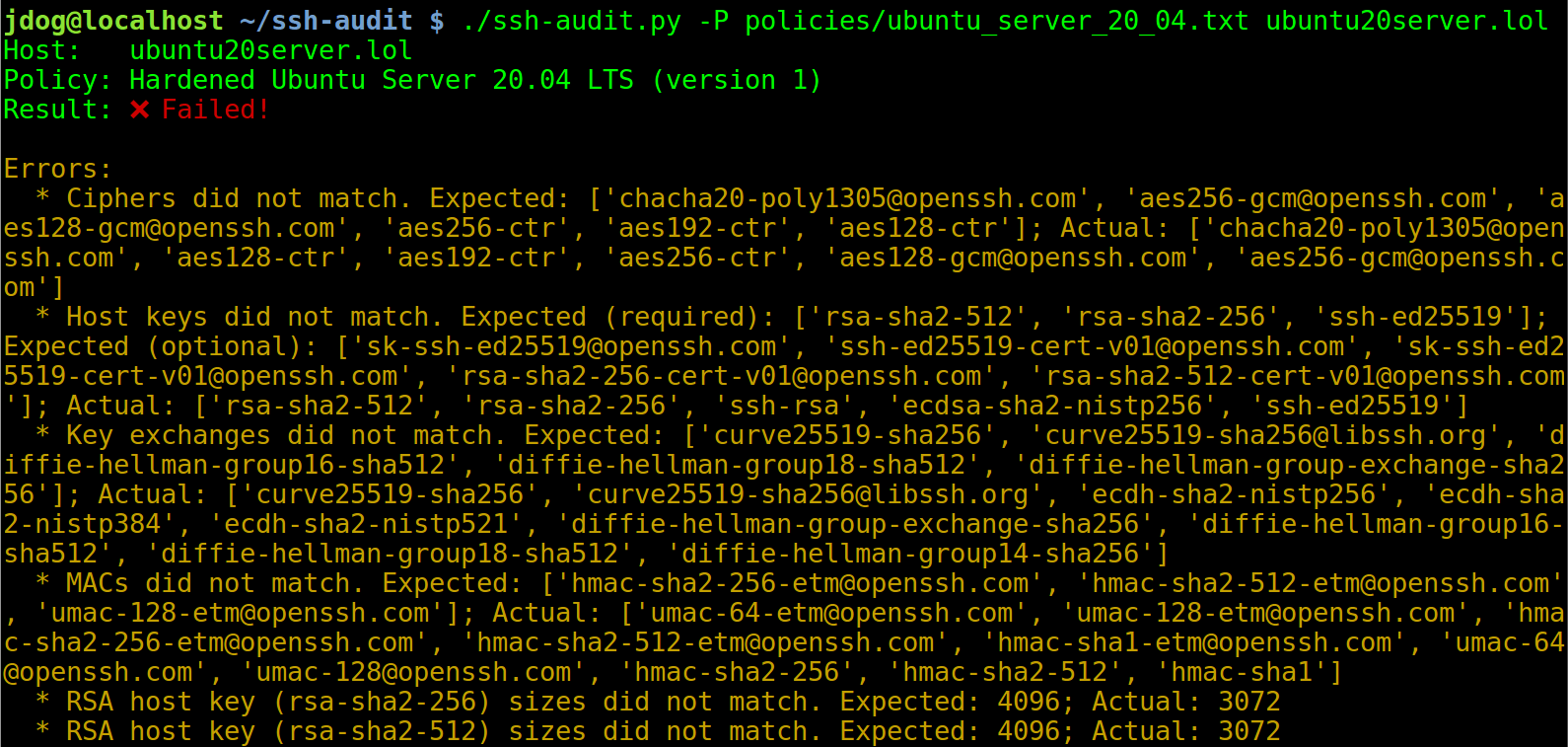
After applying the steps in the hardening guide (see below), the output changes to the following:

Client Standard Audit Example
Below is a screen shot of the client-auditing output when an unhardened OpenSSH v7.2 client connects:

Hardening Guides
Guides to harden server & client configuration can be found here: https://www.ssh-audit.com/hardening_guides.html
Pre-Built Packages
Pre-built packages are available for Windows (see the Releases page), PyPI, Snap, and Docker:
To install from PyPI:
$ pip3 install ssh-audit
To install the Snap package:
$ snap install ssh-audit
To install from Dockerhub:
$ docker pull positronsecurity/ssh-audit
(Then run with: docker run -it --rm -p 2222:2222 positronsecurity/ssh-audit 10.1.1.1)
The status of various other platform packages can be found below (via Repology):

Web Front-End
For convenience, a web front-end on top of the command-line tool is available at https://www.ssh-audit.com/.
ChangeLog
v3.3.0 (2024-10-15)
- Added Python 3.13 support.
- Added built-in policies for Ubuntu 24.04 LTS server & client, OpenSSH 9.8, and OpenSSH 9.9.
- Added IPv6 support for DHEat and connection rate tests.
- Added TCP port information to JSON policy scan results; credit Fabian Malte Kopp.
- Added LANcom LCOS server recognition and Ed448 key extraction; credit Daniel Lenski.
- Now reports ECDSA and DSS fingerprints when in verbose mode; partial credit Daniel Lenski.
- Removed CVE information based on server/client version numbers, as this was wildly inaccurate (see this thread for the full discussion, as well as the results of the community vote on this matter).
- Fixed crash when running with
-Pand-Toptions simultaneously. - Fixed host key tests from only reporting a key type at most once despite multiple hosts supporting it; credit Daniel Lenski.
- Fixed DHEat connection rate testing on MacOS X and BSD platforms; credit Drew Noel and Michael Osipov.
- Fixed invalid JSON output when a socket error occurs while performing a client audit.
- Fixed
--conn-rate-testfeature on Windows. - When scanning multiple targets (using
-T/--targets), the-p/--portoption will now be used as the default port (set to 22 if-p/--portis not given). Hosts specified in the file can override this default with an explicit port number (i.e.: "host1:1234"). For example, when using-T targets.txt -p 222, all hosts intargets.txtthat do not explicitly include a port number will default to 222; when using-T targets.txt(without-p), all hosts will use a default of 22. - Updated built-in server & client policies for Amazon Linux 2023, Debian 12, Rocky Linux 9, and Ubuntu 22.04 to improve host key efficiency and cipher resistance to quantum attacks.
- Added 1 new cipher:
grasshopper-ctr128. - Added 2 new key exchanges:
mlkem768x25519-sha256,sntrup761x25519-sha512.
v3.2.0 (2024-04-22)
- Added implementation of the DHEat denial-of-service attack (see
--dheatoption; CVE-2002-20001). - Expanded filter of CBC ciphers to flag for the Terrapin vulnerability. It now includes more rarely found ciphers.
- Fixed parsing of
ecdsa-sha2-nistp*CA signatures on host keys. Additionally, they are now flagged as potentially back-doored, just as standard host keys are. - Gracefully handle rare exceptions (i.e.: crashes) while performing GEX tests.
- The built-in man page (
-m,--manual) is now available on Docker, PyPI, and Snap builds, in addition to the Windows build. - Snap builds are now architecture-independent.
- Changed Docker base image from
python:3-slimtopython:3-alpine, resulting in a 59% reduction in image size; credit Daniel Thamdrup. - Added built-in policies for Amazon Linux 2023, Debian 12, OpenSSH 9.7, and Rocky Linux 9.
- Built-in policies now include a change log (use
-L -vto view them). - Custom policies now support the `allow_algorithm_subset_and_reorderin
Core symbols most depended-on inside this repo
infoShape
Languages
Modules by API surface
For agents
$ claude mcp add ssh-audit \
  -- python -m otcore.mcp_server <graph>