github.com/craft-ai-agents/craft-agents-oss @v0.10.5 sqlite
README
Craft Agents


How it Works (Video)
To understand what Craft Agents does and how it works watch this video.
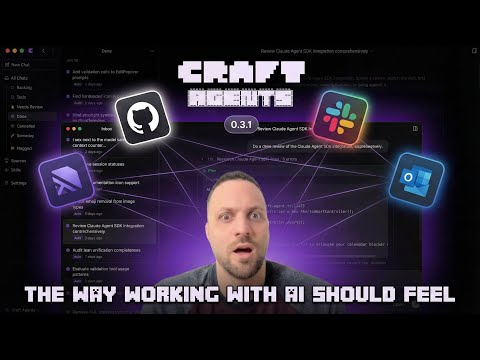
Click Here (or on the image above) to watch the video on YouTube →
Why Craft Agents was built
Craft Agents is a tool we built so that we (at craft.do) can work effectively with agents. It enables intuitive multitasking, no-fluff connection to any API or Service, sharing sessions, and a more document (vs code) centric workflow - in a beautiful and fluid UI.
It uses the Claude Agent SDK and the Pi SDK side by side—building on what we found great and improving areas where we've desired improvements.
It's built with Agent Native software principles in mind, and is highly customisable out of the box. One of the first of its kind.
Craft Agents is open source under the Apache 2.0 license - so you are free to remix, change anything. And that's actually possible. We ourselves are building Craft Agents with Craft Agents only - no code editors - so really, any customisation is just a prompt away.
We built Craft Agents because we wanted a better, more opinionated (and preferably non-CLI way) of working with the most powerful agents in the world. We'll continue to improve it, based on our experiences and intuition.
Things that are hard to believe "just work"
How do I connect to Linear, Gmail, Slack...? Tell the agent "add Linear as a source." It finds public APIs and MCP servers, reads their docs, sets up credentials, and configures everything. No config files, no setup wizards.
Check out how I just connected to Slack →
I already have my MCP config JSON. Paste it. The agent handles the rest.
What about local MCPs? Fully supported. Stdio-based MCP servers run as local subprocesses on your machine. Point it at an npx command, a Python script, or any local binary. It just works.
Can it handle custom APIs? Yes. Paste an OpenAPI spec, some endpoint URLs, screenshots of docs, whatever you have. It figures it out and guides you through the rest.
APIs too? Not just MCPs? Craft Agents connects to anything. We have it hooked up to a direct Postgres DB behind a jumpbox. Skills + Sources = magic.
How do I import my Claude Code skills and MCPs? Tell the agent you want to import your skills from Claude Code. It handles the migration.
Here I imported all my skills in one go →
How do I create a new skill? Describe what the skill should do, give it context. The agent takes care of the rest.
Do I need to restart after changes?
No. Everything is instant. Mention new skills or sources with @, even mid-conversation.
So I can just ask it anything? Yes. That's the core idea behind agent-native software. You describe what you want, and it figures out how. That's a good use of tokens.
Installation
One-Line Install (Recommended)
macOS / Linux:
curl -fsSL https://agents.craft.do/install-app.sh | bash
Windows (PowerShell):
irm https://agents.craft.do/install-app.ps1 | iex
Build from Source
git clone https://github.com/lukilabs/craft-agents-oss.git
cd craft-agents-oss
bun install
bun run electron:start
Features
- Multi-Session Inbox: Desktop app with session management, status workflow, and flagging
- Claude Code Experience: Streaming responses, tool visualization, real-time updates
- Multiple LLM Connections: Add multiple AI providers and set per-workspace defaults
- Multi-Provider Support: Run sessions with Google AI Studio, ChatGPT Plus, GitHub Copilot, or OpenAI API keys alongside Anthropic
- Craft MCP Integration: Access to 32+ Craft document tools (blocks, collections, search, tasks)
- Sources: Connect to MCP servers, REST APIs (Google, Slack, Microsoft), and local filesystems
- Permission Modes: Three-level system (Explore, Ask to Edit, Auto) with customizable rules
- Background Tasks: Run long-running operations with progress tracking
- Dynamic Status System: Customizable session workflow states (Todo, In Progress, Done, etc.)
- Theme System: Cascading themes at app and workspace levels
- Multi-File Diff: VS Code-style window for viewing all file changes in a turn
- Skills: Specialized agent instructions stored per-workspace
- File Attachments: Drag-drop images, PDFs, Office documents with auto-conversion
- Automations: Event-driven automation — create agent sessions on label changes, schedules, tool use, and more
Quick Start
- Launch the app after installation
- Choose API Connection: Use Anthropic (API key or Claude Max), Google AI Studio, ChatGPT Plus (Codex OAuth), or GitHub Copilot OAuth
- Create a workspace: Set up a workspace to organize your sessions
- Connect sources (optional): Add MCP servers, REST APIs, or local filesystems
- Start chatting: Create sessions and interact with Claude
Desktop App Features
Session Management
- Inbox/Archive: Sessions organized by workflow status
- Flagging: Mark important sessions for quick access
- Status Workflow: Todo → In Progress → Needs Review → Done
- Session Naming: AI-generated titles or manual naming
- Session Persistence: Full conversation history saved to disk
Sources
Connect external data sources to your workspace:
| Type | Examples |
|---|---|
| MCP Servers | Craft, Linear, GitHub, Notion, custom servers |
| REST APIs | Google (Gmail, Calendar, Drive, YouTube, Search Console), Slack, Microsoft |
| Local Files | Filesystem, Obsidian vaults, Git repos |
Permission Modes
| Mode | Display | Behavior |
|---|---|---|
safe |
Explore | Read-only, blocks all write operations |
ask |
Ask to Edit | Prompts for approval (default) |
allow-all |
Auto | Auto-approves all commands |
Use SHIFT+TAB to cycle through modes in the chat interface.
Keyboard Shortcuts
| Shortcut | Action |
|---|---|
Cmd+N |
New chat |
Cmd+1/2/3 |
Focus sidebar/list/chat |
Cmd+/ |
Keyboard shortcuts dialog |
SHIFT+TAB |
Cycle permission modes |
Enter |
Send message |
Shift+Enter |
New line |
Remote Server (Headless)
Craft Agents can run as a headless server on a remote machine (e.g., a Linux VPS), with the desktop app connecting as a thin client. This lets you keep long-running sessions alive, access them from multiple machines, and run compute-heavy tasks on a powerful server.
Quick Start
From the monorepo root:
# Generate a token and start the server
CRAFT_SERVER_TOKEN=$(openssl rand -hex 32) bun run packages/server/src/index.ts
The server prints the connection details on startup:
CRAFT_SERVER_URL=ws://203.0.113.5:9100
CRAFT_SERVER_TOKEN=<generated-token>
Copy these values and use them to connect the desktop app.
Connecting the Desktop App
Launch the Electron app in thin-client mode by passing the server URL and token:
CRAFT_SERVER_URL=wss://203.0.113.5:9100 CRAFT_SERVER_TOKEN=<token> bun run electron:start
In thin-client mode, the desktop app renders the UI but all session logic, tool execution, and LLM calls run on the remote server.
Environment Variables
| Variable | Required | Default | Description |
|---|---|---|---|
CRAFT_SERVER_TOKEN |
Yes | — | Bearer token for client authentication |
CRAFT_RPC_HOST |
No | 127.0.0.1 |
Bind address (0.0.0.0 for remote access) |
CRAFT_RPC_PORT |
No | 9100 |
Bind port |
CRAFT_RPC_TLS_CERT |
No | — | Path to PEM certificate file (enables wss://) |
CRAFT_RPC_TLS_KEY |
No | — | Path to PEM private key file (required with cert) |
CRAFT_RPC_TLS_CA |
No | — | Path to PEM CA chain file (optional, for client cert verification) |
CRAFT_DEBUG |
No | false |
Enable debug logging |
TLS (Recommended for Remote Access)
When exposing the server over the network, TLS encrypts the WebSocket connection (wss:// instead of ws://).
Generate a self-signed certificate (development/testing):
./scripts/generate-dev-cert.sh
# Creates certs/cert.pem and certs/key.pem (valid 365 days)
Start the server with TLS:
CRAFT_SERVER_TOKEN=<token> \
CRAFT_RPC_HOST=0.0.0.0 \
CRAFT_RPC_TLS_CERT=certs/cert.pem \
CRAFT_RPC_TLS_KEY=certs/key.pem \
bun run packages/server/src/index.ts
The server will print CRAFT_SERVER_URL=wss://<your-public-ip>:9100.
For production, use certificates from a trusted CA (e.g., Let's Encrypt) or place the server behind a reverse proxy (nginx, Caddy) that terminates TLS.
Docker
docker run -d \
  -p 9100:9100 \
  -e CRAFT_SERVER_TOKEN=<token> \
  -e CRAFT_RPC_HOST=0.0.0.0 \
  -v craft-data:/root/.craft-agent \
  craft-agents-server
To enable TLS in Docker, mount your certificates and set the env vars:
docker run -d \
  -p 9100:9100 \
  -e CRAFT_SERVER_TOKEN=<token> \
  -e CRAFT_RPC_HOST=0.0.0.0 \
  -e CRAFT_RPC_TLS_CERT=/certs/cert.pem \
  -e CRAFT_RPC_TLS_KEY=/certs/key.pem \
  -v ./certs:/certs:ro \
  -v craft-data:/root/.craft-agent \
  craft-agents-server
CLI Client
A terminal client that connects to a running Craft Agent server over WebSocket (ws:// or wss://). Use it for scripting, CI/CD pipelines, server validation, or when you prefer the command line.
Installation
# From the monorepo (requires Bun)
bun run apps/cli/src/index.ts --help

# Or add to your PATH
alias craft-cli="bun run $(pwd)/apps/cli/src/index.ts"
Connection
The CLI reads connection details from flags or environment variables:
# Via environment (set once)
export CRAFT_SERVER_URL=ws://127.0.0.1:9100
export CRAFT_SERVER_TOKEN=<your-token>

# Or via flags
craft-cli --url ws://127.0.0.1:9100 --token <token> ping
For TLS connections (wss://), use --tls-ca <path> for self-signed certificates.
Commands
| Command | Description |
|---|---|
ping |
Verify connectivity (clientId + latency) |
health |
Check credential store health |
versions |
Show server runtime versions |
workspaces |
List workspaces |
sessions |
List sessions in workspace |
connections |
List LLM connections |
sources |
List configured sources |
session create |
Create a session (--name, --mode) |
session messages <id> |
Print session message history |
session delete <id> |
Delete a session |
send <id> <message> |
Send message and stream AI response |
cancel <id> |
Cancel in-progress processing |
invoke <channel> [args] |
Raw RPC call with JSON args |
listen <channel> |
Subscribe to push events (Ctrl+C to stop) |
run <prompt> |
Self-contained: spawn server, run prompt, stream response, exit |
--validate-server |
21-step integration test (auto-spawns server if no --url) |
Run Command Flags
| Flag | Default | Description |
|---|---|---|
--workspace-dir <path> |
— | Register a workspace directory before running |
--source <slug> |
— | Enable a source (repeatable) |
--output-format <fmt> |
text |
Output format: text or stream-json |
--mode <mode> |
allow-all |
Permission mode for the session |
--no-cleanup |
false |
Skip session deletion on exit |
--server-entry <path> |
— | Custom server entry point |
--provider <name> |
anthropic |
LLM provider (anthropic, openai, google, openrouter, groq, mistral, xai, etc.) |
--model <id> |
(provider default) | Model ID (e.g., claude-sonnet-4-5-20250929, gpt-4o, gemini-2.0-flash) |
--api-key <key> |
— | API key (or $LLM_API_KEY, or provider-specific env var) |
--base-url <url> |
— | Custom API endpoint for proxies or self-hosted models |
The run command is fully self-contained — it spawns a headless server, creates a session, sends the prompt, streams the response, and exits. No separate server setup needed. An API key is resolved from --api-key, $LLM_API_KEY, or a provider-specific env var (e.g., $ANTHROPIC_API_KEY, $OPENAI_API_KEY).
Examples
# Quick connectivity check
craft-cli ping

# List sessions (human-readable)
craft-cli sessions

# Send a message and stream the AI response
craft-cli send abc-123 "What files are in the current directory?"

# Pipe input
echo "Summarize this" | craft-cli send abc-123

# JSON output for scripting
craft-cli --json workspaces | jq '.[].name'

# Self-contained run (spawns its own server)
craft-cli run "Summarize the README"
craft-cli run --workspace-dir ./my-project --source github "List open PRs"

# Multi-provider support
craft-cli run --provider openai --model gpt-4o "Summarize this repo"
GOOGLE_API_KEY=... craft-cli run --provider google --model gemini-2.0-flash "Hello"
craft-cli run --provider anthropic --base-url https://openrouter.ai/api/v1 --api-key $OR_KEY "Hello"

# Validate the server (auto-spawns if no --url)
craft-cli --validate-server
craft-cli --validate-server --url ws://127.0.0.1:9100 --token <token>
Architecture
``` craft-agent/ ├── apps/ │ ├── cli/ # Terminal client (CLI) │ └── electr
Extension points exported contracts — how you extend this code
AutomationHandler (Interface)Core symbols most depended-on inside this repo
pushShape
Languages
Modules by API surface
Dependencies from manifests, versioned
For agents
$ claude mcp add craft-agents-oss \
  -- python -m otcore.mcp_server <graph>