github.com/clidey/whodb @0.119.0 sqlite
README
 WhoDB
WhoDB
Where data access meets operational intelligence
















Available on





Quick Start • Documentation • Live Demo • Community

What is WhoDB?
WhoDB Community is the open-source data workspace. WhoDB Platform is the AI data platform for teams that need governed access, pipelines, and operational intelligence across every system they run.
Start with WhoDB Community when you need a fast, lightweight way to connect to a database, understand its shape, and query it without a heavy desktop client. Move to WhoDB Platform when your team needs more than a better SQL editor — when the question is no longer "how do I query this data" but "which customer is blocked, which account is at risk, which deploy broke something, and what should we do about it."
Built in Go and React, WhoDB starts in under a second, ships under 100MB, and uses around 90% less memory than tools like DBeaver or DataGrip. Just run docker run -it -p 8080:8080 clidey/whodb and you're in.
For local AI: connect Ollama and type questions in plain English. For enterprise governance: AES-256-GCM credential storage, SSO through Okta/Azure AD/Google Workspace, access controls down to the data-view level, and a complete audit trail, all on your own servers.
Key Features
Data grid and schema explorer

|
A spreadsheet-style grid for browsing and editing rows. Sort, filter, inline-edit, bulk-delete. The schema graph follows foreign keys visually so you can see how tables relate without reading `INFORMATION_SCHEMA`. |
| Click any node in the schema graph to pan and zoom to that table. Foreign key relationships render as edges, so tracing a join path is a visual operation rather than a mental one. |

|
Query Scratchpad

|
A Jupyter-style multi-cell query editor with syntax highlighting, autocomplete, and history. Run one cell at a time or the whole notebook. Results stay visible below each cell. |
More
- Mock data generation for development and testing
- Export to CSV, Excel, JSON, or SQL
- Visual WHERE condition builder (no SQL required)
- Natural language to SQL via Ollama, OpenAI, Anthropic, or any OpenAI-compatible provider
- Visual pipeline builder with 12 step types and cross-system joins (WhoDB Platform)
- Centralized file management for exports and reports, with version history and access controls (WhoDB Platform)
Supported databases
WhoDB Community: PostgreSQL, MySQL, SQLite3, MongoDB, Redis, MariaDB, ElasticSearch, ClickHouse, CockroachDB, DuckDB, Memcached, TiDB, Valkey, Dragonfly, OpenSearch, YugabyteDB, QuestDB, FerretDB
WhoDB Platform: All Community databases plus Oracle, SQL Server, DynamoDB, Athena, Snowflake, Cassandra, TallyPrime, PostHog, Google Analytics, ElastiCache, DocumentDB, Azure Data Lake Storage, Azure Blob, Azure Files, Azure Cosmos DB, Dynamics 365 Business Central, AWS S3, GCS, IBM DB2, Trino, Databricks, Neo4j, Memgraph, GaussDB, StarRocks, SAP HANA, BigQuery, Spanner, Redshift, Aurora, MemoryDB, SingleStore, Firestore, and more
WhoDB Platform
WhoDB Community is the sharp wedge: connect to your data quickly, understand it visually, and query it without fighting a heavy desktop client. WhoDB Platform turns that foundation into a layer for faster decisions across the company.
The platform is built around six things:
- All sources: bring operational systems into one governed data layer
- ETLs: move and shape data so teams and AI agents can use it reliably
- Ontology: map raw tables, collections, and events into business objects — customers, accounts, orders, tickets, incidents, invoices, workflows
- Governance: control who can see, query, change, and act on data
- Apps: build internal operational tools on top of shared source context
- WhoDB AI Agent: ask questions and take action across sources with the right context and permissions
The point is not to make people write SQL faster. The point is to help teams reach decisions faster:
- Which customer is blocked and why?
- Which account is at risk this week?
- Which workflow failed?
- Which deploy affected paying users?
- Which support tickets need engineering context?
- What should the team do next?
It is Palantir-like operational intelligence without the enterprise lock-in. Runs on your infrastructure; pricing is per deployment, not per seat.
Data Integration
Register a database once; every team gets a scoped view of it. Finance sees financial data, marketing sees campaign data. The relationship map shows at a glance how everything connects. Credentials are encrypted with AES-256-GCM and stored centrally, decrypted only at the moment of use, never in plain text, never shared across teams.
Pipeline Automation
Visual pipeline builder with 12 step types and cross-system joins. Runs on a schedule or reacts to events. Built for scale — the processing engine handles enterprise data volumes and recovers automatically from failures without data loss.
Live Reporting and Dashboards
Pull from multiple systems into a single report without exports or spreadsheet joins. Dashboards update in real time. Describe what you want to the AI assistant and get a working dashboard back. Automated report delivery runs on a schedule: daily revenue summaries, weekly KPI packs, monthly board decks.
Data Catalog and Ontology
A shared data dictionary your whole org works from. Map relationships between entities. Trace any number in a report back to the source row that produced it. If a figure looks wrong, you find the root cause in seconds rather than hours.
Security and Governance
- AES-256-GCM credential encryption, decrypted only at the moment of use
- Data classification labels (PII, Confidential, Restricted, Internal, or custom); access blocked automatically for anyone without the right clearance
- Data quality rules that reject bad data before it reaches reports
- Full audit trail: every access, execution, permission change, and login recorded with context
- SSO via Okta, Azure AD, Google Workspace, Auth0
- Authorization at workspace, project, data view, and classification level
- Read-only source access; WhoDB never writes to your source systems
- Air-gapped and isolated deployment supported
Internal App Builder
Describe what you need and the AI builds a working dashboard, tracker, or tool. Access controls and data classification are enforced on every app from the start. Share with your team without a deployment process or IT ticket.
Pricing
| Plan | Price | Best for |
|---|---|---|
| Community | Free, forever | Developers and small teams (production-ready, no restrictions) |
| Starter | $20/mo per deployment | Small teams needing SSO and basic governance |
| Team | $50/mo per deployment | Growing teams that need classification, quality rules, and cross-system reporting |
| Enterprise | Custom per deployment | Unlimited scale, full governance, air-gapped deployment, compliance documentation |
No per-seat pricing on any plan. Full pricing at whodb.com/pricing · Request a demo
Who uses WhoDB Platform
Common in industries where the data can't leave the building:
- Financial services: trading, risk management, and regulatory reporting from one governed platform
- Healthcare: patient data stays on-premises with a full audit trail for compliance reviews
- Government and defense: isolated deployments with complete data sovereignty
- Manufacturing: sensor data to executive dashboards, with full data lineage
- Retail and e-commerce: customer 360 without sending data to a third-party cloud
- Telecom: network and business data at scale
Try it
Live DemoPre-filled with a sample PostgreSQL database Launch Demo →
|
Video walkthroughFull feature walkthrough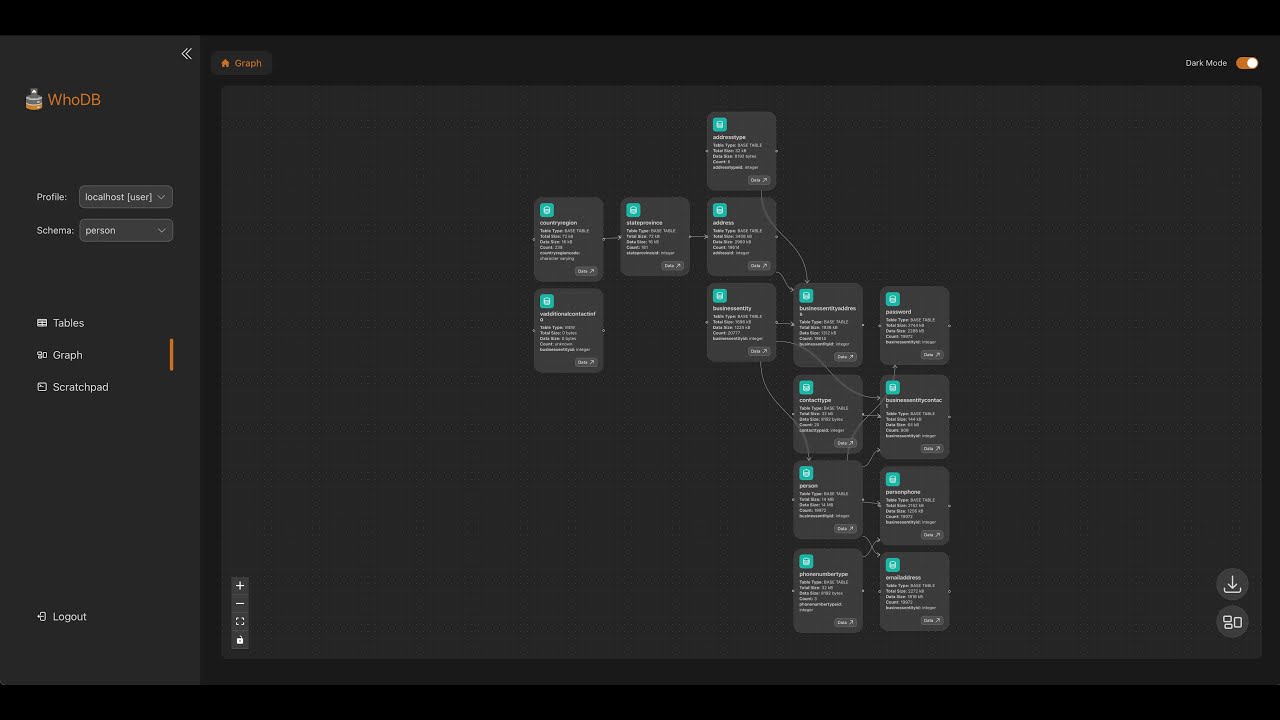 Watch →
|
Quick Start
Docker
docker run -it -p 8080:8080 clidey/whodb
Open http://localhost:8080 and connect a database.
Docker Compose
version: "3.8"
services:
  whodb:
    image: clidey/whodb
    ports:
      - "8080:8080"
    environment:
      # Ollama (local AI)
      - WHODB_OLLAMA_HOST=localhost
      - WHODB_OLLAMA_PORT=11434

      # Anthropic
      - WHODB_ANTHROPIC_API_KEY=your_key_here
      # - WHODB_ANTHROPIC_ENDPOINT=https://api.anthropic.com/v1

      # OpenAI
      - WHODB_OPENAI_API_KEY=your_key_here
      # - WHODB_OPENAI_ENDPOINT=https://api.openai.com/v1

      # Any OpenAI-compatible provider (LM Studio, OpenRouter, Requesty, etc.)
      # - WHODB_AI_GENERIC_LMSTUDIO_NAME=LM Studio
      # - WHODB_AI_GENERIC_LMSTUDIO_BASE_URL=http://host.docker.internal:1234/v1
      # - WHODB_AI_GENERIC_LMSTUDIO_MODELS=mistral-7b,llama-3-8b
      #
      # - WHODB_AI_GENERIC_OPENROUTER_NAME=OpenRouter
      # - WHODB_AI_GENERIC_OPENROUTER_BASE_URL=https://openrouter.ai/api/v1
      # - WHODB_AI_GENERIC_OPENROUTER_API_KEY=your_key_here
      # - WHODB_AI_GENERIC_OPENROUTER_MODELS=google/gemini-2.0-flash-001,anthropic/claude-3.5-sonnet
    # volumes:
    #   - ./sample.db:/db/sample.db
📖 For full installation and configuration options, see the Documentation
CLI
The CLI has an interactive TUI for browsing databases in the terminal, and an MCP server mode for Claude, Cursor, and other AI tools. Runs on macOS, Linux, and Windows.
# macOS/Linux
curl -fsSL https://raw.githubusercontent.com/clidey/whodb/main/cli/install/install.sh | bash

# npm
npm install -g @clidey/whodb-cli
whodb-cli              # launch TUI
whodb-cli mcp serve    # run as MCP server
📖 See the CLI README for full usage.
Development Setup
Prerequisites
- GoLang (latest)
- PNPM and *Node.js 16+
Extension points exported contracts — how you extend this code
ConnectionProvider (Interface)Core symbols most depended-on inside this repo
ErrorfShape
Languages
Modules by API surface
Dependencies from manifests, versioned
Datastores touched
For agents
$ claude mcp add whodb \
  -- python -m otcore.mcp_server <graph>