github.com/awalterschulze/goderive @v0.5.1
Chat with this repoWhat it actually does AI analysis from the code graph — generated when you open this
README
goderive


goderive derives mundane golang functions that you do not want to maintain and keeps them up to date.
It does this by parsing your go code for functions, which are not implemented, and then generates these functions for you by deriving their implementations from the input parameter types.
Examples
In the following code the deriveEqual function will be spotted as a function that was not implemented (or was previously derived) and has a prefix deriveEqual.
package main

type MyStruct struct {
    Int64     int64
    StringPtr *string
}

func (this *MyStruct) Equal(that *MyStruct) bool {
    return deriveEqual(this, that)
}
goderive will then generate the following code in a derived.gen.go file in the same package:
func deriveEqual(this, that *MyStruct) bool {
    return (this == nil && that == nil) ||
        this != nil && that != nil &&
            this.Int64 == that.Int64 &&
            ((this.StringPtr == nil && that.StringPtr == nil) ||
        (this.StringPtr != nil && that.StringPtr != nil && *(this.StringPtr) == *(that.StringPtr)))
}
Recursive Examples:
Set Examples:
Functional Examples:
Concurrency Examples:
Functions
Recursive Functions:
- Equal
deriveEqual(T, T) boolderiveEqual(T) func(T) bool
- Compare
deriveCompare(T, T) intderiveCompare(T) func(T) int
- DeepCopy
deriveDeepCopy(dst *T, src *T)deriveDeepCopy(dst []T, src []T)deriveDeepCopy(dst map[A]B, src map[A]B)
- Clone
deriveClone(T) T - GoString
deriveGoString(T) string - Hash
deriveHash(T) uint64
Functional Functions:
- Fmap
deriveFmap(func(A) B, []A) []BderiveFmap(func(rune) B, string) []BderiveFmap(func(A) B, func() (A, error)) (B, error)deriveFmap(func(A) (B, error), func() (A, error)) (func() (B, error), error)deriveFmap(func(A), func() (A, error)) errorderiveFmap(func(A) (B, c, d, ...), func() (A, error)) (func() (B, c, d, ...), error)
- Join
deriveJoin([][]T) []TderiveJoin([]string) stringderiveJoin(func() (T, error), error) func() (T, error)deriveJoin(func() (T, ..., error), error) func() (T, ..., error)
- Flip
deriveFlip(f func(A, B, ...) T) func(B, A, ...) T - Curry
deriveCurry(f func(A, B, ...) T) func(A) func(B, ...) T - Uncurry
deriveUncurry(f func(A) func(B, ...) T) func(A, B, ...) T - Tuple
deriveTuple(A, B, ...) func() (A, B, ...) - Compose
deriveCompose(func() (A, error), func(A) (B, error)) func() (B, error)deriveCompose(func(A) (B, error), func(B) (C, error)) func(A) (C, error)deriveCompose(func(A...) (B..., error), func(B...) (C..., error)) func(A...) (C..., error)deriveCompose(func(A...) (B..., error), ..., func(C...) (D..., error)) func(A...) (D..., error)
- Mem
deriveMem(func(A...) (B...)) func(A...) (B...)
- Traverse
deriveTraverse(func(A) (B, error), []A) ([]B, error)
- ToError
deriveToError(error, func(A...) (B..., bool)) func(A...) (B..., error)deriveToError(error, func() bool) func() error
- Apply
deriveApply(f func(...A, B) C, B) func(...A) C
Concurrency Functions:
- Fmap
- deriveFmap(func(A) B, <-chan A) <-chan B
- Join
- deriveJoin(<-chan <-chan T) <-chan T
- deriveJoin(chan <-chan T) <-chan T
- deriveJoin([]<-chan T) <-chan T
- deriveJoin([]chan T) <-chan T
- deriveJoin(chan T, chan T, ...) <-chan T
- Pipeline
- derivePipeline(func(A) <-chan B, func(B) <-chan C) func(A) <-chan C
- Do
- deriveDo(func() (A, error), func (B, error)) (A, B, error)
- Dup
- deriveDup(c <-chan T) (c1, c2 <-chan T)
Deprecated in favour of generics:
- Keys
deriveKeys(map[K]V) []K - Sort
deriveSort([]T) []T - Unique
deriveUnique([]T) []T - Set
deriveSet([]T) map[T]struct{} - Min
deriveMin(list []T, default T) (min T)deriveMin(T, T) T
- Max
deriveMax(list []T, default T) (max T)deriveMax(T, T) T
- Contains
deriveContains([]T, T) bool - Intersect
deriveIntersect(a, b []T) []TderiveIntersect(a, b map[T]struct{}) map[T]struct{}
- Union
deriveUnion(a, b []T) []TderiveUnion(a, b map[T]struct{}) map[T]struct{}
- Filter
deriveFilter(pred func(T) bool, []T) []T - All
deriveAll(pred func(T) bool, []T) bool - Any
deriveAny(pred func(T) bool, []T) bool - TakeWhile
deriveTakeWhile(pred func(T) bool, []T) []T
When goderive walks over your code it is looking for a function that: - was not implemented (or was previously derived) and - has a predefined prefix.
Functions which have been previously derived will be regenerated to keep them up to date with the latest modifications to your types. This keeps these functions, which are truly mundane to write, maintainable.
For example when someone in your team adds a new field to a struct and forgets to update the CopyTo method. This problem is solved by goderive, by generating generated functions given the new types.
Function prefixes are by default deriveCamelCaseFunctionName, for example deriveEqual.
These are customizable using command line flags.
You can derive functions for different types by using different suffixes with the same prefix. For example, if you wish to derive Equal for types MyStruct and MySecondStruct, name the functions deriveEqualMyStruct and deriveEqualMySecondStruct and goderive will derive both.
Let goderive edit your function names in your source code, by enabling autoname and dedup using the command line flags.
These flags respectively make sure that your functions have unique names and that you don't generate multiple functions that do the same thing.
How to run
install the latest version of goderive globally using:
go install github.com/awalterschulze/goderive@latest
goderive can be run from the command line:
goderive ./...
, using the same path semantics as the go tool.
You can also run goderive using go generate
And you can customize specific function prefixes
Or you can customize all function prefixes
You can let goderive rename your functions using the -autoname and -dedup flags.
If these flags are not used, goderive will not touch your code and rather return an error.
Customization
The derive package allows you to create your own code generator plugins, see all the current plugins for examples.
You can also create your own vanity binary. Including your own generators and/or customization of function prefixes, etc. This should be easy to figure out by looking at main.go
Inspired By
- Haskell's deriving
- Robert Griesemer's talk Prototype your design!
- go/types standard library
Users
These projects use goderive:
Please let us know if you are using goderive by opening an issue or a pull request that adds your project to the list.
Mentioned
- Monads for Go Programmers
- Golang Weekly
- Generating
Equalmethods for Go structs withgoderive
Please let us know if you mention goderive in a blog post, talk or go experience report, so that we can add a link to our list.
Presentations
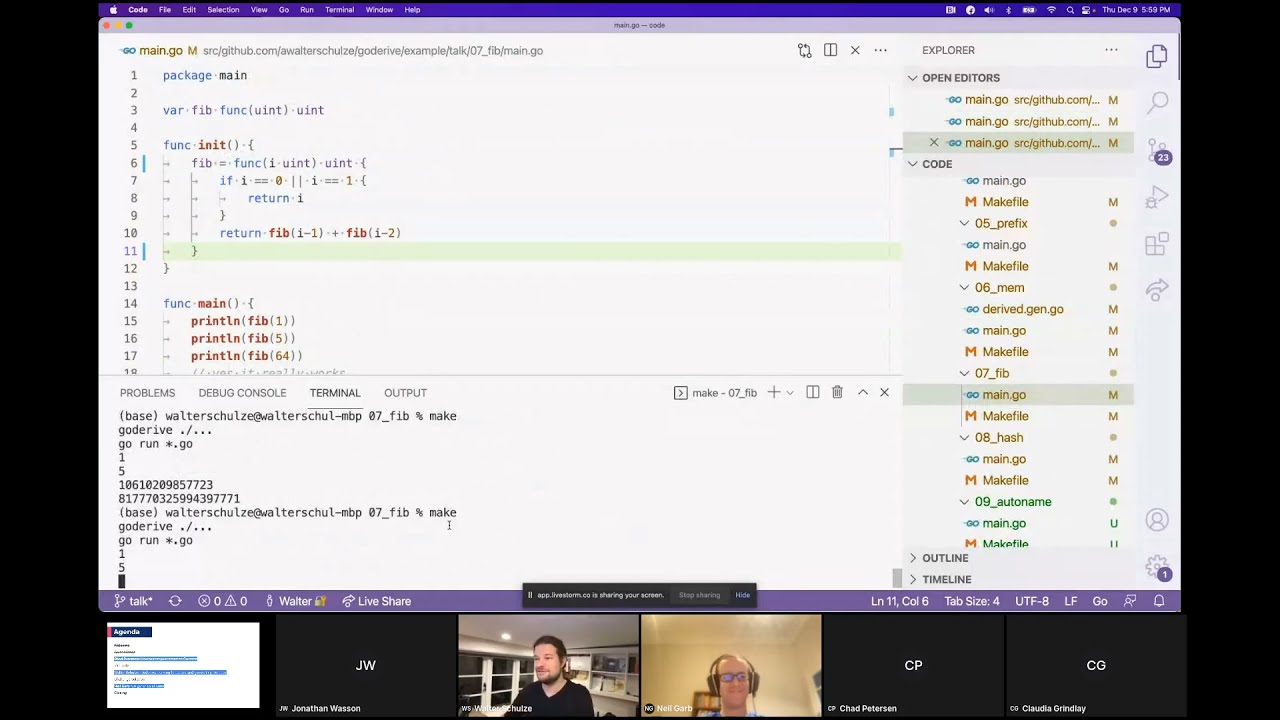
- 2021-12: goderive: Code generation with Gonads - Go Cape Town meetup (code examples)
Extension points exported contracts — how you extend this code
Generator (Interface)Core symbols most depended-on inside this repo
PShape
Languages
Modules by API surface
Used by 1 indexed graphs manifest dependencies, hub-wide
For agents
$ claude mcp add goderive \
  -- python -m otcore.mcp_server <graph>