github.com/apache/casbin @v3.10.0 sqlite
README
Casbin






News: still worry about how to write the correct Casbin policy? Casbin online editor is coming to help! Try it at: https://casbin.org/editor/

Casbin is a powerful and efficient open-source access control library for Golang projects. It provides support for enforcing authorization based on various access control models.
All the languages supported by Casbin:
 |
 |
 |
 |
|---|---|---|---|
| Casbin | jCasbin | node-Casbin | PHP-Casbin |
| production-ready | production-ready | production-ready | production-ready |
 |
 |
 |
 |
|---|---|---|---|
| PyCasbin | Casbin.NET | Casbin-CPP | Casbin-RS |
| production-ready | production-ready | production-ready | production-ready |
Table of contents
- Supported models
- How it works?
- Features
- Installation
- Documentation
- Online editor
- Tutorials
- Get started
- Policy management
- Policy persistence
- Policy consistence between multiple nodes
- Role manager
- Benchmarks
- Examples
- Middlewares
- Our adopters
Supported models
- ACL (Access Control List)
- ACL with superuser
- ACL without users: especially useful for systems that don't have authentication or user log-ins.
- ACL without resources: some scenarios may target for a type of resources instead of an individual resource by using permissions like
write-article,read-log. It doesn't control the access to a specific article or log. - RBAC (Role-Based Access Control)
- RBAC with resource roles: both users and resources can have roles (or groups) at the same time.
- RBAC with domains/tenants: users can have different role sets for different domains/tenants.
- ABAC (Attribute-Based Access Control): syntax sugar like
resource.Ownercan be used to get the attribute for a resource. - RESTful: supports paths like
/res/*,/res/:idand HTTP methods likeGET,POST,PUT,DELETE. - Deny-override: both allow and deny authorizations are supported, deny overrides the allow.
- Priority: the policy rules can be prioritized like firewall rules.
How it works?
In Casbin, an access control model is abstracted into a CONF file based on the PERM metamodel (Policy, Effect, Request, Matchers). So switching or upgrading the authorization mechanism for a project is just as simple as modifying a configuration. You can customize your own access control model by combining the available models. For example, you can get RBAC roles and ABAC attributes together inside one model and share one set of policy rules.
The most basic and simplest model in Casbin is ACL. ACL's model CONF is:
# Request definition
[request_definition]
r = sub, obj, act

# Policy definition
[policy_definition]
p = sub, obj, act

# Policy effect
[policy_effect]
e = some(where (p.eft == allow))

# Matchers
[matchers]
m = r.sub == p.sub && r.obj == p.obj && r.act == p.act
An example policy for ACL model is like:
p, alice, data1, read
p, bob, data2, write
It means:
- alice can read data1
- bob can write data2
We also support multi-line mode by appending '\' in the end:
# Matchers
[matchers]
m = r.sub == p.sub && r.obj == p.obj \
  && r.act == p.act
Further more, if you are using ABAC, you can try operator in like following in Casbin golang edition (jCasbin and Node-Casbin are not supported yet):
# Matchers
[matchers]
m = r.obj == p.obj && r.act == p.act || r.obj in ('data2', 'data3')
But you SHOULD make sure that the length of the array is MORE than 1, otherwise there will cause it to panic.
For more operators, you may take a look at govaluate
Features
What Casbin does:
- enforce the policy in the classic
{subject, object, action}form or a customized form as you defined, both allow and deny authorizations are supported. - handle the storage of the access control model and its policy.
- manage the role-user mappings and role-role mappings (aka role hierarchy in RBAC).
- support built-in superuser like
rootoradministrator. A superuser can do anything without explicit permissions. - multiple built-in operators to support the rule matching. For example,
keyMatchcan map a resource key/foo/barto the pattern/foo*.
What Casbin does NOT do:
- authentication (aka verify
usernameandpasswordwhen a user logs in) - manage the list of users or roles. I believe it's more convenient for the project itself to manage these entities. Users usually have their passwords, and Casbin is not designed as a password container. However, Casbin stores the user-role mapping for the RBAC scenario.
Installation
go get github.com/casbin/casbin/v3
Documentation
https://casbin.org/docs/overview
Online editor
You can also use the online editor (https://casbin.org/editor/) to write your Casbin model and policy in your web browser. It provides functionality such as syntax highlighting and code completion, just like an IDE for a programming language.
Tutorials
https://casbin.org/docs/tutorials
Get started
-
New a Casbin enforcer with a model file and a policy file:
go
e, _ := casbin.NewEnforcer("path/to/model.conf", "path/to/policy.csv")
Note: you can also initialize an enforcer with policy in DB instead of file, see Policy-persistence section for details.
-
Add an enforcement hook into your code right before the access happens:
```go sub := "alice" // the user that wants to access a resource. obj := "data1" // the resource that is going to be accessed. act := "read" // the operation that the user performs on the resource.
if res, _ := e.Enforce(sub, obj, act); res { // permit alice to read data1 } else { // deny the request, show an error } ```
-
Besides the static policy file, Casbin also provides API for permission management at run-time. For example, You can get all the roles assigned to a user as below:
go
roles, _ := e.GetImplicitRolesForUser(sub)
See Policy management APIs for more usage.
Policy management
Casbin provides two sets of APIs to manage permissions:
- Management API: the primitive API that provides full support for Casbin policy management.
- RBAC API: a more friendly API for RBAC. This API is a subset of Management API. The RBAC users could use this API to simplify the code.
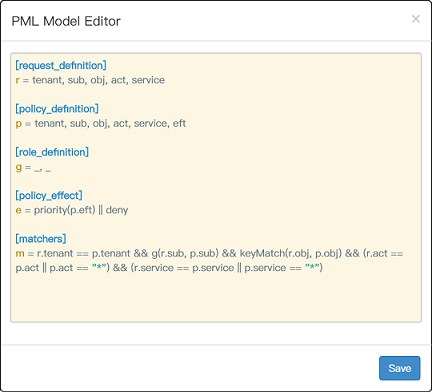
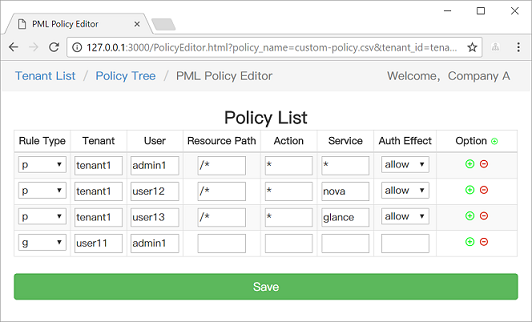
We also provide a web-based UI for model management and policy management:
Policy persistence
https://casbin.org/docs/adapters
Policy consistence between multiple nodes
https://casbin.org/docs/watchers
Role manager
https://casbin.org/docs/role-managers
Benchmarks
https://casbin.org/docs/benchmark
Examples
| Model | Model file | Policy file |
|---|---|---|
| ACL | basic_model.conf | basic_policy.csv |
| ACL with superuser | basic_model_with_root.conf | basic_policy.csv |
| ACL without users | basic_model_without_users.conf | basic_policy_without_users.csv |
| ACL without resources | basic_model_without_resources.conf | basic_policy_without_resources.csv |
| RBAC | rbac_model.conf | rbac_policy.csv |
| RBAC with resource roles | rbac_model_with_resource_roles.conf | rbac_policy_with_resource_roles.csv |
| RBAC with domains/tenants | rbac_model_with_domains.conf | rbac_policy_with_domains.csv |
| ABAC | [abac_model.conf](https://github.com |
Extension points exported contracts — how you extend this code
BatchAdapter (Interface)Core symbols most depended-on inside this repo
NewEnforcerShape
Languages
Modules by API surface
Used by 2 indexed graphs manifest dependencies, hub-wide
Dependencies from manifests, versioned
For agents
$ claude mcp add casbin \
  -- python -m otcore.mcp_server <graph>