github.com/alexellis/arkade @0.11.107 sqlite
README
arkade - Open Source Marketplace For Developer Tools
arkade is how developers install the latest versions of their favourite CLI tools and Kubernetes apps.
With arkade get, you'll have kubectl, kind, terraform, and jq on your machine faster than you can type apt-get install or brew update.






With 193 CLIs and 53 Kubernetes apps (charts, manifests, installers) available for Kubernetes, gone are the days of contending with dozens of README files just to set up a development stack with the usual suspects like ingress-nginx, Postgres, and cert-manager.
- arkade - Open Source Marketplace For Developer Tools
- Support arkade 👋 (From Our Sponsors)
- Should you try arkade?
- Getting arkade
- Usage overview
- Download CLI tools with arkade
- Install System Packages
- Install packages from OCI images
- Install CLIs during CI with GitHub Actions
- Bump Helm chart versions
- Verify and upgrade images in Helm charts
- Verify images within a helm chart
- Installing apps with arkade
- Create a Kubernetes cluster
- Install a Kubernetes app
- Uninstall an app
- Reduce the repetition
- Say goodbye to values.yaml and hello to flags
- Override with
--set - Compounding apps
- Get a self-hosted TLS registry with authentication
- Get a public IP for a private cluster and your IngressController
- Explore the apps
- Community \& contributing
- Sponsored apps
- Sponsored by
- FAQ
- Catalog of apps and CLIs
Support arkade 👋 (From Our Sponsors)
Try slicervm.com - turn your Mac into an API for running Linux. Sandbox your agents - run Kubernetes - locally and FAST.
Should you try arkade?
Arkade is built to save you time so you can focus and get productive quickly.
I was setting up a new dev environment yesterday. Kind, helm, kustomize, kubectl, all this stuff. My take is - arkade is highly underappreciated. I'd spend an hour in the past to install such tools. With arkade it was under ten minutes.
Ivan Velichko, SRE @ Booking.com
Before arkade whenever I used to spin up an instance, I used to go to multiple sites and download the binary. Arkade is one of my favourite tools.
Kumar Anurag - Cloud Native Enthusiast
It's hard to use K8s without Arkade these days. My team at @lftechnology absolutely loves it.
arkade is really a great tool to install CLI tools, and system packages, check this blog on how to get started with arkade it's a time saver.
This is real magic get #kubernetes up and going in a second; then launch #openfaas a free better than lambda solution that uses docker images.
Greg runs Fullstack JS and is a JavaScript developer
for getting the basics installed, nothing beats arkade it can install commonly used cli tools like kubectl locally for you, as well as common k8s pkgs like ingress-nginx or portainer
I finally got around to installing Arkade, super simple! quicker to install this than the argocli standalone commands, but there are lots of handy little tools in there. also, the neat little part about arkade, not only does it make it easy to install a ton of different apps and CLIs you can also get the info on them as well pretty quickly.
You've to install the latest and greatest tools for your daily @kubernetesio tasks? No problem, check out #arkade the open source #kubernetes marketplace 👍
Thorsten Hans - Cloud Native consultant
If you want to install quickly a new tool in your dev env or in your k8s cluster you can use the Arkade (https://github.com/alexellis/arkade) easy and quick you should it try out! Ps. I contribute to this project 🥰
Carlos Panato - Staff engineer @ Mattermost
arkade is the 'brew install' of Kubernetes. You can install and run an application in a single command. Finally! https://github.com/alexellis/arkade / by Alex Ellis
John Arundel - Cloud consultant, author
Demo
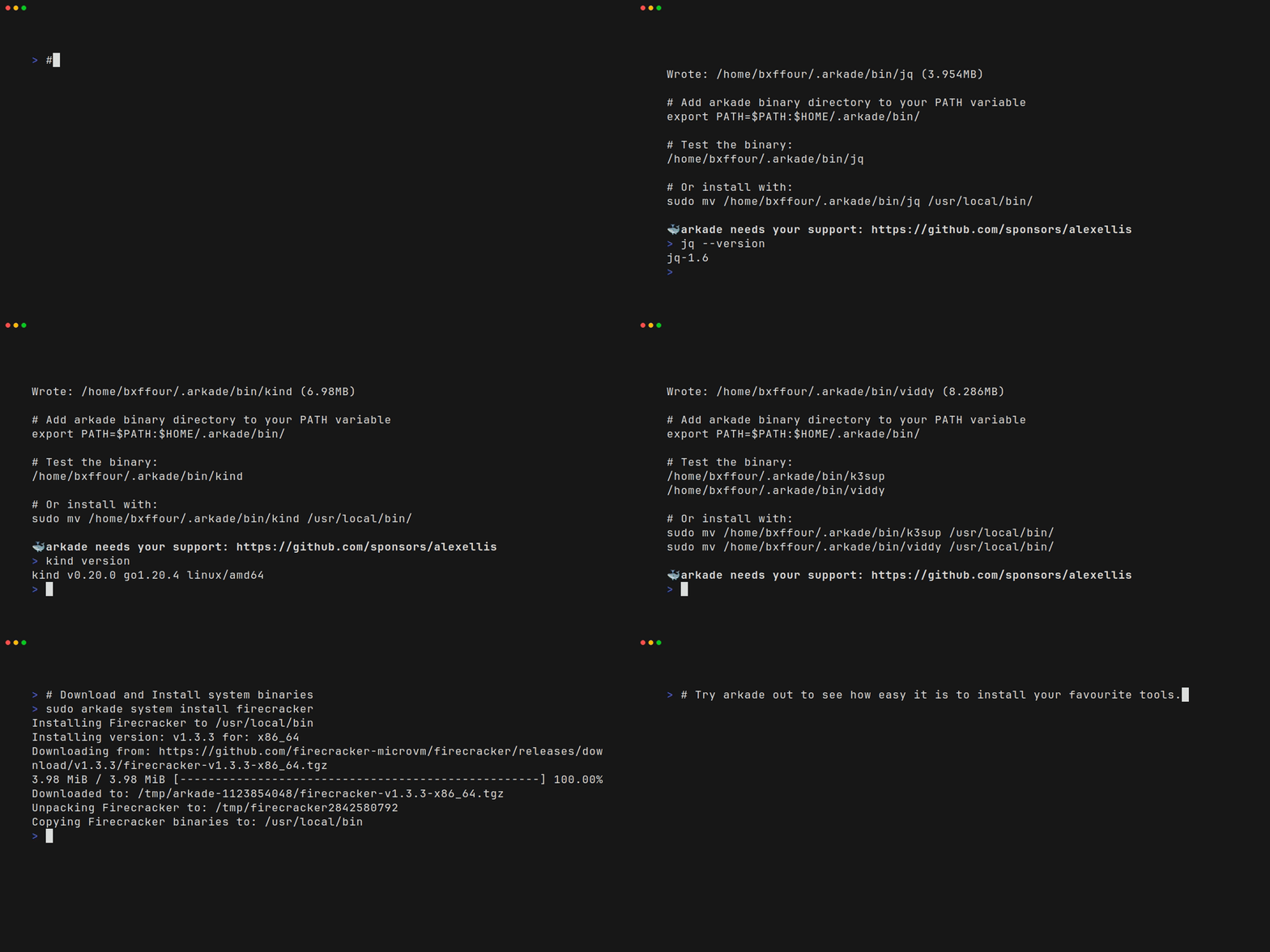
Getting arkade
# Note: you can also run without `sudo` and move the binary yourself
curl -sLS https://get.arkade.dev | sudo sh

arkade --help
ark --help  # a handy alias

# Windows users with Git Bash
curl -sLS https://get.arkade.dev | sh
Windows users: arkade requires bash to be available, therefore Windows users should install and use Git Bash
An alias of ark is created at installation time, so you can also run ark install APP
Usage overview
Arkade can be used to install Kubernetes apps or to download CLI tools.
arkade install- install a Kubernetes apparkade info- see the post installation screen for a Kubernetes apparkade get- download a CLI toolarkade update- perform a self-update of arkade on MacOS and Linux
An arkade "app" could represent a helm chart such as openfaas/faas-netes, a custom CLI installer such as istioctl, or a set of static manifests (i.e. MetalLB).
An arkade "tool" is a CLI that can be downloaded for your operating system. Arkade downloads statically-linked binaries from their upstream locations on GitHub or the vendor's chosen URL such as with kubectl and terraform.
Did you know? Arkade users run
arkade getboth on their local workstations, and on their CI runners such as GitHub Actions or Jenkins.
Download CLI tools with arkade
arkade downloads the correct version of a CLI for your OS and CPU.
With automatic detection of: Windows / MacOS / Linux / Intel / ARM.
# Download a binary release of a tool

arkade get kubectl

# Download a specific version of that tool
arkade get kubectl@v1.22.0

# Download multiple tools at once
arkade get kubectl \
  helm \
  istioctl

# Download multiple specific versions
arkade get faas-cli@0.13.15 \
  kubectl@v1.22.0

# Override machine os/arch
arkade get faas-cli \
  --arch arm64 \
  --os linux

# Override machine os/arch
arkade get faas-cli \
  --arch arm64 \
  --os darwin
This is a time saver compared to searching for download pages every time you need a tool.
Search CLIs available via arkade get by name or keyword, with alias support (e.g. "k8s" expands to "Kubernetes"):
arkade search helm
arkade search k8s
Files are stored at $HOME/.arkade/bin/
Want to download tools to a custom path such as into the GitHub Actions cached tool folder?
arkade get faas-cli kubectl \
  --path $HOME/runner/_work/_tools

# Usage:
/runner/_work/_tools/faas-cli version

PATH=$PATH:$HOME/runner/_work/_tools
faas-cli version
Think of arkade get TOOL as a doing for CLIs, what arkade install does for helm.
Adding a new tool for download is as simple as editing tools.go.
Click here for the full catalog of CLIs
Install System Packages
System packages are tools designed for installation on a Linux workstation, server or CI runner.
These are a more limited group of applications designed for quick setup, scripting and CI, and generally do not fit into the arkade get pattern, due to additional installation steps or system configuration.
# Show packages
arkade system install

# Show package flags
arkade system install go --help

# Install latest version of Go to /usr/local/bin/go
arkade system install go

# Install Go 1.18 to /tmp/go
arkade system install go \
  --version 1.18 \
  --path /tmp/

# Install containerd for ARM64, 32-bit ARM or x86_64
# with systemd enabled
arkade system install containerd \
  --systemd
Run the following to see what's available arkade system install:
  actions-runner   Install GitHub Actions Runner
  buildkitd        Install Buildkitd
  caddy            Install Caddy Server
  cni              Install CNI plugins
  containerd       Install containerd
  firecracker      Install Firecracker
  gitlab-runner    Install GitLab Runner
  go               Install Go
  node             Install Node.js
  node_exporter    Install Node Exporter
  prometheus       Install Prometheus
  pwsh             Install Powershell
  registry         Install registry
  tc-redirect-tap  Install tc-redirect-tap
  zvol-snapshotter Install containerd zvol snapshotter
The initial set of system apps is now complete, learn more in the original proposal: Feature: system packages for Linux servers, CI and workstations #654
Install Packages from OCI images
For packages distributed in Open Container Initiative (OCI) images, you can use arkade oci install to extract them to a given folder on your system.
vmmeter is one example of a package that is only published as a container image, which is not released on a GitHub releases page.
# Install to /usr/local/bin (default)
arkade oci install ghcr.io/openfaasltd/vmmeter

# Install to a custom path
arkade oci install ghcr.io/openfaasltd/vmmeter /usr/local/bin

# Install to current directory
arkade oci install ghcr.io/openfaasltd/vmmeter .
Options:
* Path can be specified as a positional argument (e.g., /usr/local/bin or .)
* --version - the version of the package to extract, if not specified the :latest tag is used
* --arch - the architecture to extract, if not specified the host's architecture is used
Install CLIs during CI with GitHub Actions
Example of downloading faas-cli (specific version) and kubectl (latest), putting them into the PATH automatically, and executing one of them in a subsequent step.
    - uses: alexellis/arkade-get@master
      with:
        kubectl: latest
        faas-cli: 0.14.10
    - name: check for faas-cli
      run: |
        faas-cli version
If you just need system applications, you could also try "setup-arkade":
    - uses: alexellis/setup-arkade@v2
    - name: Install containerd and go
      run: |
        arkade system install containerd
        arkade system install go
Bump Helm chart versions
To bump the patch version of your Helm chart, run arkade chart bump -f ./chart/values.yaml. This updates the patch component of the version specified in Chart.yaml.
arkade chart bump -f ./charts/flagger/values.yaml
charts/flagger/Chart.yaml 1.36.0 => 1.37.0
By default, the new version is written to stdout. To bump the version in the file, run the above command with the --write flag.
To bump the version in the chart's Chart.yaml only if the chart has any changes, specify the --check-for-updates flag:
```bash arkade chart bump -f ./c
Extension points exported contracts — how you extend this code
ProgressCallback (FuncType)Core symbols most depended-on inside this repo
MakeToolsShape
Languages
Modules by API surface
Dependencies from manifests, versioned
For agents
$ claude mcp add arkade \
  -- python -m otcore.mcp_server <graph>