github.com/abadojack/whatlanggo @v1.0.1
Chat with this repoWhat it actually does AI analysis from the code graph — generated when you open this
README
Whatlanggo


Natural language detection for Go.
Features
- Supports 84 languages
- 100% written in Go
- No external dependencies
- Fast
- Recognizes not only a language, but also a script (Latin, Cyrillic, etc)
Getting started
Installation:
go get -u github.com/abadojack/whatlanggo
Simple usage example:
package main

import (
    "fmt"

    "github.com/abadojack/whatlanggo"
)

func main() {
    info := whatlanggo.Detect("Foje funkcias kaj foje ne funkcias")
    fmt.Println("Language:", info.Lang.String(), " Script:", whatlanggo.Scripts[info.Script], " Confidence: ", info.Confidence)
}
Blacklisting and whitelisting
package main

import (
    "fmt"

    "github.com/abadojack/whatlanggo"
)

func main() {
    //Blacklist
    options := whatlanggo.Options{
        Blacklist: map[whatlanggo.Lang]bool{
            whatlanggo.Ydd: true,
        },
    }

    info := whatlanggo.DetectWithOptions("האקדמיה ללשון העברית", options)

    fmt.Println("Language:", info.Lang.String(), "Script:", whatlanggo.Scripts[info.Script])

    //Whitelist
    options1 := whatlanggo.Options{
        Whitelist: map[whatlanggo.Lang]bool{
            whatlanggo.Epo: true,
            whatlanggo.Ukr: true,
        },
    }

    info = whatlanggo.DetectWithOptions("Mi ne scias", options1)
    fmt.Println("Language:", info.Lang.String(), " Script:", whatlanggo.Scripts[info.Script])
}
For more details, please check the documentation.
Requirements
Go 1.8 or higher
How does it work?
How does the language recognition work?
The algorithm is based on the trigram language models, which is a particular case of n-grams. To understand the idea, please check the original whitepaper Cavnar and Trenkle '94: N-Gram-Based Text Categorization'.
How IsReliable calculated?
It is based on the following factors:
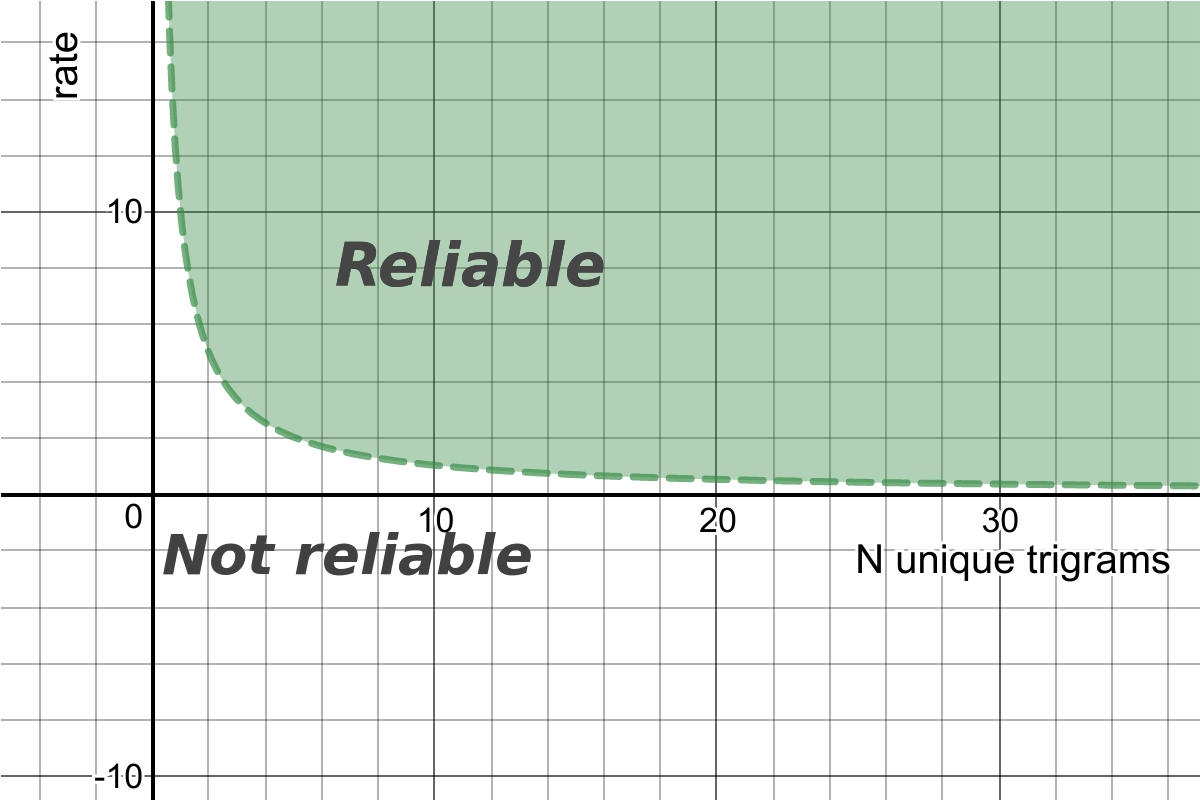
* How many unique trigrams are in the given text
* How big is the difference between the first and the second(not returned) detected languages? This metric is called rate in the code base.
Therefore, it can be presented as 2d space with threshold functions, that splits it into "Reliable" and "Not reliable" areas. This function is a hyperbola and it looks like the following one:
For more details, please check a blog article Introduction to Rust Whatlang Library and Natural Language Identification Algorithms.
License
Derivation
whatlanggo is a derivative of Franc (JavaScript, MIT) by Titus Wormer.
Acknowledgements
Thanks to greyblake (Potapov Sergey) for creating whatlang-rs from where I got the idea and algorithms.
Core symbols most depended-on inside this repo
LangToStringShape
Languages
Modules by API surface
Used by 3 indexed graphs manifest dependencies, hub-wide
For agents
$ claude mcp add whatlanggo \
  -- python -m otcore.mcp_server <graph>