github.com/Tessil/hat-trie @v0.7.1
Chat with this repoBrowse by type
What it actually does AI analysis from the code graph — generated when you open this
README

A C++ implementation of a fast and memory efficient HAT-trie
Trie implementation based on the "HAT-trie: A Cache-conscious Trie-based Data Structure for Strings." (Askitis Nikolas and Sinha Ranjan, 2007) paper. For now, only the pure HAT-trie has been implemented, the hybrid version may arrive later. Details regarding the HAT-trie data structure can be found here.
The library provides an efficient and compact way to store a set or a map of strings by compressing the common prefixes. It also allows to search for keys that match a prefix. Note though that the default parameters of the structure are geared toward optimizing exact searches, if you do a lot of prefix searches you may want to reduce the burst threshold through the burst_threshold method.
It's a well adapted structure to store a large number of strings.
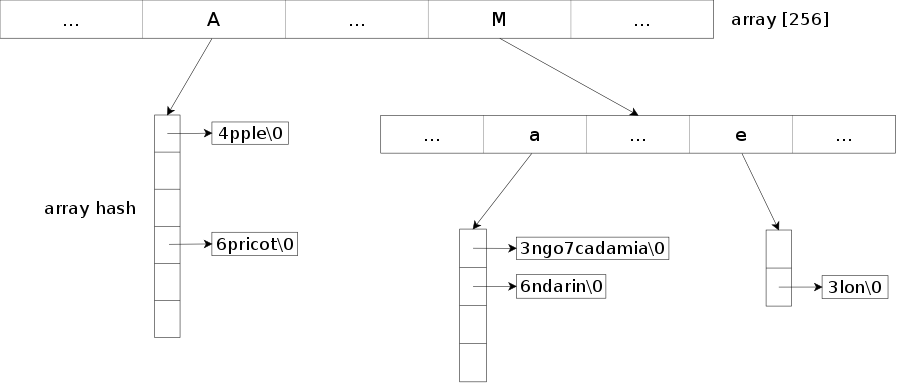
For the array hash part, the array-hash project is used and included in the repository.
The library provides two classes: tsl::htrie_map and tsl::htrie_set.
Overview
- Header-only library, just add the include directory to your include path and you are ready to go. If you use CMake, you can also use the
tsl::hat_trieexported target from the CMakeLists.txt. - Low memory usage while keeping reasonable performances (see benchmark).
- Support prefix searches through
equal_prefix_range(useful for autocompletion for example) and prefix erasures througherase_prefix. - Support longest matching prefix searches through
longest_prefix. - Support for efficient serialization and deserialization (see example and the
serialize/deserializemethods in the API for details). - Keys are not ordered as they are partially stored in a hash map.
- All operations modifying the data structure (insert, emplace, erase, ...) invalidate the iterators.
- Support null characters in the key (you can thus store binary data in the trie).
- Support for any type of value as long at it's either copy-constructible or both nothrow move constructible and nothrow move assignable.
- The balance between speed and memory usage can be modified through the
max_load_factormethod. A lower max load factor will increase the speed, a higher one will reduce the memory usage. Its default value is set to 8.0. - The default burst threshold, which is the maximum size of an array hash node before a burst occurs, is set to 16 384 which provides good performances for exact searches. If you mainly use prefix searches, you may want to reduce it to something like 1024 or lower for faster iteration on the results through the
burst_thresholdmethod. - By default the maximum allowed size for a key is set to 65 535. This can be raised through the
KeySizeTtemplate parameter.
Thread-safety and exception guarantees are similar to the STL containers.
Hash function
The default hash function used by the structure depends on the presence of std::string_view. If it is available, std::hash<std::string_view> is used, otherwise a simple FNV-1a hash function is used to avoid any dependency.
If you can't use C++17 or later, we recommend to replace the hash function with something like CityHash, MurmurHash, FarmHash, ... for better performances. On the tests we did, CityHash64 offers a ~20% improvement on reads compared to FNV-1a.
#include <city.h>

struct str_hash {
    std::size_t operator()(const char* key, std::size_t key_size) const {
        return CityHash64(key, key_size);
    }
};

tsl::htrie_map<char, int, str_hash> map;
The std::hash<std::string> can't be used efficiently as the structure doesn't store any std::string object. Any time a hash would be needed, a temporary std::string would have to be created.
Benchmark
Wikipedia dataset
The benchmark consists in inserting all the titles from the main namespace of the Wikipedia archive into the data structure, check the used memory space after the insert (including potential memory fragmentation) and search for all the titles again in the data structure. The peak memory usage during the insert process is also measured with time(1).
- Dataset: enwiki-20170320-all-titles-in-ns0.gz
- Size: 262.7 MiB
- Number of keys: 13 099 148
- Average key length: 19.90
- Median key length: 17
- Max key length: 251
Each title is associated with an int (32 bits). All the hash based structures use CityHash64 as hash function. For the tests marked with reserve, the reserve function is called beforehand to avoid any rehash.
Note that tsl::hopscotch_map, std::unordered_map, google::dense_hash_map and spp::sparse_hash_map use std::string as key which imposes a minimum size of 32 bytes (on x64) even if the key is only one character long. Other structures may be able to store one-character keys with 1 byte + 8 bytes for a pointer (on x64).
The benchmark was compiled with GCC 6.3 and ran on Debian Stretch x64 with an Intel i5-5200u and 8Go of RAM. Best of 20 runs was taken.
The code of the benchmark can be found on Gist.
Unsorted
The enwiki-20170320-all-titles-in-ns0.gz dataset is alphabetically sorted. For this benchmark, we first shuffle the dataset through shuf(1) to avoid a biased sorted dataset.
| Library | Data structure | Peak memory (MiB) | Memory (MiB) | Insert (ns/key) | Read (ns/key) |
|---|---|---|---|---|---|
| tsl::htrie_map | HAT-trie | 405.22 | 402.25 | 643.10 | 250.87 |
| tsl::htrie_map |
max_load_factor=4 | HAT-trie | 471.85 | 468.50 | 638.66 | 212.90 | | tsl::htrie_map
max_load_factor=2 | HAT-trie | 569.76 | 566.52 | 630.61 | 201.10 | | tsl::htrie_map
max_load_factor=1 | HAT-trie | 713.44 | 709.81 | 645.76 | 190.87 | | cedar::da | Double-array trie | 1269.68 | 1254.41 | 1102.93 | 557.20 | | cedar::da ORDERED=false | Double-array trie | 1269.80 | 1254.41 | 1089.78 | 570.13 | | cedar::da | Double-array reduced trie | 1183.07 | 1167.79 | 1076.68 | 645.79 | | cedar::da ORDERED=false | Double-array reduced trie | 1183.14 | 1167.85 | 1065.43 | 641.98 | | cedar::da | Double-array prefix trie | 498.69 | 496.54 | 1096.90 | 628.01 | | cedar::da ORDERED=false | Double-array prefix trie | 498.65 | 496.60 | 1048.40 | 628.94 | | hat-trie1 (C) | HAT-trie | 504.07 | 501.50 | 917.49 | 261.00 | | qp trie (C) | QP trie | 941.23 | 938.17 | 1349.25 | 1281.46 | | crit-bit trie (C) | Crit-bit trie | 1074.96 | 1071.98 | 2930.42 | 2869.74 | | JudySL (C) | Judy array | 631.09 | 628.37 | 884.29 | 803.58 | | JudyHS (C) | Judy array | 723.44 | 719.47 | 476.79 | 417.15 | | tsl::array_map | Array hash table | 823.54 | 678.73 | 603.94 | 138.24 | | tsl::array_map
with reserve | Array hash table | 564.26 | 555.91 | 249.52 | 128.28 | | tsl::hopscotch_map | Hash table | 1325.83 | 1077.99 | 368.26 | 119.49 | | tsl::hopscotch_map
with reserve | Hash table | 1080.51 | 1077.98 | 240.58 | 119.91 | | google::dense_hash_map | Hash table | 2319.40 | 1677.11 | 466.60 | 138.87 | | google::dense_hash_map
with reserve | Hash table | 1592.51 | 1589.99 | 259.56 | 120.40 | | spp::sparse_hash_map | Sparse hash table | 918.67 | 917.10 | 769.00 | 175.59 | | spp::sparse_hash_map
with reserve | Sparse hash table | 913.35 | 910.65 | 427.22 | 159.08 | | std::unordered_map | Hash table | 1249.05 | 1246.60 | 590.88 | 173.58 | | std::unordered_map
with reserve | Hash table | 1212.23 | 1209.71 | 350.33 | 178.70 |
- As the hash function can't be passed in parameter, the code of the library itself is modified to use CityHash64.
Sorted
The key are inserted and read in alphabetical order.
| Library | Data structure | Peak memory (MiB) | Memory (MiB) | Insert (ns/key) | Read (ns/key) |
|---|---|---|---|---|---|
| tsl::htrie_map | HAT-trie | 396.10 | 393.22 | 255.76 | 68.08 |
| tsl::htrie_map |
max_load_factor=4 | HAT-trie | 465.02 | 461.80 | 248.88 | 59.23 | | tsl::htrie_map
max_load_factor=2 | HAT-trie | 543.99 | 541.21 | 230.13 | 53.50 | | tsl::htrie_map
max_load_factor=1 | HAT-trie | 692.29 | 689.70 | 243.84 | 49.22 | | cedar::da | Double-array trie | 1269.58 | 1254.41 | 278.51 | 54.72 | | cedar::da ORDERED=false | Double-array trie | 1269.66 | 1254.41 | 264.43 | 56.02 | | cedar::da | Double-array reduced trie | 1183.01 | 1167.78 | 254.60 | 69.18 | | cedar::da ORDERED=false | Double-array reduced trie | 1183.03 | 1167.78 | 241.45 | 69.67 | | cedar::da | Double-array prefix trie | 621.59 | 619.38 | 246.88 | 57.83 | | cedar::da ORDERED=false | Double-array prefix trie | 621.59 | 619.38 | 187.98 | 58.56 | | hat-trie2 (C) | HAT-trie | 521.25 | 518.52 | 503.01 | 86.40 | | qp trie (C) | QP trie | 940.65 | 937.66 | 392.86 | 190.19 | | crit-bit trie (C) | Crit-bit trie | 1074.87 | 1071.98 | 430.04 | 347.60 | | JudySL (C) | Judy array | 616.95 | 614.27 | 279.07 | 114.47 | | JudyHS (C) | Judy array | 722.29 | 719.47 | 439.66 | 372.25 | | tsl::array_map | Array hash table | 826.98 | 682.99 | 612.31 | 139.16 | | tsl::array_map
with reserve | Array hash table | 565.37 | 555.35 | 246.55 | 126.32 | | tsl::hopscotch_map | Hash table | 1331.87 | 1078.02 | 375.19 | 118.08 | | tsl::hopscotch_map
with reserve | Hash table | 1080.51 | 1077.97 | 238.93 | 117.20 | | google::dense_hash_map | Hash table | 2325.27 | 1683.07 | 483.95 | 137.09 | | google::dense_hash_map
with reserve | Hash table | 1592.54 | 1589.99 | 257.22 | 113.71 | | spp::sparse_hash_map | Sparse hash table | 920.96 | 918.70 | 772.03 | 176.64 | | spp::sparse_hash_map
with reserve | Sparse hash table | 914.84 | 912.47 | 422.85 | 158.73 | | std::unordered_map | Hash table | 1249.09 | 1246.65 | 594.85 | 173.54 | | std::unordered_map
with reserve | Hash table | 1212.21 | 1209.71 | 347.40 | 176.49 |
- As the hash function can't be passed in parameter, the code of the library itself is modified to use CityHash64.
Dr. Askitis dataset
The benchmark consists in inserting all the words from the "Distinct Strings" dataset of Dr. Askitis into the data structure, check the used memory space and search for all the words from the "Skew String Set 1" dataset (where a string can be present multiple times) in the data structure. Note that the strings in this dataset have a quite short average and median key length (which may not be a realistic use case compared to the Wikipedia dataset used above). It's similar to the one on the cedar homepage.
- Dataset: distinct_1 (write) / skew1_1 (read)
- Size: 290.45 MiB / 1 029.46 MiB
- Number of keys: 28 772 169 / 177 999 203
- Average key length: 9.59 / 5.06
- Median key length: 8 / 4
- Max key length: 126 / 62
The benchmark protocol is the same as for the [Wikipedia dataset](https://
Core symbols most depended-on inside this repo
Shape
Languages
Modules by API surface
For agents
$ claude mcp add hat-trie \
  -- python -m otcore.mcp_server <graph>