github.com/NVlabs/tiny-cuda-nn @v2.0
Chat with this repoBrowse by type
What it actually does AI analysis from the code graph — generated when you open this
README
Tiny CUDA Neural Networks 
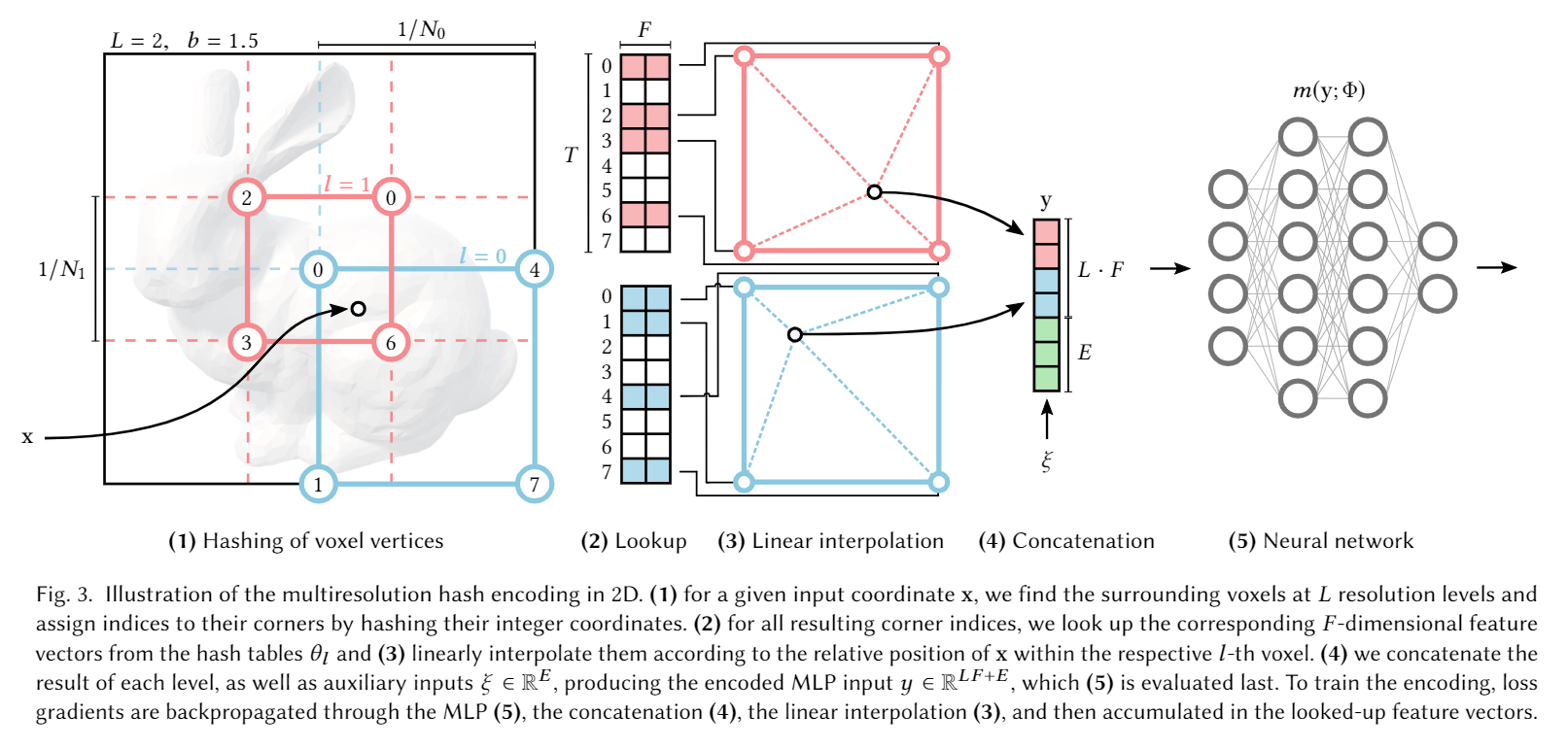
This is a small, self-contained framework for training and querying neural networks. Most notably, it contains a lightning fast "fully fused" multi-layer perceptron (technical paper), a versatile multiresolution hash encoding (technical paper), as well as support for various other input encodings, losses, and optimizers.
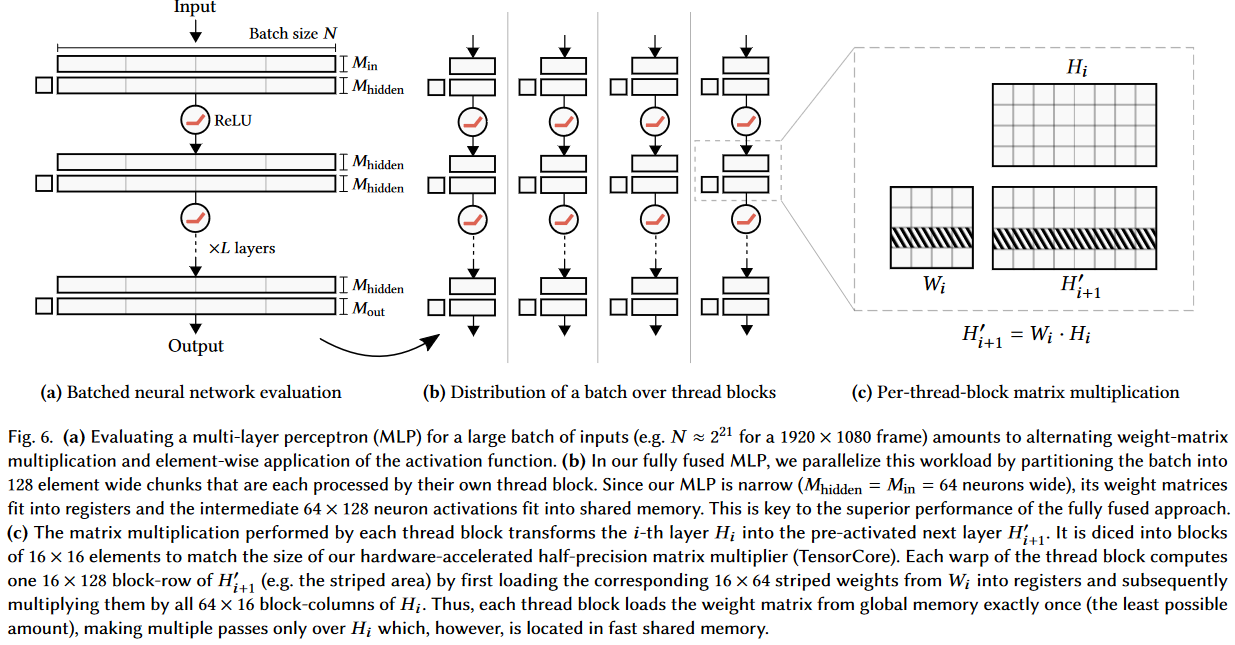
Performance
 Fully fused networks vs. TensorFlow v2.5.0 w/ XLA. Measured on 64 (solid line) and 128 (dashed line) neurons wide multi-layer perceptrons on an RTX 3090. Generated by
 benchmarks/bench_ours.cu and benchmarks/bench_tensorflow.py using data/config_oneblob.json.
Usage
Tiny CUDA neural networks have a simple C++/CUDA API:
#include <tiny-cuda-nn/common.h>

// Configure the model
nlohmann::json config = {
    {"loss", {
        {"otype", "L2"}
    }},
    {"optimizer", {
        {"otype", "Adam"},
        {"learning_rate", 1e-3},
    }},
    {"encoding", {
        {"otype", "HashGrid"},
        {"n_levels", 16},
        {"n_features_per_level", 2},
        {"log2_hashmap_size", 19},
        {"base_resolution", 16},
        {"per_level_scale", 2.0},
    }},
    {"network", {
        {"otype", "FullyFusedMLP"},
        {"activation", "ReLU"},
        {"output_activation", "None"},
        {"n_neurons", 64},
        {"n_hidden_layers", 2},
    }},
};

using namespace tcnn;

auto model = create_from_config(n_input_dims, n_output_dims, config);
model->set_jit_fusion(supports_jit_fusion()); // Optional: accelerate with JIT fusion

// Train the model (batch_size must be a multiple of tcnn::BATCH_SIZE_GRANULARITY)
GPUMatrix<float> training_batch_inputs(n_input_dims, batch_size);
GPUMatrix<float> training_batch_targets(n_output_dims, batch_size);

for (int i = 0; i < n_training_steps; ++i) {
    generate_training_batch(&training_batch_inputs, &training_batch_targets); // <-- your code

    float loss;
    model.trainer->training_step(training_batch_inputs, training_batch_targets, &loss);
    std::cout << "iteration=" << i << " loss=" << loss << std::endl;
}

// Use the model
GPUMatrix<float> inference_inputs(n_input_dims, batch_size);
generate_inputs(&inference_inputs); // <-- your code

GPUMatrix<float> inference_outputs(n_output_dims, batch_size);
model.network->inference(inference_inputs, inference_outputs);
Important: enabling JIT fusion is a new, optional feature with tiny-cuda-nn v2.0 and later. It is recommended to always enable it for a performance boost of 1.5x to 2.5x, depending on the model and GPU. Newer GPUs exhibit larger speedups. Please open an issue if you encounter a slowdown or other problems with JIT fusion enabled.
Example: learning a 2D image
We provide a sample application where an image function (x,y) -> (R,G,B) is learned. It can be run via
tiny-cuda-nn$ ./build/mlp_learning_an_image data/images/albert.jpg data/config_hash.json
producing an image every couple of training steps. Each 1000 steps should take a bit over 1 second with the default configuration on an RTX 4090.
| 10 steps | 100 steps | 1000 steps | Reference image |
|---|---|---|---|
 |
 |
 |
 |
Requirements
- An NVIDIA GPU; tensor cores increase performance when available. All shown results come from an RTX 3090.
- A C++14 capable compiler. The following choices are recommended and have been tested:
- Windows: Visual Studio 2019 or 2022
- Linux: GCC/G++ 8 or higher
- A recent version of CUDA. The following choices are recommended and have been tested:
- Windows: CUDA 11.5 or higher
- Linux: CUDA 10.2 or higher
- CMake v3.21 or higher.
- The fully fused MLP component of this framework requires a very large amount of shared memory in its default configuration. It will likely only work on an RTX 3090, an RTX 2080 Ti, or higher-end GPUs. Lower end cards must reduce the
n_neuronsparameter or use theCutlassMLP(better compatibility but slower) instead.
If you are using Linux, install the following packages
sudo apt-get install build-essential git
We also recommend installing CUDA in /usr/local/ and adding the CUDA installation to your PATH.
For example, if you have CUDA 12.6.3, add the following to your ~/.bashrc
export PATH="/usr/local/cuda-12.6.3/bin:$PATH"
export LD_LIBRARY_PATH="/usr/local/cuda-12.6.3/lib64:$LD_LIBRARY_PATH"
Compilation (Windows & Linux)
Begin by cloning this repository and all its submodules using the following command:
$ git clone --recursive https://github.com/nvlabs/tiny-cuda-nn
$ cd tiny-cuda-nn
Then, use CMake to build the project: (on Windows, this must be in a developer command prompt)
tiny-cuda-nn$ cmake . -B build -DCMAKE_BUILD_TYPE=RelWithDebInfo
tiny-cuda-nn$ cmake --build build --config RelWithDebInfo -j
If compilation fails inexplicably or takes longer than an hour, you might be running out of memory. Try running the above command without -j in that case.
PyTorch extension
tiny-cuda-nn comes with a PyTorch extension that allows using the fast MLPs and input encodings from within a Python context. These bindings can be significantly faster than full Python implementations; in particular for the multiresolution hash encoding.
The overheads of Python/PyTorch can nonetheless be extensive if the batch size is small. For example, with a batch size of 64k, the bundled
mlp_learning_an_imageexample is ~2x slower through PyTorch than native CUDA. With a batch size of 256k and higher (default), the performance is much closer.
Begin by setting up a Python 3.X environment with a recent, CUDA-enabled version of PyTorch. Then, invoke
pip install git+https://github.com/NVlabs/tiny-cuda-nn/#subdirectory=bindings/torch
Alternatively, if you would like to install from a local clone of tiny-cuda-nn, invoke
tiny-cuda-nn$ cd bindings/torch
tiny-cuda-nn/bindings/torch$ python setup.py install
Upon success, you can use tiny-cuda-nn models as in the following example:
import commentjson as json
import tinycudann as tcnn
import torch

with open("data/config_hash.json") as f:
    config = json.load(f)

# Option 1: efficient Encoding+Network combo.
model = tcnn.NetworkWithInputEncoding(
    n_input_dims, n_output_dims,
    config["encoding"], config["network"]
)

# Option 2: separate modules. Slower but more flexible.
encoding = tcnn.Encoding(n_input_dims, config["encoding"])
network = tcnn.Network(encoding.n_output_dims, n_output_dims, config["network"])
model = torch.nn.Sequential(encoding, network)

model.jit_fusion = tcnn.supports_jit_fusion() # Optional: accelerate with JIT fusion
See samples/mlp_learning_an_image_pytorch.py for an example.
Components
Following is a summary of the components of this framework. The JSON documentation lists configuration options.
| Networks | ||
|---|---|---|
| Fully fused MLP | src/fully_fused_mlp.cu |
Lightning fast implementation of small multi-layer perceptrons (MLPs). |
| CUTLASS MLP | src/cutlass_mlp.cu |
MLP based on CUTLASS' GEMM routines. Slower than fully-fused, but handles larger networks and still is reasonably fast. |
| Input encodings | ||
|---|---|---|
| Composite | include/tiny-cuda-nn/encodings/composite.h |
Allows composing multiple encodings. Can be, for example, used to assemble the Neural Radiance Caching encoding [Müller et al. 2021]. |
| Frequency | include/tiny-cuda-nn/encodings/frequency.h |
NeRF's [Mildenhall et al. 2020] positional encoding applied equally to all dimensions. |
| Grid | include/tiny-cuda-nn/encodings/grid.h |
Encoding based on trainable multiresolution grids. Used for Instant Neural Graphics Primitives [Müller et al. 2022]. The grids can be backed by hashtables, dense storage, or tiled storage. |
| Identity | include/tiny-cuda-nn/encodings/identity.h |
Leaves values untouched. |
| Oneblob | include/tiny-cuda-nn/encodings/oneblob.h |
From Neural Importance Sampling [Müller et al. 2019] and Neural Control Variates [Müller et al. 2020]. |
| SphericalHarmonics | include/tiny-cuda-nn/encodings/spherical_harmonics.h |
A frequency-space encoding that is more suitable to direction vectors than component-wise ones. |
| TriangleWave | include/tiny-cuda-nn/encodings/triangle_wave.h |
Low-cost alternative to the NeRF's encoding. Used in Neural Radiance Caching [Müller et al. 2021]. |
| Losses | ||
|---|---|---|
| L1 | include/tiny-cuda-nn/losses/l1.h |
Standard L1 loss. |
| Relative L1 | include/tiny-cuda-nn/losses/l1.h |
Relative L1 loss normalized by the network prediction. |
| MAPE | include/tiny-cuda-nn/losses/mape.h |
Mean absolute percentage error (MAPE). The same as Relative L1, but normalized by the target. |
| SMAPE | include/tiny-cuda-nn/losses/smape.h |
Symmetric mean absolute percentage error (SMAPE). The same as Relative L1, but normalized by the mean of the prediction and the target. |
| L2 | include/tiny-cuda-nn/losses/l2.h |
Standard L2 loss. |
| Relative L2 | include/tiny-cuda-nn/losses/relative_l2.h |
Relative L2 loss normalized by the network prediction [Lehtinen et al. 2018]. |
| Relative L2 Luminance | include/tiny-cuda-nn/losses/relative_l2_luminance.h |
Same as above, but normalized by the luminance of the network prediction. Only applicable when network prediction is RGB. Used in Neural Radiance Caching [Müller et al. 2021]. |
| Cross Entropy | include/tiny-cuda-nn/losses/cross_entropy.h |
Standard cross entropy loss. Only applicable when the network prediction is a PDF. |
| Variance | include/tiny-cuda-nn/losses/variance_is.h |
Standard variance loss. Only applicable when the network prediction is a PDF. |
| Optimizers | ||
|---|---|---|
| Adam | include/tiny-cuda-nn/optimizers/adam.h |
Implementation of Adam [Kingma and Ba 2014], generalized to AdaBound [Luo et al. 2019]. |
| Novograd | include/tiny-cuda-nn/optimizers/lookahead.h |
Implementation of Novograd [Ginsburg et al. 2019]. |
| SGD | include/tiny-cuda-nn/optimizers/sgd.h |
Standard stochastic gradient descent (SGD). |
| Shampoo | include/tiny-cuda-nn/optimizers/shampoo.h |
Implementation of the 2nd order Shampoo optimizer [Gupta et al. 2018] with home-grown optimizations as well as those by Anil et al. [2020]. |
| Average | include/tiny-cuda-nn/optimizers/average.h |
Wraps another optimizer and computes a linear average of the weights over the last N iterations. The average is used for inference only (does not feed back into training). |
| Batched | include/tiny-cuda-nn/optimizers/batched.h |
Wraps another optimizer, invoking the nested optimizer once every N steps on the averaged gradient. Has the same effect as increasing the batch size but requires only a constant amount of memory. |
| Composite | include/tiny-cuda-nn/optimizers/composite.h |
Allows using several optimizers on different parameters. |
| EMA | include/tiny-cuda-nn/optimizers/average.h |
Wraps another optimizer and computes an exponential moving average of the weights. The average is used for inference only (does not feed back into training). |
| Exponential Decay | include/tiny-cuda-nn/optimizers/exponential_decay.h |
Wraps another optimizer and performs piecewise-constant exponential learning-rate decay. |
| Lookahead | include/tiny-cuda-nn/optimizers/lookahead.h |
Wraps another optimizer, implementing the lookahead algorithm [Zhang et al. 2019]. |
License and Citation
This framework is licensed under the BSD 3-clause license. Please see LICENSE.txt for details.
If you use it in your research, we would appreciate a citation via
@software{tiny-cuda-nn,
    author = {M\"uller, Thomas},
    license = {BSD-3-Clause},
    month = {4},
    title = {{tiny-cuda-nn}},
    url = {https://github.com/NVlabs/tiny-cuda-nn},
    version = {2.0},
    year = {2021}
}
For business inquiries, please visit our website and submit the form: NVIDIA Research Licensing
Publications & Software
Among others, this framework powers the following publications:
Instant Neural Graphics Primitives with a Multiresolution Hash Encoding
Thomas Müller, Alex Evans, Christoph Schied, [Alexander Keller](https://research
Core symbols most depended-on inside this repo
Shape
Languages
Modules by API surface
For agents
$ claude mcp add tiny-cuda-nn \
  -- python -m otcore.mcp_server <graph>