github.com/Johswald/learning_where_to_learn @main
Chat with this repoBrowse by type
What it actually does AI analysis from the code graph — generated when you open this
README
Learning where to learn - Gradient sparsity in meta and continual learning
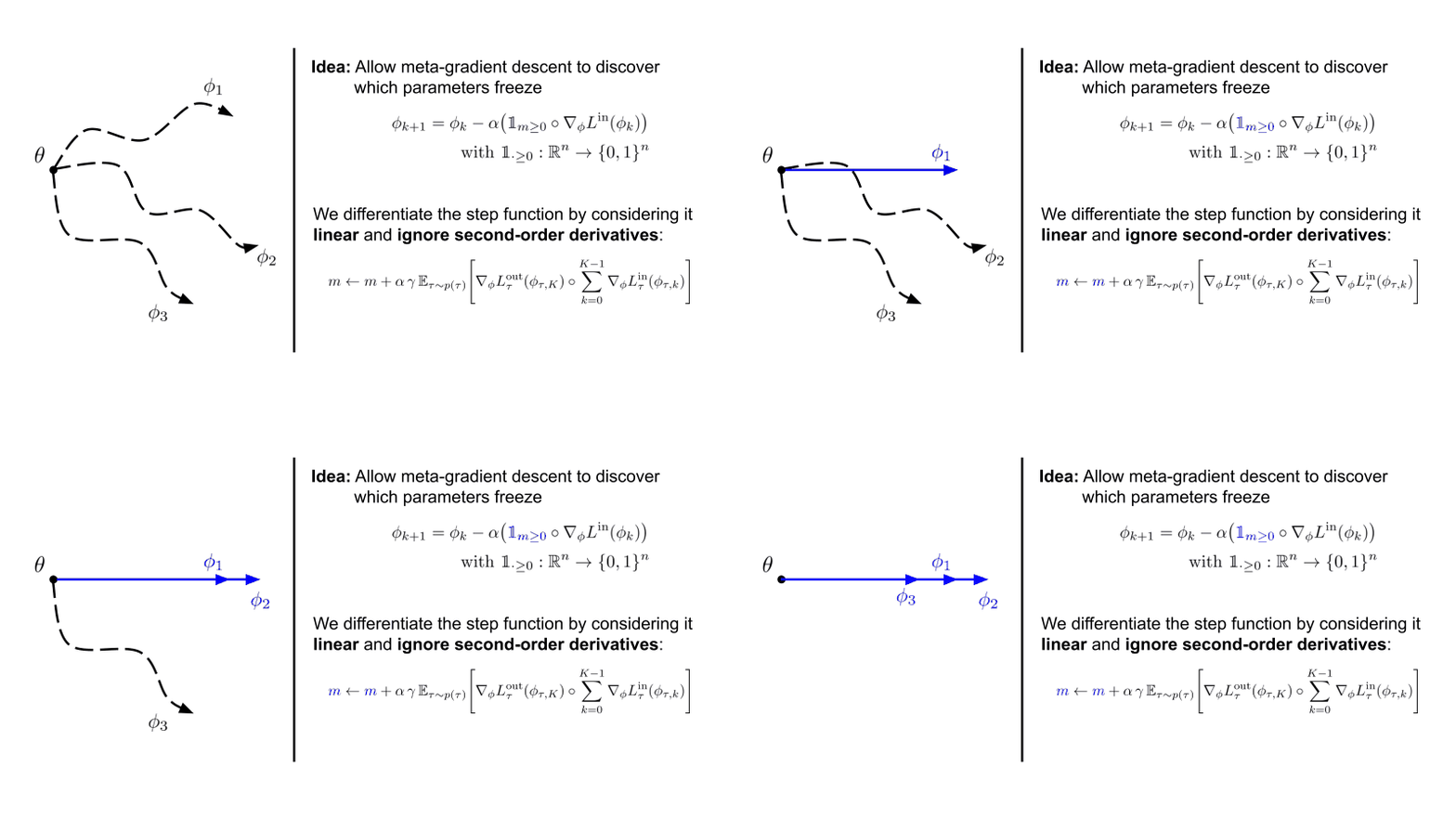
In this paper, we investigate gradient sparsity found by MAML in various continual and few-shot learning scenarios.\ Instead of only learning the initialization of neural network parameters, we additionally meta-learn parameters underneath a step function that stops gradient descent when smaller then 0.
We term this version Sparse-MAML - Link to the paper here.
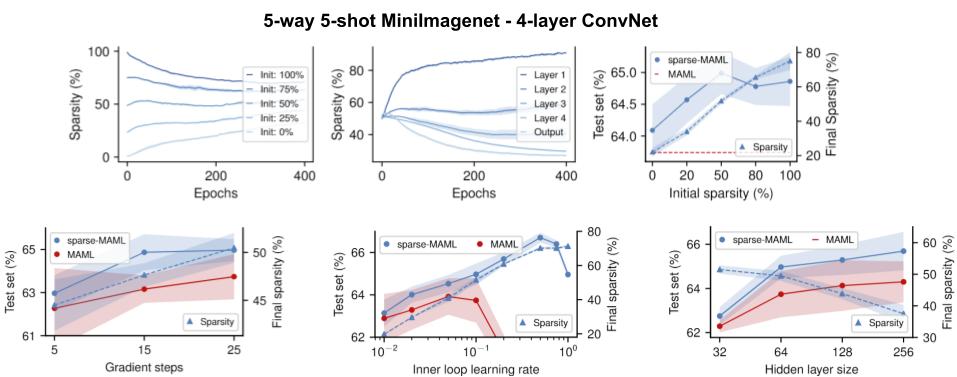
Interestingly, we see that structured sparsity emerges in both the classic 4-layer ConvNet as well as a ResNet-12 for few-shot learning. This is accompanied by improved robustness and generalisation across many hyperparameters.
Note that Sparse-MAML is an extremely simple variant of MAML that possesses only the possibility to shut on/off training of specific parameters compared to proper gradient modulation.
This codebase implents the few-shot learning experiments that are presented in the paper. To reproduce the results in the paper, please follow these instructions:
Installation
1. Install a conda env:
conda create -n sparse-MAML
2. Activate the env:
source activate sparse-MAML
3. Install anaconda:
conda install anaconda
4. Install extra requiremetns (make sure you use the correct pip3):
pip3 install -r requirements.txt
5. Run:
chmod u+x run_sparse_MAML.sh
6. Execute:
./run_sparse_MAML.sh
Results
| MiniImageNet Few-Shot | MAML | ANIL | BOIL | sparse-MAML | sparse-ReLU-MAML |
|---|---|---|---|---|---|
| 5-way 5-shot | ConvNet | 63.15 | 61.50 | 66.45 | 67.03 | 66.80 |
| 5-way 1-shot | ConvNet | 48.07 | 46.70 | 49.61 | 50.35 | 50.15 |
| 5-way 5-shot | ResNet12 | 69.36 | 70.03 | 70.50 | 70.02 | 73.01 |
| 5-way 1-shot | ResNet12 | 53.91 | 55.25 | - | 55.02 | 56.39 |
BOIL results are taken from the original paper.
This code based is heavily build on top of torchmeta.
Core symbols most depended-on inside this repo
Shape
Languages
Modules by API surface
For agents
$ claude mcp add learning_where_to_learn \
  -- python -m otcore.mcp_server <graph>