github.com/Ionaru/easy-markdown-editor @2.21.0 sqlite
README
EasyMDE - Markdown Editor




This repository is a fork of SimpleMDE, made by Sparksuite. Go to the dedicated section for more information.
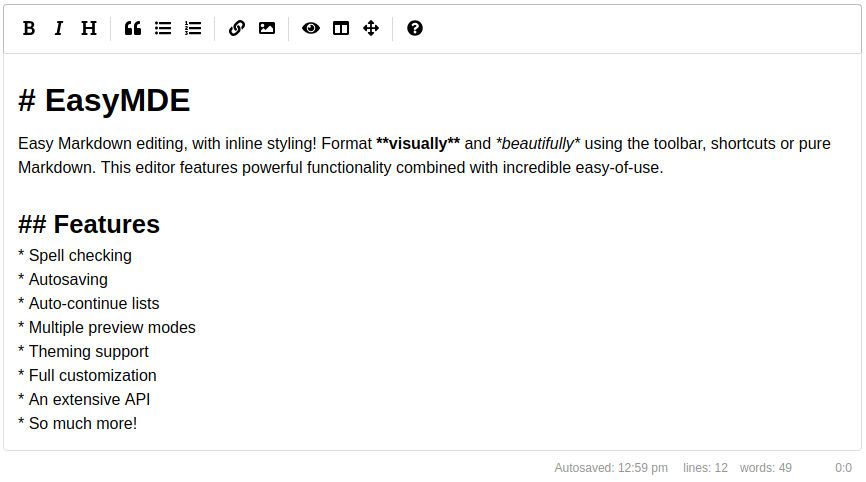
A drop-in JavaScript text area replacement for writing beautiful and understandable Markdown. EasyMDE allows users who may be less experienced with Markdown to use familiar toolbar buttons and shortcuts.
In addition, the syntax is rendered while editing to clearly show the expected result. Headings are larger, emphasized words are italicized, links are underlined, etc.
EasyMDE also features both built-in auto saving and spell checking. The editor is entirely customizable, from theming to toolbar buttons and javascript hooks.
Quick access
- EasyMDE - Markdown Editor
- Quick access
- Install EasyMDE
- How to use
- Configuration
- Advanced use
- How it works
- SimpleMDE fork
- Hacking EasyMDE
- Contributing
- License
Install EasyMDE
Via npm:
npm install easymde
Via the UNPKG CDN:
<link rel="stylesheet" href="https://unpkg.com/easymde/dist/easymde.min.css">
<script src="https://unpkg.com/easymde/dist/easymde.min.js"></script>
Or jsDelivr:
<link rel="stylesheet" href="https://cdn.jsdelivr.net/npm/easymde/dist/easymde.min.css">
<script src="https://cdn.jsdelivr.net/npm/easymde/dist/easymde.min.js"></script>
How to use
Loading the editor
After installing and/or importing the module, you can load EasyMDE onto the first textarea element on the web page:
<textarea></textarea>
<script>
const easyMDE = new EasyMDE();
</script>
Alternatively you can select a specific textarea, via JavaScript:
<textarea id="my-text-area"></textarea>
<script>
const easyMDE = new EasyMDE({element: document.getElementById('my-text-area')});
</script>
Editor functions
Use easyMDE.value() to get the content of the editor:
<script>
easyMDE.value();
</script>
Use easyMDE.value(val) to set the content of the editor:
<script>
easyMDE.value('New input for **EasyMDE**');
</script>
Configuration
Options list
- autoDownloadFontAwesome: If set to
true, force downloads Font Awesome (used for icons). If set tofalse, prevents downloading. Defaults toundefined, which will intelligently check whether Font Awesome has already been included, then download accordingly. - autofocus: If set to
true, focuses the editor automatically. Defaults tofalse. - autosave: Saves the text that's being written and will load it back in the future. It will forget the text when the form it's contained in is submitted.
- enabled: If set to
true, saves the text automatically. Defaults tofalse. - delay: Delay between saves, in milliseconds. Defaults to
10000(10 seconds). - submit_delay: Delay before assuming that submit of the form failed and saving the text, in milliseconds. Defaults to
autosave.delayor10000(10 seconds). - uniqueId: You must set a unique string identifier so that EasyMDE can autosave. Something that separates this from other instances of EasyMDE elsewhere on your website.
- timeFormat: Set DateTimeFormat. More information see DateTimeFormat instances. Default
locale: en-US, format: hour:minute. - text: Set text for autosave.
- autoRefresh: Useful, when initializing the editor in a hidden DOM node. If set to
{ delay: 300 }, it will check every 300 ms if the editor is visible and if positive, call CodeMirror'srefresh(). - blockStyles: Customize how certain buttons that style blocks of text behave.
- bold: Can be set to
**or__. Defaults to**. - code: Can be set to
```or~~~. Defaults to```. - italic: Can be set to
*or_. Defaults to*. - unorderedListStyle: can be
*,-or+. Defaults to*. - scrollbarStyle: Chooses a scrollbar implementation. The default is "native", showing native scrollbars. The core library also provides the "null" style, which completely hides the scrollbars. Addons can implement additional scrollbar models.
- element: The DOM element for the
textareaelement to use. Defaults to the firsttextareaelement on the page. - forceSync: If set to
true, force text changes made in EasyMDE to be immediately stored in original text area. Defaults tofalse. - hideIcons: An array of icon names to hide. Can be used to hide specific icons shown by default without completely customizing the toolbar.
- indentWithTabs: If set to
false, indent using spaces instead of tabs. Defaults totrue. - initialValue: If set, will customize the initial value of the editor.
- previewImagesInEditor: - EasyMDE will show preview of images,
falseby default, preview for images will appear only for images on separate lines. - imagesPreviewHandler: - A custom function for handling the preview of images. Takes the parsed string between the parantheses of the image markdown
as argument and returns a string that serves as thesrcattribute of the<img>tag in the preview. Enables dynamic previewing of images in the frontend without having to upload them to a server, allows copy-pasting of images to the editor with preview. - insertTexts: Customize how certain buttons that insert text behave. Takes an array with two elements. The first element will be the text inserted before the cursor or highlight, and the second element will be inserted after. For example, this is the default link value:
["[", "](http://)"]. - horizontalRule
- image
- link
- table
- lineNumbers: If set to
true, enables line numbers in the editor. - lineWrapping: If set to
false, disable line wrapping. Defaults totrue. - minHeight: Sets the minimum height for the composition area, before it starts auto-growing. Should be a string containing a valid CSS value like
"500px". Defaults to"300px". - maxHeight: Sets fixed height for the composition area.
minHeightoption will be ignored. Should be a string containing a valid CSS value like"500px". Defaults toundefined. - onToggleFullScreen: A function that gets called when the editor's full screen mode is toggled. The function will be passed a boolean as parameter,
truewhen the editor is currently going into full screen mode, orfalse. - parsingConfig: Adjust settings for parsing the Markdown during editing (not previewing).
- allowAtxHeaderWithoutSpace: If set to
true, will render headers without a space after the#. Defaults tofalse. - strikethrough: If set to
false, will not process GFM strikethrough syntax. Defaults totrue. - underscoresBreakWords: If set to
true, let underscores be a delimiter for separating words. Defaults tofalse. - overlayMode: Pass a custom codemirror overlay mode to parse and style the Markdown during editing.
- mode: A codemirror mode object.
- combine: If set to
false, will replace CSS classes returned by the default Markdown mode. Otherwise the classes returned by the custom mode will be combined with the classes returned by the default mode. Defaults totrue. - placeholder: If set, displays a custom placeholder message.
- previewClass: A string or array of strings that will be applied to the preview screen when activated. Defaults to
"editor-preview". - previewRender: Custom function for parsing the plaintext Markdown and returning HTML. Used when user previews.
- promptURLs: If set to
true, a JS alert window appears asking for the link or image URL. Defaults tofalse. - promptTexts: Customize the text used to prompt for URLs.
- image: The text to use when prompting for an image's URL. Defaults to
URL of the image:. - link: The text to use when prompting for a link's URL. Defaults to
URL for the link:. - iconClassMap: Used to specify the icon class names for the various toolbar buttons.
- uploadImage: If set to
true, enables the image upload functionality, which can be triggered by drag and drop, copy-paste and through the browse-file window (opened when the user click on the upload-image icon). Defaults tofalse. - imageMaxSize: Maximum image size in bytes, checked before upload (note: never trust client, always check the image size at server-side). Defaults to
1024 * 1024 * 2(2 MB). - imageAccept: A comma-separated list of mime-types used to check image type before upload (note: never trust client, always check file types at server-side). Defaults to
image/png, image/jpeg. - imageUploadFunction: A custom function for handling the image upload. Using this function will render the options
imageMaxSize,imageAccept,imageUploadEndpointandimageCSRFTokenineffective.- The function gets a file and
onSuccessandonErrorcallback functions as parameters.onSuccess(imageUrl: string)andonError(errorMessage: string)
- The function gets a file and
- imageUploadEndpoint: The endpoint where the images data will be sent, via an asynchronous POST request. The server is supposed to save this image, and return a JSON response.
- if the request was successfully processed (HTTP 200 OK):
{"data": {"filePath": "<filePath>"}}where filePath is the path of the image (absolute ifimagePathAbsoluteis set to true, relative if otherwise); - otherwise:
{"error": "<errorCode>"}, where errorCode can benoFileGiven(HTTP 400 Bad Request),typeNotAllowed(HTTP 415 Unsupported Media Type),fileTooLarge(HTTP 413 Payload Too Large) orimportError(see errorMessages below). If errorCode is not one of the errorMessages, it is alerted unchanged to the user. This allows for server-side error messages. No default value.
- if the request was successfully processed (HTTP 200 OK):
- imagePathAbsolute: If set to
true, will treatimageUrlfromimageUploadFunctionand filePath returned fromimageUploadEndpointas an absolute rather than relative path, i.e. not prependwindow.location.originto it. - imageCSRFToken: CSRF token to include with AJAX call to upload image. For various instances like Django, Spring and Laravel.
- imageCSRFName: CSRF token filed name to include with AJAX call to upload image, applied when
imageCSRFTokenhas value, defaults tocsrfmiddlewaretoken. - imageCSRFHeader: If set to
true, passing CSRF token via header. Defaults tofalse, which pass CSRF through request body. - imageTexts: Texts displayed to the user (mainly on the status bar) for the import image feature, where
#image_name#,#image_size#and#image_max_size#will replaced by their respective values, that can be used for customization or internationalization:- sbInit: Status message displayed initially if
uploadImageis set totrue. Defaults toAttach files by drag and dropping or pasting from clipboard.. - sbOnDragEnter: Status message displayed when the user drags a file to the text area. Defaults to
Drop image to upload it.. - sbOnDrop: Status message displayed when the user drops a file in the text area. Defaults to
Uploading images #images_names#. - sbProgress: Status message displayed to show uploading progress. Defaults to
Uploading #file_name#: #progress#%. - sbOnUploaded: Status message displayed when the image has been uploaded. Defaults to
Uploaded #image_name#. - sizeUnits: A comma-separated list of units used to display messages with human-readable file sizes. Defaults to
B, KB, MB(example:218 KB). You can useB,KB,MBinstead if you prefer without whitespaces (218KB).
- sbInit: Status message displayed initially if
- errorMessages: Errors displayed to the user, using the
errorCallbackoption, where#image_name#,#image_size#and#image_max_size#will replaced by their respective values, that can be used for customization or internationalization:- noFileGiven: The server did not receive any file from the user. Defaults to
You must select a file.. - typeNotAllowed: The user send a file type which doesn't match the
imageAcceptlist, or the server returned this error code. Defaults toThis image type is not allowed.. - fileTooLarge
- noFileGiven: The server did not receive any file from the user. Defaults to
Extension points exported contracts — how you extend this code
ArrayOneOrMore (Interface)Core symbols most depended-on inside this repo
expectValueShape
Languages
Modules by API surface
Dependencies from manifests, versioned
For agents
$ claude mcp add easy-markdown-editor \
  -- python -m otcore.mcp_server <graph>