github.com/IceFireDB/IceFireDB @main
Chat with this repoBrowse by type
What it actually does AI analysis from the code graph — generated when you open this
README
🚀 IceFireDB
Decentralized Database Infrastructure for Web2 & Web3






A high-performance, decentralized database engine bridging Web2 and Web3 ecosystems with advanced distributed consensus and storage capabilities.
📖 Table of Contents
- 🌟 Overview
- ✨ Key Features
- 🏗️ Architecture
- 📚 Documentation
- 🔧 Project Components
- IceFireDB-SQLite
- IceFireDB-SQLProxy
- IceFireDB-Redis-Proxy
- IceFireDB-PubSub
- IceFireDB-NoSQL
- ⚙️ System Design
- 🚀 Quick Start
- 📋 Command Support
- 🎯 Roadmap
- 📄 License
🌟 Overview
IceFireDB is an advanced decentralized database infrastructure that bridges traditional Web2 applications with the emerging Web3 ecosystem. Built on cutting-edge distributed systems research, it provides a robust foundation for building decentralized applications with enterprise-grade performance and reliability.
Core Innovations
- Hybrid Consensus: Combines Raft for intra-site consistency with P2P CRDT for cross-site synchronization
- Multi-Storage Support: Seamlessly integrates disk storage, OSS, and IPFS for flexible data persistence
- Protocol Compatibility: Supports both SQL (MySQL protocol) and NoSQL (Redis RESP protocol) interfaces
- Decentralized Networking: Enables automatic P2P networking for distributed data synchronization
✨ Key Features
| Feature | Status | Description |
|---|---|---|
| 🚀 High Performance | 🔄 Ongoing Optimization | Optimized for low-latency, high-throughput operations |
| 💾 Multi-Storage Support | ✅ Implemented | LSM disk, OSS, IPFS, and hybrid storage drivers |
| 🔄 Distributed Consistency | ✅ Implemented | Raft, P2P-CRDT, and IPFS-LOG consensus modes |
| 🌐 IPFS Integration | 🧪 Beta | Persistent decentralized storage layer |
| 🤖 P2P Auto-Networking | 🧪 Beta | Automatic decentralized network formation |
| 🔑 KV Storage Engine | 🧪 Beta | CRDT-based and IPFS-LOG based KV stores |
| 🧠 AI Vector Database | 🔄 In Progress | Vector storage and similarity search capabilities |
| 📡 NATS Integration | 🔄 In Progress | High-performance decentralized messaging |
| 📝 Tamper-Resistant Logs | 📋 Planned | Auditable, scalable logging with QED integration |
| 🌉 Web2-Web3 Bridge | 📋 Planned | Immutable data witness layer |
| 🔄 Hot/Cold Storage | ✅ Implemented | Tiered storage via hybriddb driver |
🏗️ Architecture

Decentralized Database Engine

IceFireDB is designed as a bridge between Web2 and Web3 worlds, enabling: - Web2 Migration: Traditional applications can gradually adopt decentralization - Web3 Native: Built-in support for decentralized storage and consensus - Data Immutability: Ensures data integrity and auditability - Protocol Flexibility: Supports both SQL and NoSQL interfaces

📚 Documentation

📖 Comprehensive Documentation
Visit our official documentation center for detailed guides, API references, and architectural deep dives:
🔗 Documentation Center - https://docs.icefiredb.xyz/icefiredb_docs/
Our documentation includes: - 🚀 Quick start guides - 🏗️ Architecture overviews - 🔧 Installation and configuration - 📚 API references - 🎯 Best practices - 🔍 Troubleshooting guides
🔧 Project Components
IceFireDB is composed of several specialized components that work together to provide comprehensive decentralized database capabilities:
🗄️ IceFireDB-SQLite
A decentralized SQLite database that enables global distributed SQL operations: - MySQL Protocol Support: Write data using standard MySQL protocol - P2P Synchronization: Automatic data synchronization across nodes - SQLite Backend: Leverages SQLite for local data persistence - Global Distribution: Build global distributed database systems
🔄 IceFireDB-SQLProxy
Decentralized SQL database networking system for traditional Web2 databases: - Web2 Migration: Enables gradual decentralization of existing MySQL databases - Command Synchronization: Automatic command replication across network nodes - MySQL Integration: Seamless integration with existing MySQL infrastructure - Global Storage: Build globally distributed storage with automatic networking
🔴 IceFireDB-Redis-Proxy
Adds decentralization capabilities to traditional Redis databases: - Redis Protocol: Full Redis RESP protocol compatibility - Decentralized Middleware: Network proxy for Redis decentralization - Cluster Support: Works with Redis clusters and single instances - Data Synchronization: Automatic instruction synchronization across nodes
📡 IceFireDB-PubSub
High-performance decentralized publish-subscribe system: - Redis PubSub Compatibility: Seamless migration from Redis pub/sub - High Availability: Built-in redundancy and failover mechanisms - P2P Networking: Decentralized peer-to-peer subscription network - Web2 Migration: Easy transition for existing Redis pub/sub applications
🗃️ IceFireDB-NoSQL
Core NoSQL database engine with multiple operational modes: - Web2 Mode: Distributed Raft-based disk Redis database - Web3 Mode: Decentralized IPFS storage mode - Hybrid Operation: Support for both traditional and decentralized storage - Protocol Support: Full Redis RESP protocol implementation
📋 Command Support
IceFireDB provides comprehensive Redis-compatible command support across all major data types:
📝 Strings
- Basic Operations: SET, GET, DEL, EXISTS, INCR, DECR, APPEND
- Bit Operations: SETBIT, GETBIT, BITCOUNT, BITOP, BITPOS
- Range Operations: GETRANGE, SETRANGE, GETSET
- Expiration: SETEX, SETEXAT, EXPIRE, EXPIREAT, TTL
- Batch Operations: MGET, MSET
🗂️ Hashes
- Field Operations: HSET, HGET, HDEL, HEXISTS, HGETALL
- Incremental: HINCRBY
- Key Management: HKEYS, HVALS, HLEN, HSTRLEN
- Batch Operations: HMSET, HMGET
- Expiration: HEXPIRE, HEXPIREAT, HTTL, HKEYEXIST
- Management: HCLEAR, HMCLEAR, HSETEX
📋 Lists
- Push/Pop: LPUSH, RPUSH, LPOP, RPOP, RPOPLPUSH
- Access: LINDEX, LRANGE, LSET, LLEN
- Management: LTRIM, LCLEAR, LMCLEAR
- Expiration: LEXPIRE, LEXPIREAT, LTTL, LKEYEXISTS
🔢 Sets
- Membership: SADD, SREM, SISMEMBER, SMEMBERS
- Operations: SINTER, SUNION, SDIFF
- Store Operations: SINTERSTORE, SUNIONSTORE, SDIFFSTORE
- Management: SCARD, SCLEAR, SMCLEAR
- Expiration: SEXPIRE, SEXPIREAT, STTL, SPERSIST, SKEYEXISTS
📊 Sorted Sets
- Score Operations: ZADD, ZSCORE, ZINCRBY
- Range Operations: ZRANGE, ZREVRANGE, ZRANGEBYSCORE, ZREVRANGEBYSCORE
- Rank Operations: ZRANK, ZREVRANK
- Management: ZCARD, ZCOUNT, ZREM, ZCLEAR
- Range Removal: ZREMRANGEBYSCORE, ZREMRANGEBYRANK
⚙️ System Design
IceFireDB implements a sophisticated layered architecture with the following core components:
| Component | Description | Technologies |
|---|---|---|
| 🌐 Network Layer | Multi-protocol networking with hybrid consensus | P2P, RAFT, NATS |
| 💾 Storage Layer | Multi-engine storage abstraction with Web2/Web3 compatibility | goleveldb, badger, hybriddb, IPFS, CRDT, IPFS-LOG, IPFS-SYNCKV, OSS |
| 📡 Protocol Layer | Multi-protocol support for broad application compatibility | RESP, SQL |
| 🔧 Codec Layer | Core data abstraction and encoding/decoding engine | KV, Strings, Hashes, Lists, Sorted Sets, Sets, SQL, PubSub |
🧱 Backend Support Matrix (1.0.0)
Storage backends are classified by support tier for the 1.0.0 release. "GA" backends are recommended for production; "Beta" are usable and CI-tested but may need tuning or carry caveats; "Experimental" are decentralized/external-service backends still maturing.
| Backend | Tier | Storage | External dependency | Notes |
|---|---|---|---|---|
goleveldb |
GA | Local LSM (default) | none | Default engine; mature ledis storage. |
hybriddb |
GA | Local hot/cold tier | none | ristretto cache over leveldb; has dedicated unit tests. |
badger |
Beta | Local LSM | none | CI-tested; default open options are memory-heavy — tune before heavy production use. |
ipfs-synckv |
Beta | IPFS + local mirror | IPFS daemon (:5001) | Encrypted (AES-GCM); CI-tested against a real IPFS node. |
ipfs |
Experimental | IPFS | IPFS daemon (:5001) | Decentralized storage; beta maturity. |
ipfs-log |
Experimental | IPFS append-only log | IPFS daemon (:5001) | Decentralized log; multi-node identifier via --ipfs-log-dbname. |
oss |
Experimental | S3 / object storage | S3 endpoint + credentials | Object-storage backend. |
crdt |
Experimental | P2P CRDT | libp2p networking | Conflict-free cross-site sync; beta maturity. |
All backends are exercised by the per-backend CI jobs in
.github/workflows/test.yml. Tier reflects production-readiness and operational complexity, not just test coverage. RESP semantics are identical across backends — see COMPATIBILITY.md.
💾 Durability & --nosync
Writes go through the Raft log before being applied to the storage backend. By
default each Raft log append is synced to disk (fsync) before the write is
acknowledged, so an acknowledged write survives a power loss or process crash on
that node.
- Default (sync on): durable but slower — every write pays an
fsync. --nosync: the Raft log is not fsync'd on every append. Writes are much faster, but a sudden power loss or OS crash can lose the most recent acknowledged writes on that node. A clean process kill (e.g.SIGKILL) is still safe because the data already reached the OS page cache;--nosynconly trades away protection against losing un-flushed pages on power/kernel failure.
In a multi-node cluster, a Raft write commits once a majority of nodes have
appended it, so the cluster as a whole tolerates the loss of a minority of nodes
even with --nosync. Crash-recovery and leader-failover behavior is verified by
the integration tests (make test-integration).
Recommendation: keep the default (sync on) for single-node or durability-
sensitive deployments; consider --nosync only for multi-node clusters where the
majority-commit guarantee and higher throughput outweigh per-node power-loss risk.
🚀 Quick Start
Get started with IceFireDB in minutes with our comprehensive quick start guide:
🎯 Roadmap
IceFireDB originated as a distributed NoSQL database for Web2 scenarios and continues to evolve:
- Web2 Support: Ongoing support for traditional distributed NoSQL databases
- Web3 Expansion: Increased focus on decentralized database technologies
- Hybrid Approach: Bridging Web2 and Web3 ecosystems with seamless migration paths
- Community Driven: Development guided by community needs and contributions
We're grateful for our community partners and contributors who continue to drive innovation forward.
📄 License
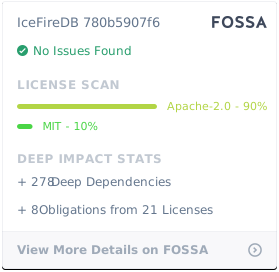
IceFireDB is released under the Apache License 2.0:
📝 Legal Disclaimer
Important
Extension points exported contracts — how you extend this code
browse all types & interfaces →
Core symbols most depended-on inside this repo
Shape
Languages
Modules by API surface
For agents
$ claude mcp add IceFireDB \
  -- python -m otcore.mcp_server <graph>