github.com/Hironsan/anago @1.0.0
Chat with this repoWhat it actually does AI analysis from the code graph — generated when you open this
README
anaGo
anaGo is a Python library for sequence labeling, implemented in Keras.
anaGo can solve sequence labeling tasks such as named entity recognition (NER), Part-of-Speech tagging (POS tagging), semantic role labeling (SRL) and so on. Unlike traditional sequence labeling solver, we don't need to define any language dependent features. Thus, we can easily use anaGo for any languages.
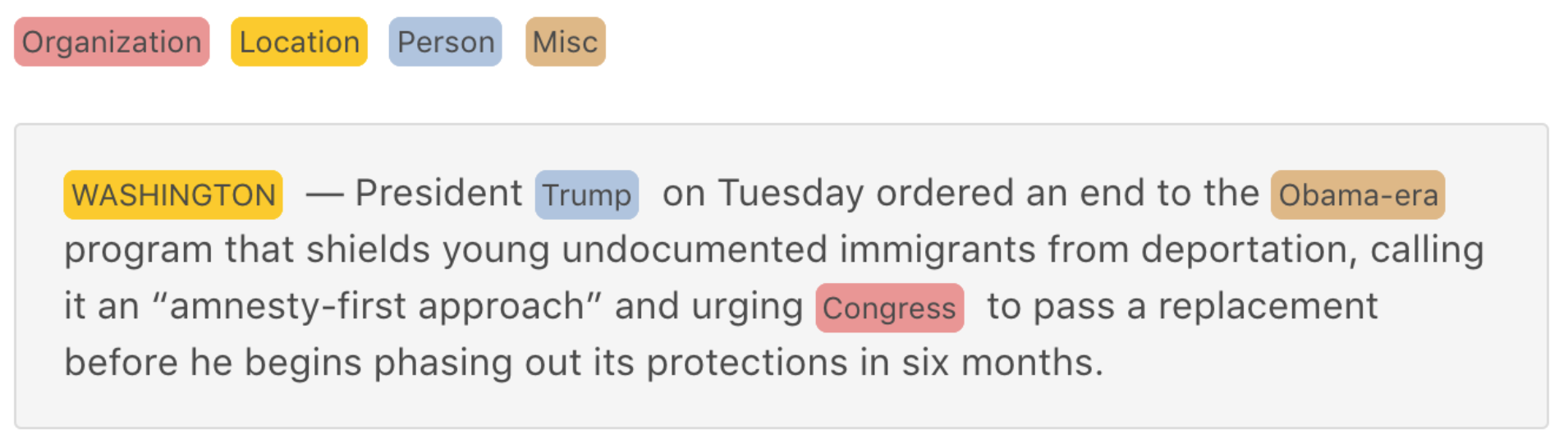
As an example of anaGo, the following images show named entity recognition in English and Japanese:

Get Started
In anaGo, the simplest type of model is the Sequence model. Sequence model includes essential methods like fit, score, analyze and save/load. For more complex features, you should use the anaGo modules such as models, preprocessing and so on.
Here is the data loader:
>>> from anago.utils import load_data_and_labels

>>> x_train, y_train = load_data_and_labels('train.txt')
>>> x_test, y_test = load_data_and_labels('test.txt')
>>> x_train[0]
['EU', 'rejects', 'German', 'call', 'to', 'boycott', 'British', 'lamb', '.']
>>> y_train[0]
['B-ORG', 'O', 'B-MISC', 'O', 'O', 'O', 'B-MISC', 'O', 'O']
You can now iterate on your training data in batches:
>>> import anago

>>> model = anago.Sequence()
>>> model.fit(x_train, y_train, epochs=15)
Epoch 1/15
541/541 [==============================] - 166s 307ms/step - loss: 12.9774
...
Evaluate your performance in one line:
>>> model.score(x_test, y_test)
80.20  # f1-micro score
# For more performance, you have to use pre-trained word embeddings.
# For now, anaGo's best score is 90.70 f1-micro score.
Or tagging text on new data:
>>> text = 'President Obama is speaking at the White House.'
>>> model.analyze(text)
{
    "words": [
        "President",
        "Obama",
        "is",
        "speaking",
        "at",
        "the",
        "White",
        "House."
    ],
    "entities": [
        {
            "beginOffset": 1,
            "endOffset": 2,
            "score": 1,
            "text": "Obama",
            "type": "PER"
        },
        {
            "beginOffset": 6,
            "endOffset": 8,
            "score": 1,
            "text": "White House.",
            "type": "LOC"
        }
    ]
}
To download a pre-trained model, call download function:
>>> from anago.utils import download

>>> url = 'https://storage.googleapis.com/chakki/datasets/public/ner/model_en.zip'
>>> download(url)
'Downloading...'
'Complete!'
>>> model = anago.Sequence.load('weights.h5', 'params.json', 'preprocessor.pickle')
>>> model.score(x_test, y_test)
90.61
Feature Support
anaGo supports following features:
- Model Training
- Model Evaluation
- Tagging Text
- Custom Model Support
- Downloading pre-trained model
- GPU Support
- Character feature
- CRF Support
- Custom Callback Support
anaGo officially supports Python 3.4–3.6.
Installation
To install anaGo, simply use pip:
$ pip install anago
or install from the repository:
$ git clone https://github.com/Hironsan/anago.git
$ cd anago
$ python setup.py install
Documentation
(coming soon)
Fantastic documentation is available at http://example.com/.
Reference
This library uses bidirectional LSTM + CRF model based on Neural Architectures for Named Entity Recognition by Lample, Guillaume, et al., NAACL 2016.
Core symbols most depended-on inside this repo
load_data_and_labelsShape
Languages
Modules by API surface
For agents
$ claude mcp add anago \
  -- python -m otcore.mcp_server <graph>