github.com/Hal0ai/hal0 @v0.9.3
Chat with this repoWhat it actually does AI analysis from the code graph — generated when you open this
README

Open-source home AI inference platform
hal0.dev · Install · Docs · Roadmap · Discord
hal0 turns a Linux box — ideally a Ryzen AI Max+ 395 with 128 GB of unified memory — into a polished, OpenAI-compatible inference appliance. Hardware-aware slots, prewired chat UI, signed self-update. One command installs the lot.
Every inference workload runs as its own podman container under a
hal0-slot@<name>.service unit. hal0-api on :8080 is the sole
control plane — it owns slot state machines, dispatches OpenAI-compatible
/v1/* requests to the right slot port, and serves the dashboard. No
shared inference daemon; no extra process to babysit.
curl -fsSL https://hal0.dev/install.sh | bash
Status: v0.9.0 — first public beta. Container-runtime era, declarative config. Each slot (
agent,utility,embed,rerank,stt,tts,img,vision, NPU trio) runs as a dedicated podman container (hal0-slot@<name>.service). Slot definitions live in/etc/hal0/slots/<name>.toml; backend profiles in/etc/hal0/profiles.toml; the model catalog isregistry.toml— the single source of truth for every HuggingFace coordinate and SHA-256 digest. The launch command for every slot is resolved from a single source (deduped, with per-flag provenance), Stacks apply declarative model/slot layouts atomically, and profiles share the same portable export/import envelope. hal0 is Strix Halo native, not Strix-Halo-only: experimental CUDA + multi-GPU pinning ride alongside the ROCm/Vulkan defaults. Companion services (Open WebUI, ComfyUI, Hermes, Hindsight) are managed from one Services dashboard page with mDNS discovery; the dashboard itself has a redesigned fixed-band layout with a live telemetry header. Seed profiles are virtual (code-defined, self-healing on upgrade) with dedicated embed/rerank lanes and a model×profile×slot MTP decision; models carry a preferred runtime profile, interrupted pulls resume, and voice runs end-to-end (NPU STT + Kokoro or GPU Qwen3-TTS). The one-liner writes the first-run sentinel only — no model picks, no downloads; runhal0 setupanytime to configure models, extensions, and NPU interactively. SeePLAN.md§1 for what ships now and the path to v1.0.
Screenshots
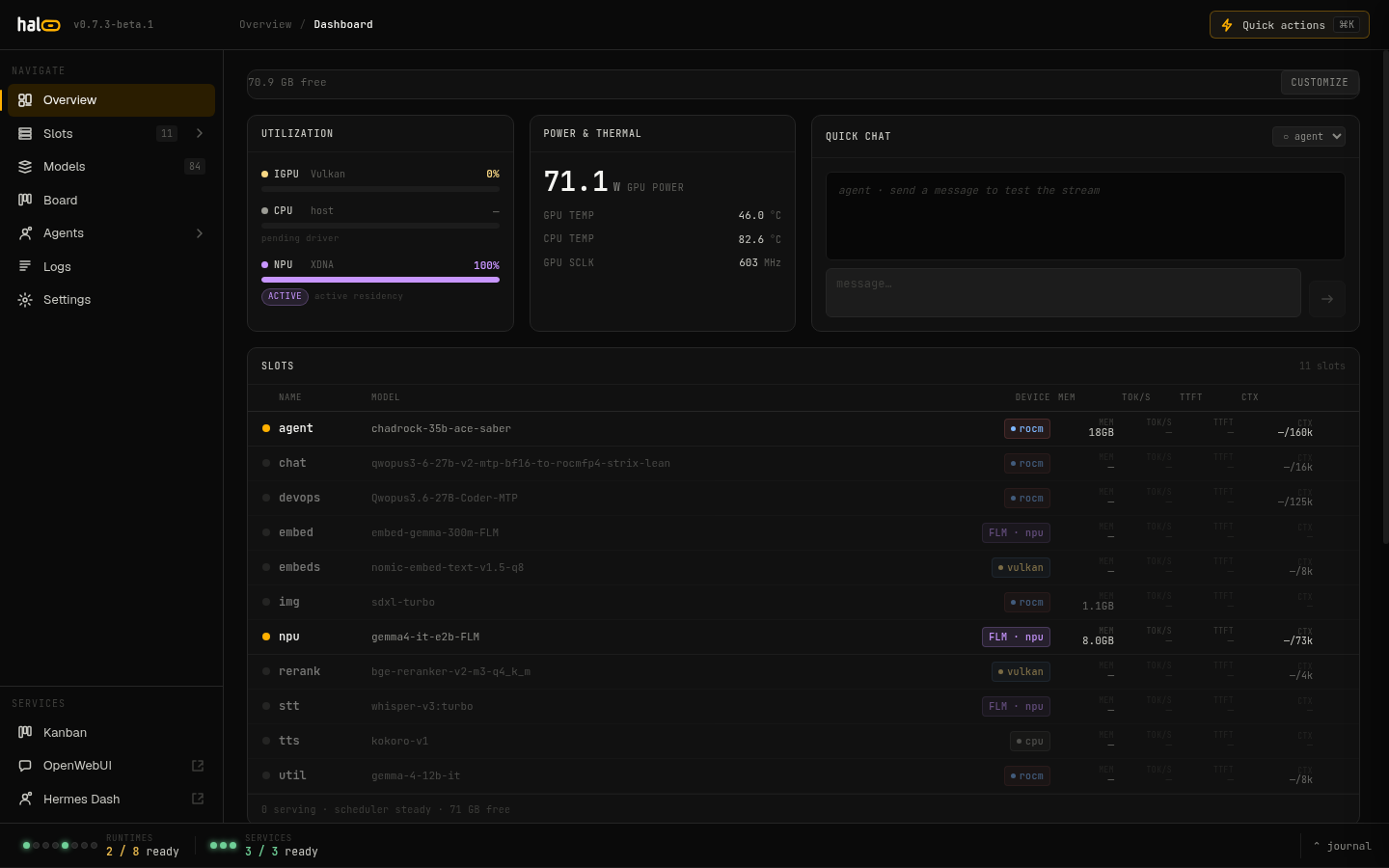 Dashboard — unified-memory hero, at-a-glance health, and live slot rows.
 |
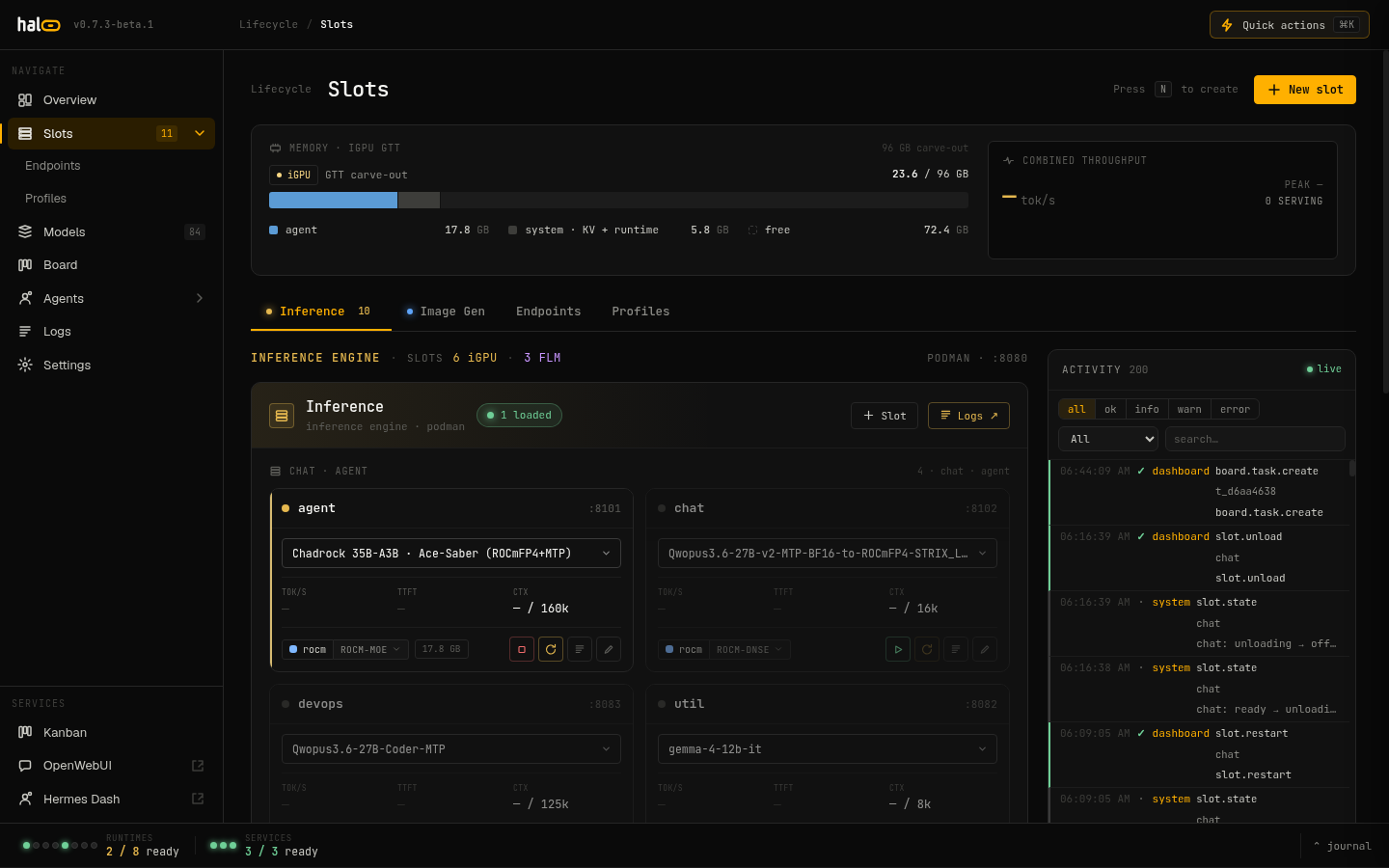 Slots — the inference engine: per-slot models, devices, and live telemetry.
 |
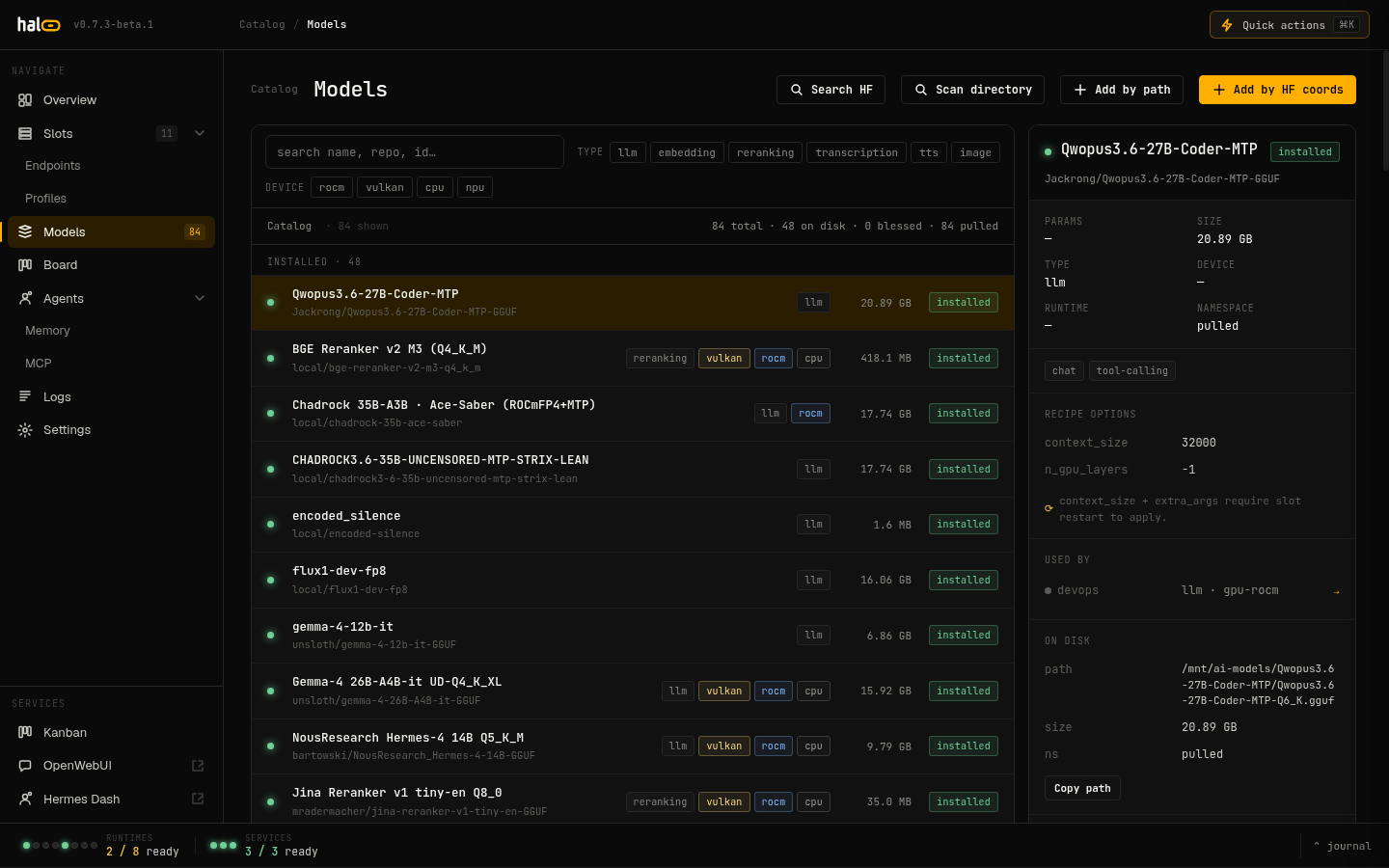 Model registry — catalogue with quant chips and pull status.
 |
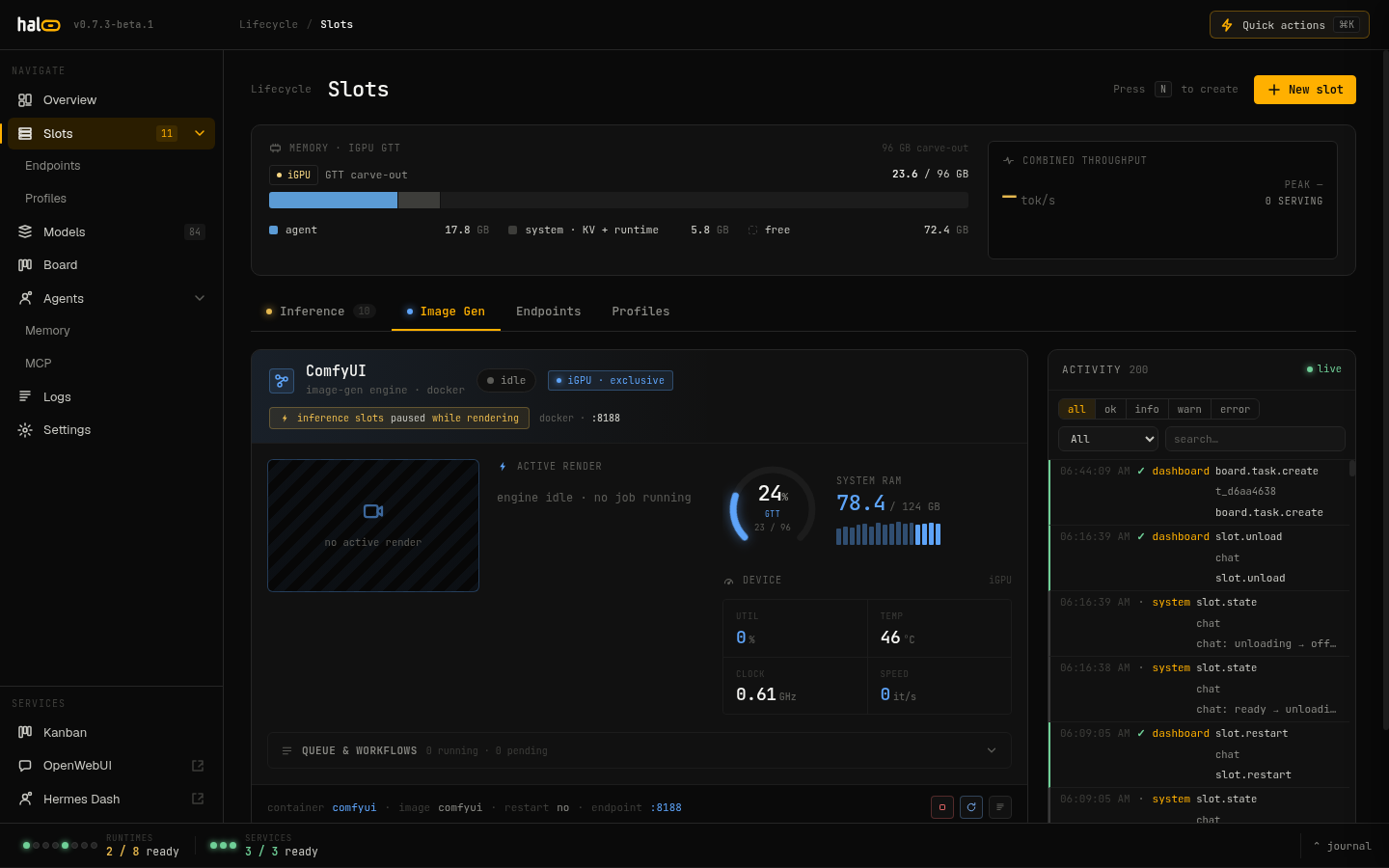 Image generation — ComfyUI queue and GPU gauges.
 |
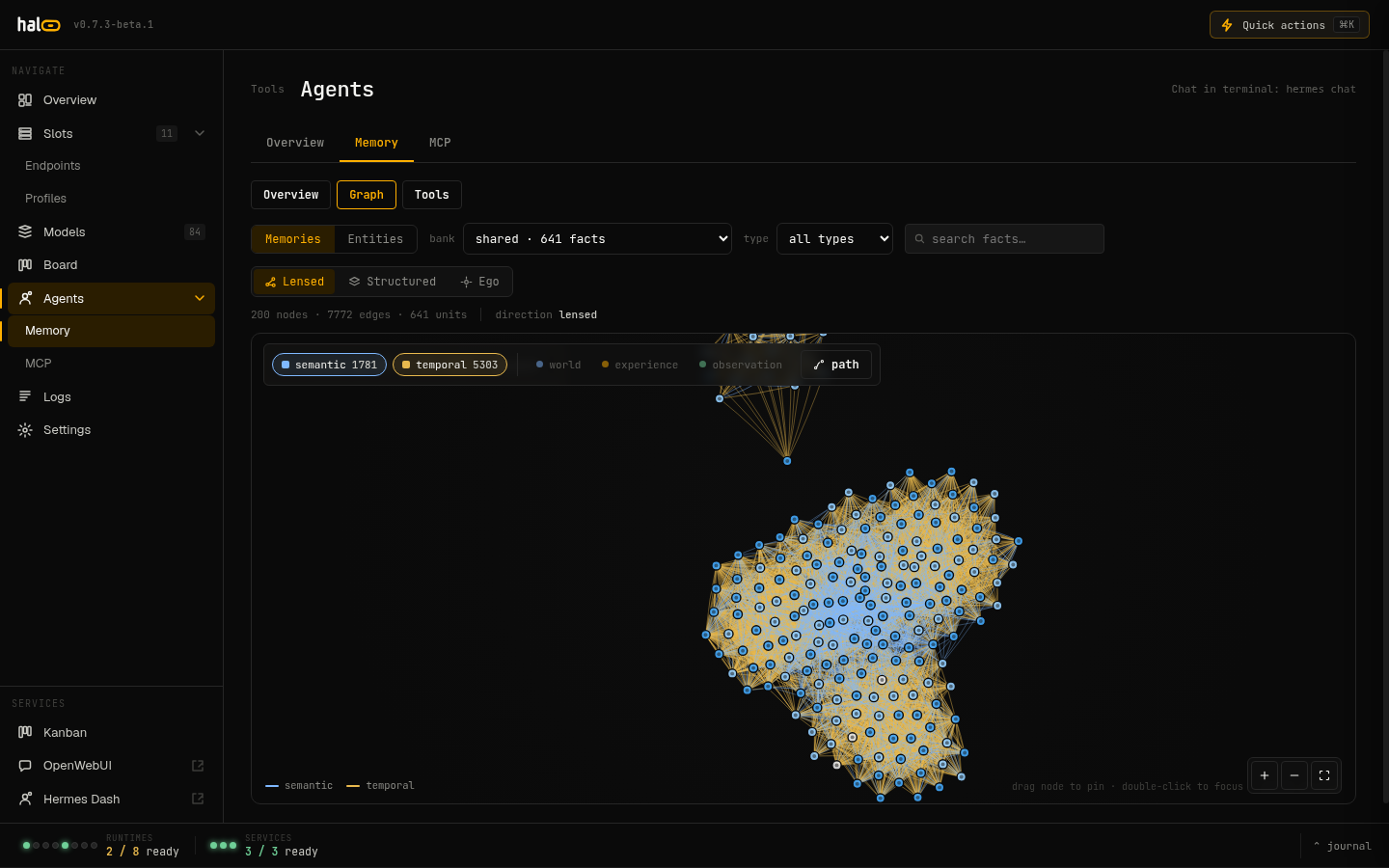 Memory — Hindsight facts and graph extraction.
 |
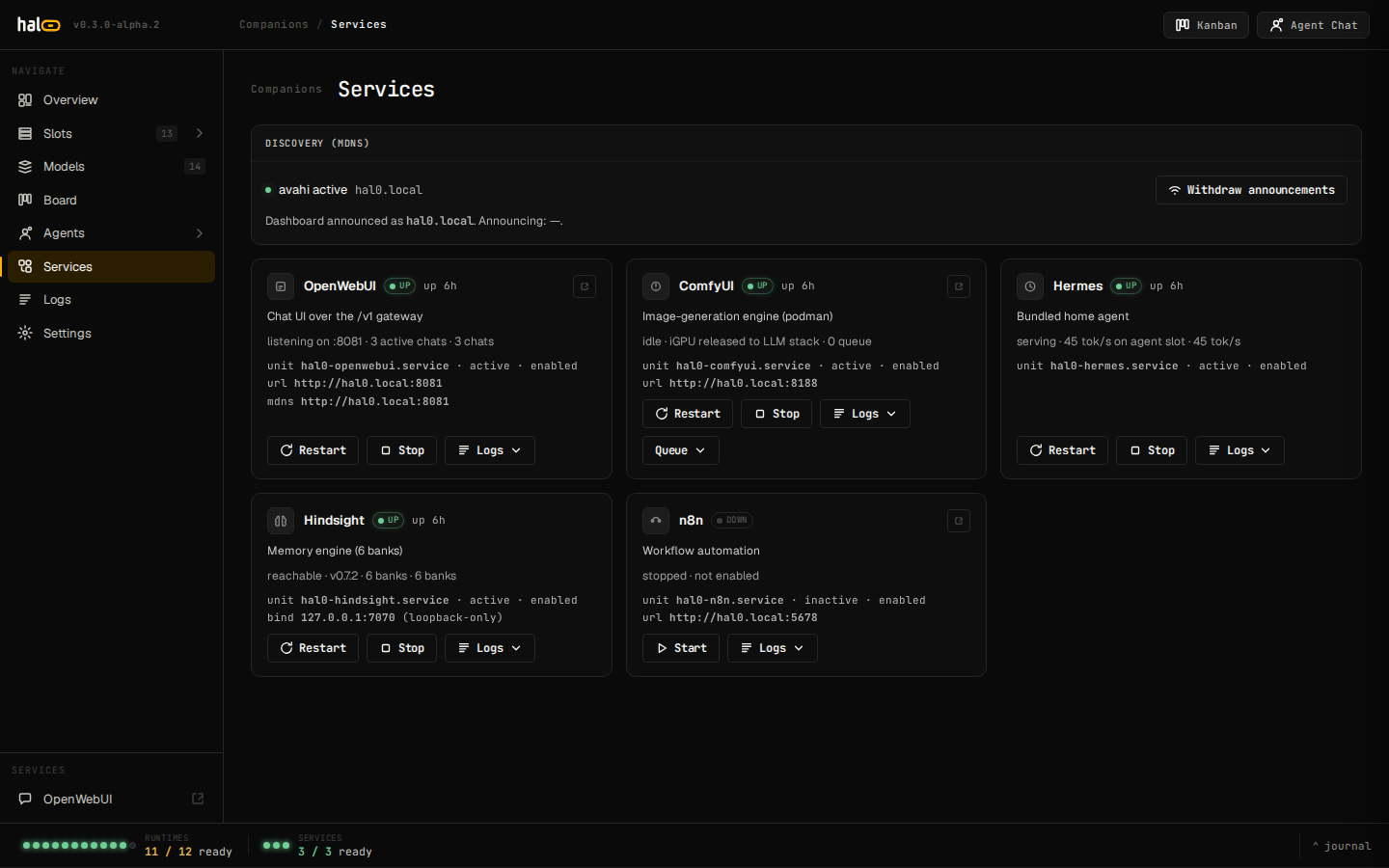 Services — Open WebUI, ComfyUI, Hermes, Hindsight, n8n with mDNS.
 |
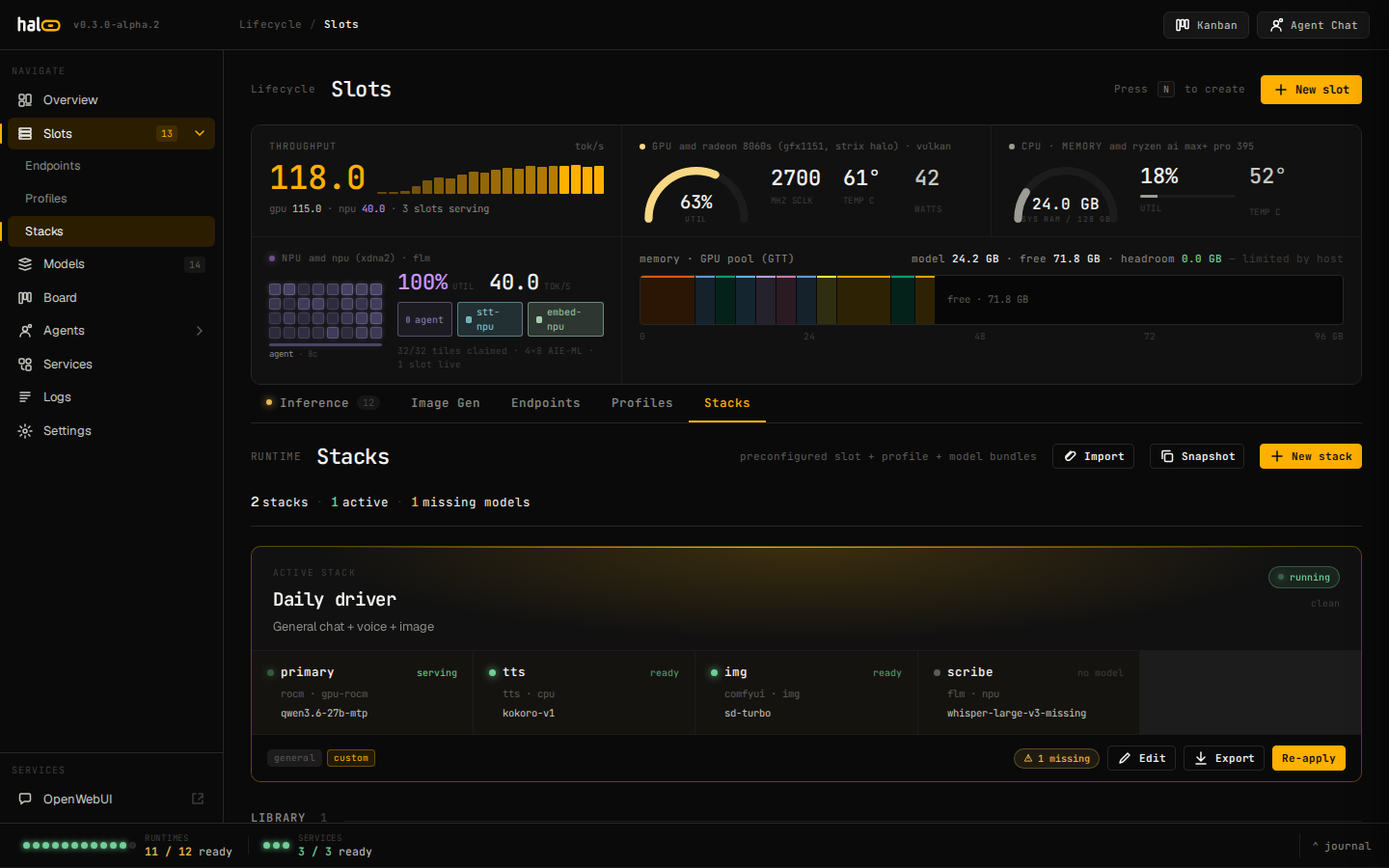 Stacks — declarative slot + profile + model bundles, applied atomically.
 |
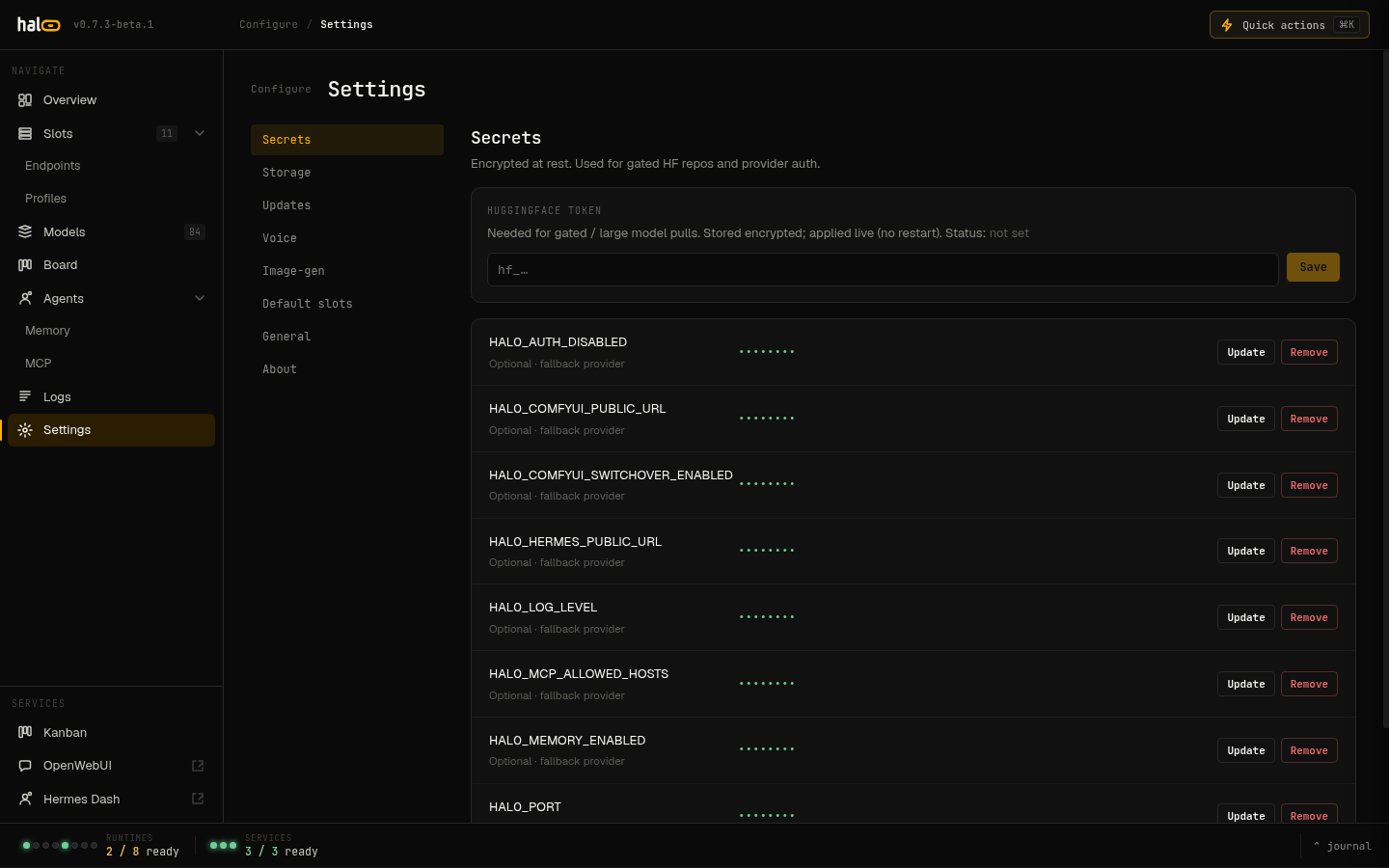 Settings — full
 hal0.toml parity with an Advanced section. |
More in the docs.
Why hal0
Strix Halo native, but not Strix-Halo-only. The probe is UMA-aware
on Strix Halo and falls back to portable parsers (/proc/cpuinfo,
/proc/meminfo, lspci) on every other host. The platform field on
/api/hardware resolves to one of strix-halo, wsl2, lxc,
proxmox-kvm, kvm, bare-metal-{nvidia,amd,intel}-gpu, or
bare-metal-cpu-only, and the dashboard only labels memory as
"unified" when it actually is. The slot-fit warnings size against the
real unified pool, not a BAR carve-out. The XDNA NPU is a first-class
device — opt-in even at Pro/Max tier, packing three model roles into
one process via the FLM trio (see below). 128 GB Ryzen AI Max+ 395 is
the reference deployment — not a hopeful port.
One control plane, six modalities, dedicated containers. Each
slot runs in isolation — chat, embed, rerank, STT, TTS, and image
generation each get their own podman container with its own image,
flags, port, and lifecycle. Concurrent workloads don't share a process
pool; they share only the GPU through the arbiter. Slot state is
persisted to /var/lib/hal0/slots/<name>/state.json and streamed via
SSE. Chat + embed alone sustains ~258 tok/s on Strix Halo at the
reference ROCm FP4 loadout.
NPU multi-role via the FLM trio. On Strix Halo with FastFlowLM
installed, a single FLM process inside the hal0-toolbox-flm container
hosts chat + transcription + embedding concurrently on the one AMDXDNA
hardware context — ~2 GB NPU memory, gemma3:1b at 40 tok/s +
Whisper-V3-Turbo + Embedding-Gemma all coresident. hal0 exposes this
as three slots (npu, stt-npu, embed-npu); the npu.toml
[npu] table toggles ASR and embed. The host-side FLM .deb is
installed for device-sanity probes only — inference runs in the
container. See ADR-0009 (FLM trio NPU packing) for why.
Dispatcher with single-flight + OmniRouter tool-calling. Registry-aware
routing across local slots and external upstreams (OpenRouter,
Anthropic, OpenAI, custom). The client-side OmniRouter loop provides
8 OpenAI tool-calling tools (image generation/editing, TTS,
transcription, vision, embed, rerank, route_to_chat) dispatched
through hal0 from any chat slot whose model carries the tool-calling
label. The set is filtered per request — a tool only appears in the
prompt if its target slot is enabled and its model carries the
required labels.
Reliability bar. Atomic env file writes. Schema-validated TOML.
Structured error envelopes ({"error":{"code":"slot.not_ready",...}}).
Cosign-verified self-update with one-flag rollback. Per-type LRU
concurrency with active-inference protection — a serving slot cannot
be evicted out from under a streaming request.
What's in the box
- OpenAI-compatible
/v1/*API — chat, completions, embeddings, rerank, audio transcriptions, audio speech, image generations, image edits, models. Drop-in for any OpenAI SDK; point your client athttp://localhost:8080/v1and go. - Slots — each named target in
capabilities.tomlcarries atype(llm | embedding | reranking | transcription | tts | image), adevice(gpu-rocm | gpu-vulkan | cpu | npu | img), amodel, plusenabledand optionaldefault. Eight seeded slots (agent,utility,embed,rerank,stt,tts,img,vision) plus NPU slots (npu,stt-npu,embed-npu) when FastFlowLM is installed. User-added slots viahal0 slot create NAME --type TYPE --model MODEL. Slots refer to a profile in/etc/hal0/profiles.tomlthat pins the container image + flag bundle for that backend. - Container runtime — each slot runs as its own podman container
under
hal0-slot@<name>.service.hal0-apion:8080is the control plane; slot containers bind loopback ports (8081–8099 + fixed seeds). No shared inference daemon. See docs/concepts/architecture.mdx. hal0 setupTUI — after install (or anytime),hal0 setupwalks you through storage, Extensions (Apps / Agents), Main and Agent model selection, and NPU opt-in, then downloads models with live progress. Non-interactive:hal0 setup --autoapplies recommended defaults without prompting. Other flags:--storage-dir PATH,--no-pull(seed slots without downloading models),--no-extensions. SetHAL0_SKIP_SETUP=1to skip first-run setup entirely during install.- Hardware-aware probe — detects GPU / NPU / unified memory,
writes
/etc/hal0/hardware.json, surfaces VRAM/RAM fit warnings inline in the slot form and duringhal0 setup. - Dispatcher — registry-aware routing, cold-cache prefetch, upstream fallback (OpenRouter, Anthropic, OpenAI, custom OpenAI-shaped endpoints). Mix local + remote per-model in one config.
- Dashboard — React 18 + Vite UI for slot/model management, hardware-aware configuration, live logs, system health, and a built-in chat page (with popout window + reasoning toggle). SSE-backed status + log tail. Journal panel streams per-slot container logs via journald. Dark by default. Live telemetry — Power & Thermal (GPU clock/temp/power) and Per-Slot Throughput — is on by default, and the logs/events surface is unified across channels with real source/slot attribution. The slots page splits into Inference | Image Gen tabs: the Image-Gen tab operates the ComfyUI container (live GTT/RAM gauges, queue depth, model inventory) with a gated inference ⇄ generation iGPU switchover behind a blast-radius confirm.
- Extensions — selectable Apps (Open WebUI) and Agents (Hermes,
Pi) that
hal0 setupauto-wires into the platform. - Companion-service management —
/api/servicesis the declarative source of truth for OpenWebUI, Hermes, Hindsight, ComfyUI, and n8n: audit-logged systemd lifecycle actions (start/stop/restart/enable/ disable), mDNS.localadvertisement, and a dedicated dashboard Services page. - Stacks — declarative, runtime-switchable model/slot layouts as a
replacement for install-time bundle tiers. A
StackConfigis planned into a change set, applied atomically (with rollback) and converged against the live slot set; drift is detected by content hash. Stacks export/import via a checksummed.hal0stack.jsonenvelope, and a live config can be snapshotted back into a Stack. - OpenWebUI prewired — chat at
:3001, zero config. The installer writesopenwebui.envpointing at the local hal0 API. - OmniRouter (8 tools) —
generate_image,edit_image,text_to_speech,transcribe_audio,analyze_image(vision),embed_text,rerank_documents,route_to_chat. Dispatched client-side from chat slots; dynamically filtered per request. - Image generation, day one —
POST /v1/images/generationsvia ComfyUI in theimgslot container (ROCm).hal0 setuplets you select image-gen as part of the initial configuration. - Atomic self-update with rollback —
hal0 update --channel
  stable|nightly
. Cosign-verified tarballs swap a/usr/lib/hal0/currentsymlink;--rollbackreverts. - One-line install —
curl -fsSL https://hal0.dev/install.sh | bashwrites the first-run sentinel and wiring automatically — no model picks, no download, no interaction needed. Runhal0 setupafterward to choose models and configure apps and agents. (--models-dir=PATHorHAL0_MODELS_DIR=PATHredirects model pulls off/var/lib/hal0/models). The bootstrap fetches the release manifest, sha256-verifies the tarball, cosign-verifies the signature against the workflow OIDC identity, then hands off toinstaller/install.sh. - One-line Proxmox VE install — on a Proxmox host,
bash -c "$(curl
  -fsSL https://raw.githubusercontent.com/Hal0ai/hal0/main/scripts/proxmox-ve/hal0.sh)"
creates an unprivileged Debian 13 LXC and runs the standard bootstrap inside it.--advancedopens whiptail prompts; every parameter has an env-var override (CTID,RAM_MB,STORAGE, …). Hardware-agnostic — Strix Halo passthrough still requires the privileged-LXC recipe. Seescripts/proxmox-ve/README.md.
Bundled agents
hal0 ships two MCP servers and one bundled agent app. The MCP
servers (/mcp/admin for slot / model / capability / config / hardware
/ log admin and /mcp/memory for Hindsight-backed long-term memory) are
reachable by any MCP-speaking client — Claude Code, future RAG
services, external scripts. The bundled agent is single-pick at install:
pi-coder (CLI shape, installed from Hal0ai/pi-mono fork via
@earendil-works/pi-coding-agent on npm) or Hermes-Agent (service
shape, installed via the hal0-owned hermes wrapper — hal0-hermes is
kept as a back-compat symlink; connects to
hal0-api via HAL0_INFERENCE_BASE=http://127.0.0.1:8080). Select
one during hal0 setup (Extensions step) or any time via hal0 agent
install <name>; swap atomically with --switch. Capital-D destructive MCP calls
(model_pull, slot_delete, config_write, etc.) gate through a
header bell + inbox modal in th