github.com/FareedKhan-dev/ai-long-task @main
Chat with this repoBrowse by type
What it actually does AI analysis from the code graph — generated when you open this
README
An AI-Native System for Solving Long-Horizon Tasks




An open-source implementation of AlphaEvolve-inspired architecture for tackling complex, multi-day engineering and scientific discovery tasks with an AI-native engineering team.
Table of Contents
- Introduction: Beyond Single-Prompt Agents
- Core Philosophy: An Algorithmic Approach to AI Engineering
- Key Features
- Project Structure
- Getting Started
- Prerequisites
- Installation
- Configuration
- Usage
- Command-Line Interface (CLI)
- Using LongHorizon as a Library (API)
- Configuration Deep Dive
- Architectural Concepts Explained
- The Compute Layer: Resilient LLM Ensembles
- Evolutionary Memory: MAP-Elites & Island Models
- Multi-Stage Evaluation Pipeline
- Research Layer: Autonomous SOTA Hunting
- Prompt Engineering as Infrastructure
- How to Contribute
Introduction: Beyond Single-Prompt Agents
State-of-the-art AI models can maintain reasoning chains for hours, but achieving reliable, multi-day performance on complex engineering tasks requires a systems approach. LongHorizon is an AI-native framework designed to solve this exact class of long-horizon tasks problems that require sustained, iterative optimization over hours or even days.
Inspired by Google's AlphaEvolve, LongHorizon treats AI-driven development as an evolutionary simulation, creating a "team" of AI agents that collaborate, compete, and evolve solutions over time. This is not about better prompting; it's an algorithmic engine for automated engineering.
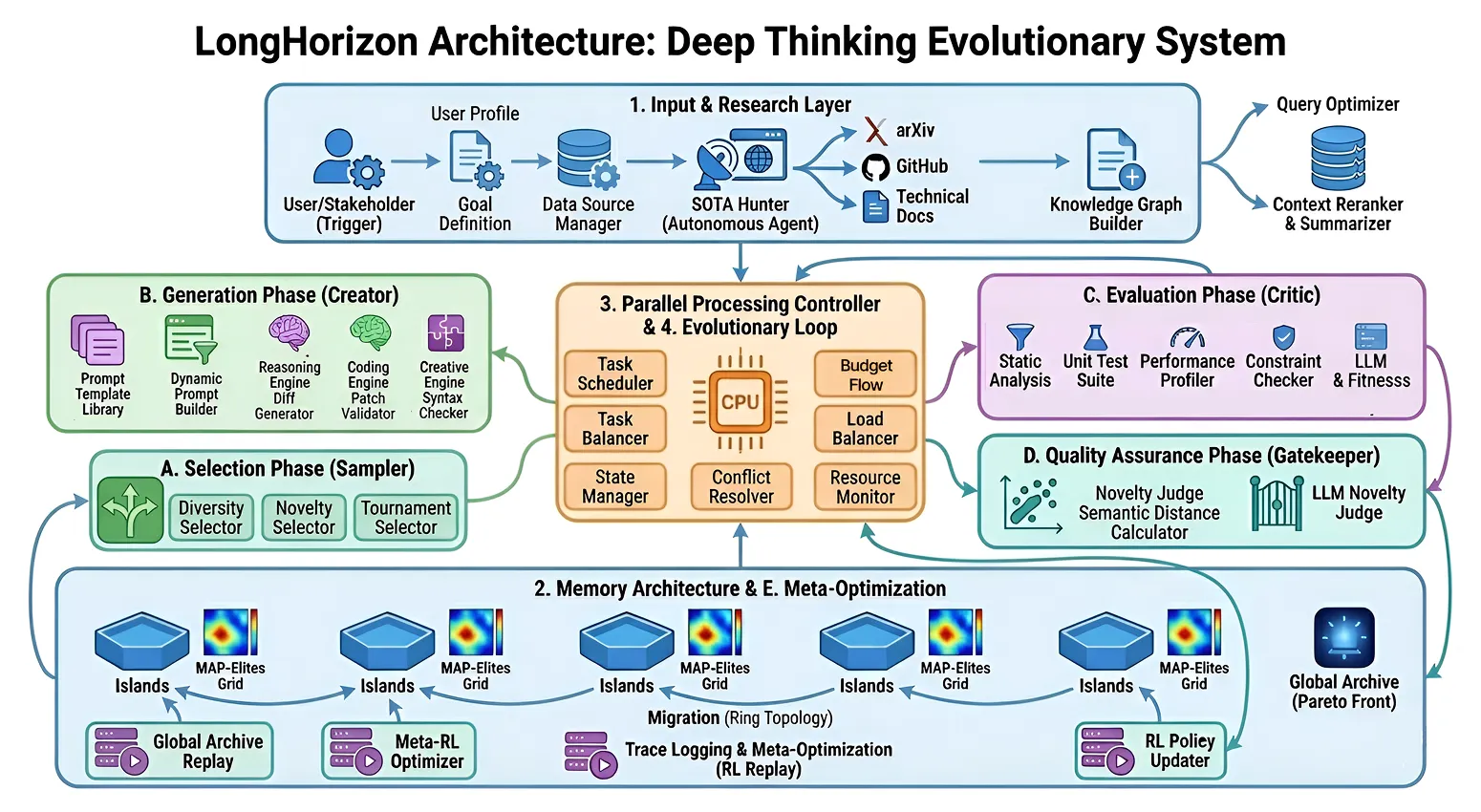
Core Philosophy: An Algorithmic Approach to AI Engineering
At its core, LongHorizon is built on the principle that agents capable of long-term reasoning require an algorithmic-based approach. This includes:
- MAP-Elites: To explore and preserve a diverse archive of high-quality solutions, avoiding premature convergence on a single "good enough" answer.
- Island Model Evolution: To run parallel, isolated populations with controlled migration, enhancing exploration and preventing catastrophic forgetting.
- Multi-Stage Evaluation: To intelligently filter solutions using a cascade of tests, performance profiling, visual inspection, and LLM-based judging, saving vast amounts of compute.
- Stateful Memory & Artifacts: To persist execution traces, logs, and learned behaviors across long runs, enabling checkpointing and deep analysis.
- Autonomous Research: To empower agents to browse the web, read documentation, and incorporate state-of-the-art knowledge before starting the evolution.
Key Features
- Multi-Model LLM Ensembles: Mix cheap/fast and expensive/powerful models with weighted sampling to optimize cost and performance.
- Island-Based Evolution: Maintain genetic diversity by evolving multiple populations in parallel.
- MAP-Elites for Diversity: Preserves not just the "best" solution, but the best solution for different niches (e.g., "fastest," "most concise," "most novel").
- Cascade Evaluation: Fails fast on bad solutions with a multi-stage evaluation pipeline, saving compute.
- Visual QA with Computer Use: Empowers agents to "see" and evaluate GUIs, plots, and other visual outputs.
- Autonomous Web Research: An integrated "SOTA Hunter" agent browses the web to find cutting-edge solutions before evolution begins.
- Diff-Based Evolution: Radically reduces token cost and improves precision by evolving code via
SEARCH/REPLACEblocks instead of full rewrites. - Stateful & Resumable: Checkpointing system allows you to stop and resume multi-day runs without losing progress.
- Comprehensive Tracing: Logs every evolutionary step (parent, child, prompt, metrics) to a JSONL file for analysis and reinforcement learning.
- Containerized & Deployable: Comes with a
Dockerfilefor easy deployment on local machines or cloud clusters.
Project Structure
The project is organized into modular components, each with a clear responsibility, enabling scalability and maintainability.
longhorizon/
├── api.py                          # Public API for using LongHorizon as a library
├── cli.py                          # Command-line interface
├── config.py                       # Configuration data classes and loader
├── Dockerfile                      # Docker definition for containerized deployment
├── longhorizon-run.py              # Main executable script
├── pyproject.toml                  # Project dependencies and metadata
│
├── configs/
│   └── default_config.yaml         # Baseline configuration template
│
├── core/
│   ├── controller.py               # Orchestrates the main evolutionary loop
│   ├── researcher.py               # Autonomous web research agent (SOTA Hunter)
│   └── iteration.py                # Logic for a single evolutionary step
│
├── data/
│   ├── database.py                 # Implements evolutionary memory (MAP-Elites, Islands)
│   └── evolution_trace.py          # Logs evolutionary steps for analysis and RL
│
├── evaluation/
│   ├── evaluator.py                # Main evaluation runner with cascade logic
│   ├── visual_evaluator.py         # Visual QA using multimodal models
│   └── novelty_judge.py            # LLM-based diversity/novelty assessment
│
├── llm/
│   ├── base.py                     # Abstract LLMInterface for provider-agnostic calls
│   ├── ensemble.py                 # Manages multi-model weighted sampling
│   └── openai.py                   # OpenAI/Azure/Groq/etc. compatible client
│
├── prompts/
│   └── defaults/                   # Built-in default prompt templates and fragments
│
└── utils/
    ├── async_utils.py              # Concurrency tools like TaskPool and retry logic
    └── code_utils.py               # Helpers for parsing diffs and code blocks
Getting Started
Prerequisites
- Python 3.10+
- Git
- An API key for an OpenAI-compatible LLM provider (e.g., OpenAI, Gemini, Groq, Together).
Installation
-
Clone the repository:
bash git clone https://github.com/FareedKhan-dev/ai-long-task.git cd ai-long-task -
Install the package in editable mode: This will install all required dependencies from
pyproject.toml.bash pip install -e . -
(Optional for Dev) Install development dependencies for testing and linting:
bash
    pip install -e ".[dev]"
Configuration
-
Set up Environment Variables: LongHorizon securely loads API keys from environment variables. Create a
.envfile in the root directory: ```env # For OpenAI models OPENAI_API_KEY="sk-..."For Gemini models (via Google AI Studio's OpenAI-compatible endpoint)
GEMINI_API_KEY="..."
For separate embedding models (optional)
OPENAI_EMBEDDING_API_KEY="sk-..." ``` The application will automatically load these variables.
-
Customize the Configuration (Optional): Copy the default configuration file to create your own experimental setup.
bash
    cp longhorizon/configs/default_config.yaml my_experiment_config.yaml
Now, you can editmy_experiment_config.yamlto change models, evolutionary parameters, and more.
Usage
LongHorizon can be used both as a command-line tool for running full experiments and as a Python library for integration into other projects.
Command-Line Interface (CLI)
The CLI is the primary way to run an evolutionary experiment.
Basic Syntax:
longhorizon-run <initial_program> <evaluation_file> [options]
Example: Optimizing a GPU Kernel (from the blog post)
Let's run the MLX kernel optimization example. The necessary files are already in the repository.
longhorizon-run \
    examples/mlx_problem/initial_program.py \
    examples/mlx_problem/evaluator.py \
    --config examples/mlx_problem/config.yaml \
    --output mlx_optimization_run
initial_program.py: The baseline, unoptimized GQA implementation.evaluator.py: The "bulletproof" evaluator that benchmarks speed and correctness.--config config.yaml: Specifies the evolutionary strategy (models, prompts, etc.).--output mlx_optimization_run: The directory where all results, checkpoints, and logs will be saved.
Resuming from a Checkpoint:
If your run is interrupted, you can resume it from the last checkpoint:
longhorizon-run \
    examples/mlx_problem/initial_program.py \
    examples/mlx_problem/evaluator.py \
    --config examples/mlx_problem/config.yaml \
    --output mlx_optimization_run \
    --checkpoint mlx_optimization_run/checkpoints/checkpoint_100
Using LongHorizon as a Library (API)
You can easily integrate LongHorizon's evolutionary engine into your own Python code using the high-level API in longhorizon.api.
Example 1: General-purpose code evolution
from longhorizon.api import evolve_code, EvolutionResult

# 1. Define your initial code
initial_code = """
def slow_sort(arr):
    # EVOLVE-BLOCK-START
    n = len(arr)
    for i in range(n):
        for j in range(0, n - i - 1):
            if arr[j] > arr[j + 1]:
                arr[j], arr[j + 1] = arr[j + 1], arr[j]
    return arr
    # EVOLVE-BLOCK-END
"""

# 2. Define your evaluator function
def sorting_evaluator(program_path: str):
    # This function will be executed in a separate process
    import importlib.util
    import random

    # Load the evolved module
    spec = importlib.util.spec_from_file_location("evolved_module", program_path)
    module = importlib.util.module_from_spec(spec)
    spec.loader.exec_module(module)

    # Test with random data
    test_data = [random.randint(0, 1000) for _ in range(100)]
    expected = sorted(test_data.copy())

    try:
        result = module.slow_sort(test_data.copy())
        correctness = 1.0 if result == expected else 0.0
    except Exception:
        correctness = 0.0

    return {"score": correctness}

# 3. Run the evolution!
result: EvolutionResult = evolve_code(
    initial_code=initial_code,
    evaluator=sorting_evaluator,
    iterations=50
)

print(f"Evolution complete! Best score: {result.best_score}")
print("--- Best Code ---")
print(result.best_code)
Example 2: Evolving a specific function with test cases
from longhorizon.api import evolve_function

# The function we want to optimize
def add(a, b):
    return a + b

# A set of test cases to guide evolution
test_cases = [
    ((2, 3), 5),
    ((-1, 1), 0),
    ((100, 200), 300)
]

# Evolve the function
result = evolve_function(
    func=add,
    test_cases=test_cases,
    iterations=100
)

print(f"Best score (test pass rate): {result.best_score}")
print("--- Evolved Function ---")
print(result.best_code)
Configuration Deep Dive
The behavior of LongHorizon is controlled by a single YAML file. The longhorizon/configs/default_config.yaml file is heavily commented and serves as the best reference. Here are the key sections:
-
llm: Configures the LLM ensembles.models: A list of models for code generation. Each has anameandweight.evaluator_models: A separate list of models for LLM-as-a-Judge.api_base/api_key: Can be set here or resolved from${ENV_VAR}.temperature,timeout,retries: Default generation parameters.
-
database: Controls the evolutionary memory and strategy.population_size: Total number of programs to keep.num_islands: Number of parallel populations to evolve.migration_interval: How often (in generations) to share best solutions between islands.feature_dimensions: Defines the axes for the MAP-Elites grid (e.g.,["complexity", "diversity"]).
-
evaluator: Configures the evaluation pipeline.timeout: Max time in seconds for a single evaluation to run.parallel_evaluations: How many programs to evaluate concurrently.cascade_evaluation: Set totrueto enable multi-stage evaluation.cascade_thresholds: A list of scores a program must achieve to proceed to the next stage.
-
browser_use/computer_use: Enable the advanced research and visual QA agents.enabled: Set totrueto activate these capabilities.model: The multimodal model to use (e.g.,gpt-4o).
Architectural Concepts Explained
The Compute Layer: Resilient LLM Ensembles
The llm/ module provides a resilient, provider-agnostic interface for interacting with language models.
llm.base.LLMInterface: An abstract base class that defines the contract for all LLM clients, ensuring our core logic doesn't depend on a specific provider.- **`llm.ope
Core symbols most depended-on inside this repo
Shape
Languages
Modules by API surface
For agents
$ claude mcp add ai-long-task \
  -- python -m otcore.mcp_server <graph>