github.com/Comfy-Org/ComfyUI-Manager @4.2.2 sqlite
README
ComfyUI Manager
ComfyUI-Manager is an extension designed to enhance the usability of ComfyUI. It offers management functions to install, remove, disable, and enable various custom nodes of ComfyUI. Furthermore, this extension provides a hub feature and convenience functions to access a wide range of information within ComfyUI.
NOTICE
- V4.0: Modify the structure to be installable via pip instead of using git clone.
- V3.16: Support for
uvhas been added. Setuse_uvinconfig.ini. - V3.10:
double-click featureis removed - This feature has been moved to https://github.com/ltdrdata/comfyui-connection-helper
- V3.3.2: Overhauled. Officially supports https://registry.comfy.org/.
- You can see whole nodes info on ComfyUI Nodes Info page.
Installation
-
When installing the latest ComfyUI, it will be automatically installed as a dependency, so manual installation is no longer necessary.
-
Manual installation of the nightly version:
- Clone to a temporary directory (Note: Do not clone into
ComfyUI/custom_nodes.)git clone https://github.com/Comfy-Org/ComfyUI-Manager - Install via pip
cd ComfyUI-Manager
  pip install .
- Clone to a temporary directory (Note: Do not clone into
-
See also: https://github.com/Comfy-Org/comfy-cli
Front-end
- The built-in front-end of ComfyUI-Manager is the legacy front-end. The front-end for ComfyUI-Manager is now provided via ComfyUI Frontend.
- To enable the legacy front-end, set the environment variable
ENABLE_LEGACY_COMFYUI_MANAGER_FRONTtotruebefore running.
How To Use
-
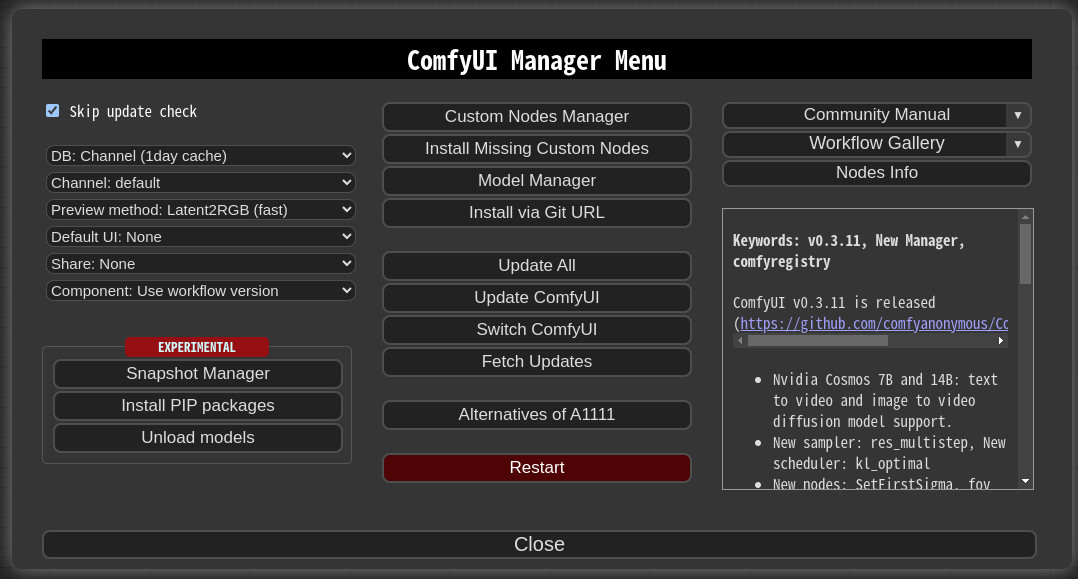
Click "Manager" button on main menu

-
If you click on 'Install Custom Nodes' or 'Install Models', an installer dialog will open.
- There are three DB modes:
DB: Channel (1day cache),DB: Local, andDB: Channel (remote). Channel (1day cache)utilizes Channel cache information with a validity period of one day to quickly display the list.- This information will be updated when there is no cache, when the cache expires, or when external information is retrieved through the Channel (remote).
- Whenever you start ComfyUI anew, this mode is always set as the default mode.
Localuses information stored locally in ComfyUI-Manager.- This information will be updated only when you update ComfyUI-Manager.
- For custom node developers, they should use this mode when registering their nodes in
custom-node-list.jsonand testing them.
Channel (remote)retrieves information from the remote channel, always displaying the latest list.-
In cases where retrieval is not possible due to network errors, it will forcibly use local information.
-
The
Fetch Updatesmenu retrieves update data for custom nodes locally. Actual updates are applied by clicking theUpdatebutton in theInstall Custom Nodesmenu.
- There are three DB modes:
-
Click 'Install' or 'Try Install' button.
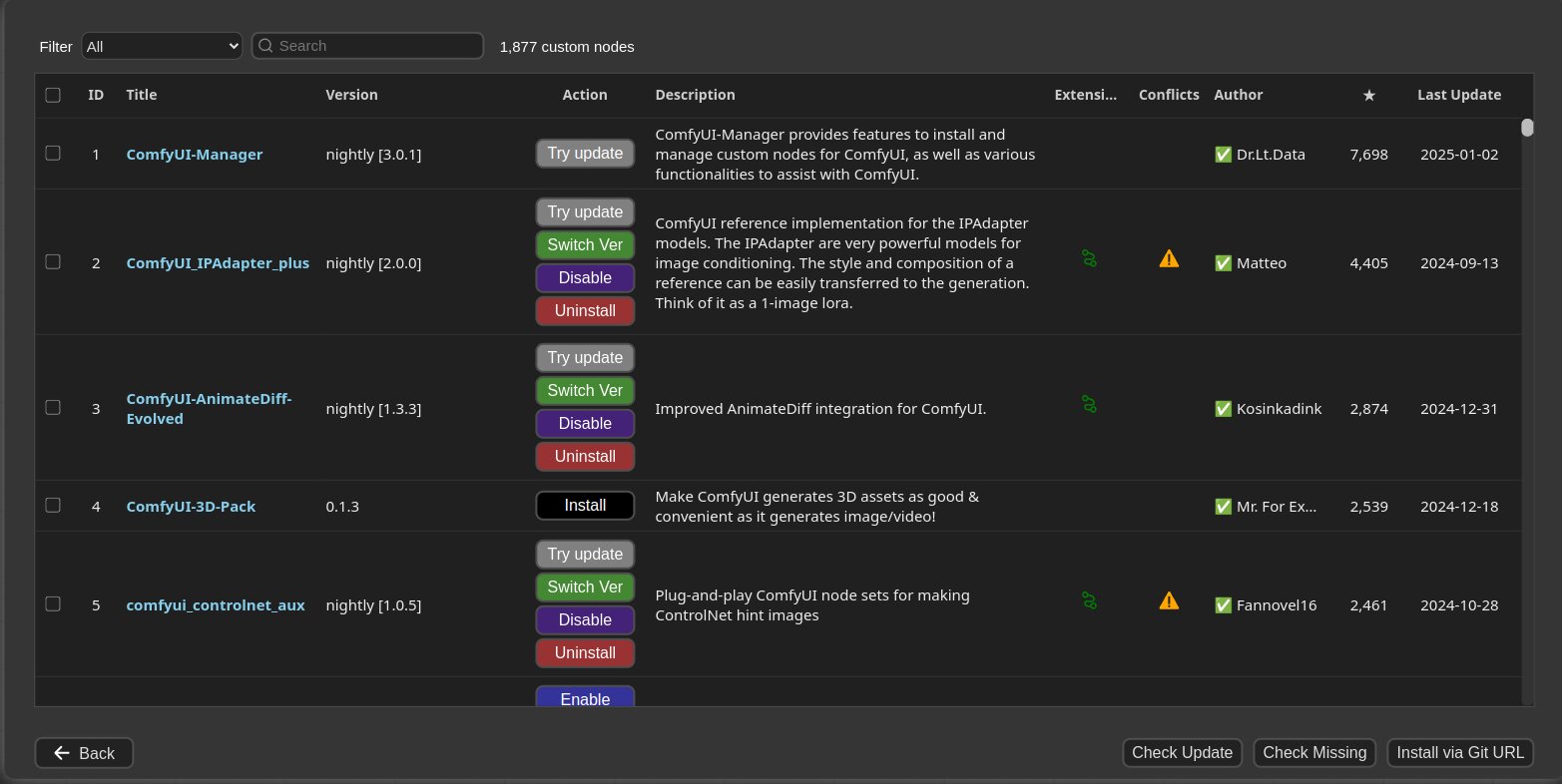
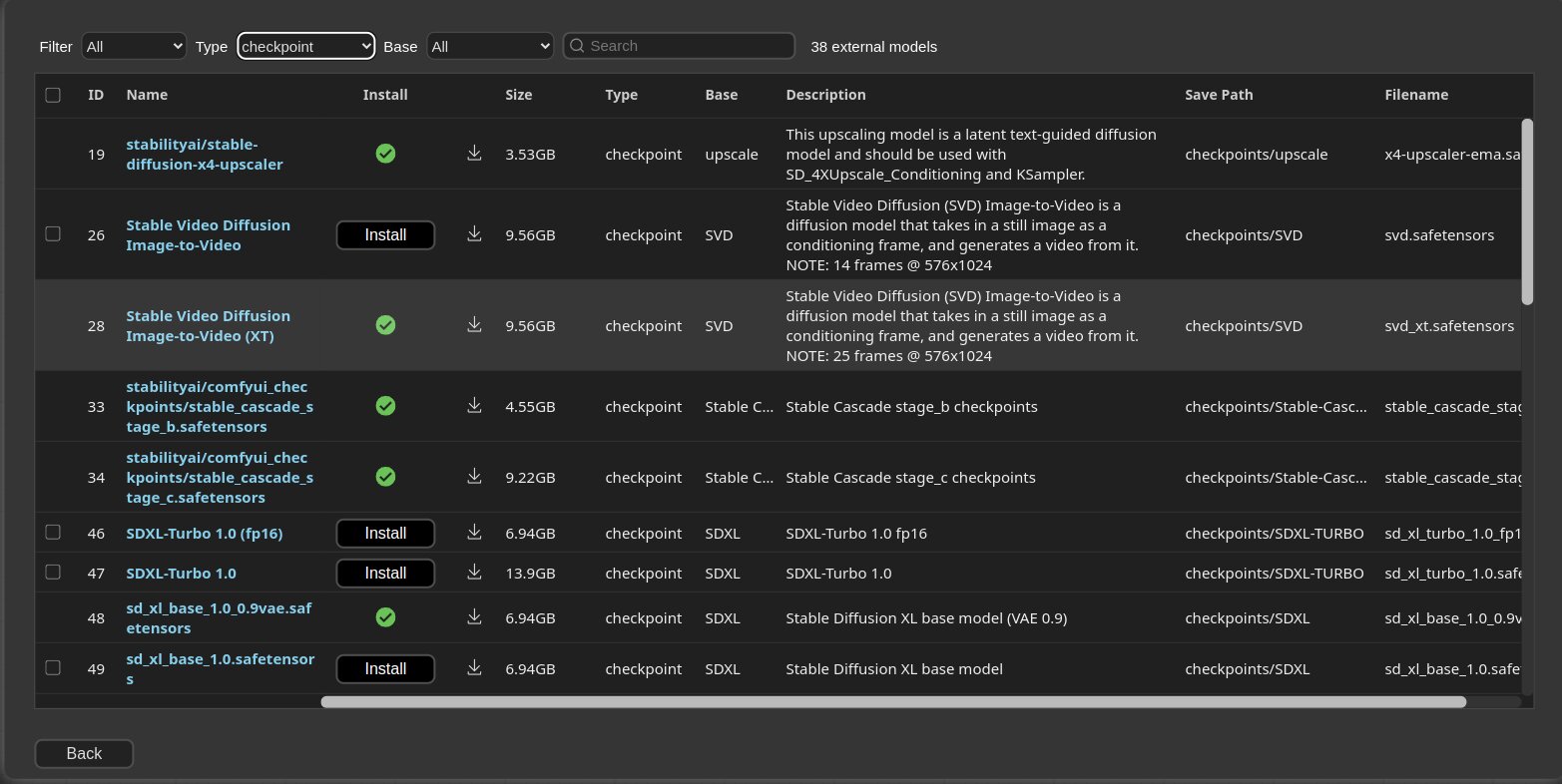
- Installed: This item is already installed.
- Install: Clicking this button will install the item.
-
Try Install: This is a custom node of which installation information cannot be confirmed. Click the button to try installing it.
-
If a red background
Channelindicator appears at the top, it means it is not the default channel. Since the amount of information held is different from the default channel, many custom nodes may not appear in this channel state. - Channel settings have a broad impact, affecting not only the node list but also all functions like "Update all."
- Conflicted Nodes with a yellow background show a list of nodes conflicting with other extensions in the respective extension. This issue needs to be addressed by the developer, and users should be aware that due to these conflicts, some nodes may not function correctly and may need to be installed accordingly.
-
Share
-
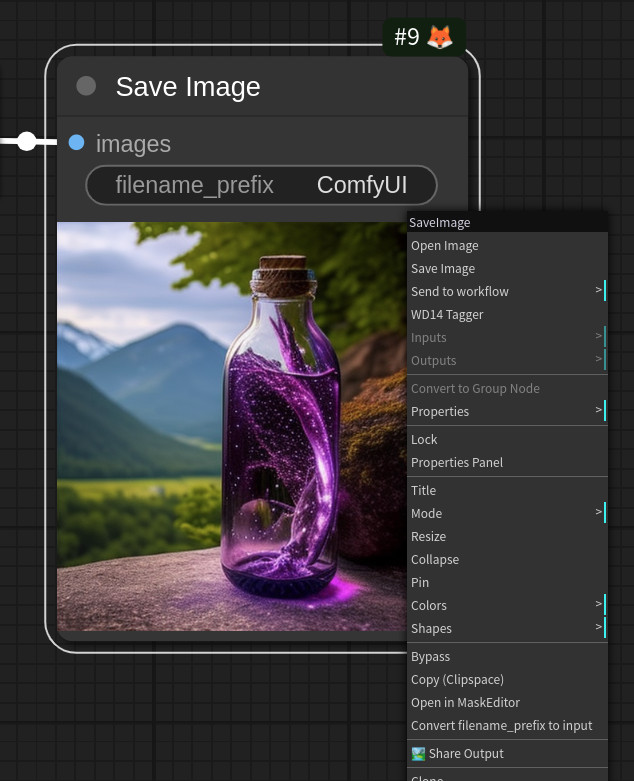
You can share the workflow by clicking the Share button at the bottom of the main menu or selecting Share Output from the Context Menu of the Image node.
- Currently, it supports sharing via https://comfyworkflows.com/, https://openart.ai, https://youml.com as well as through the Matrix channel.
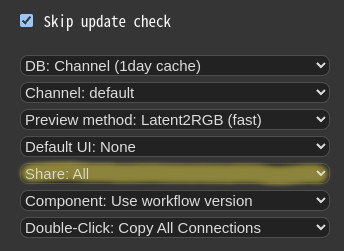
- Through the Share settings in the Manager menu, you can configure the behavior of the Share button in the Main menu or Share Output button on Context Menu.
None: hide from Main menuAll: Show a dialog where the user can select a title for sharing.
Paths
In ComfyUI-Manager V4.0.3b4 and later, configuration files and dynamically generated files are located under <USER_DIRECTORY>/__manager/.
- If executed without any options, the path defaults to ComfyUI/user.
-
It can be set using --user-directory .
-
Basic config files:
<USER_DIRECTORY>/__manager/config.ini - Configurable channel lists:
<USER_DIRECTORY>/__manager/channels.ini - Configurable pip overrides:
<USER_DIRECTORY>/__manager/pip_overrides.json - Configurable pip blacklist:
<USER_DIRECTORY>/__manager/pip_blacklist.list - Configurable pip auto fix:
<USER_DIRECTORY>/__manager/pip_auto_fix.list - Saved snapshot files:
<USER_DIRECTORY>/__manager/snapshots - Startup script files:
<USER_DIRECTORY>/__manager/startup-scripts - Component files:
<USER_DIRECTORY>/__manager/components
extra_model_paths.yaml Configuration
The following settings are applied based on the section marked as is_default.
custom_nodes: Path for installing custom nodes- Importing does not need to adhere to the path set as
is_default, but this is the path where custom nodes are installed by theComfyUI Nodes Manager.
- Importing does not need to adhere to the path set as
download_model_base: Path for downloading models
Snapshot-Manager
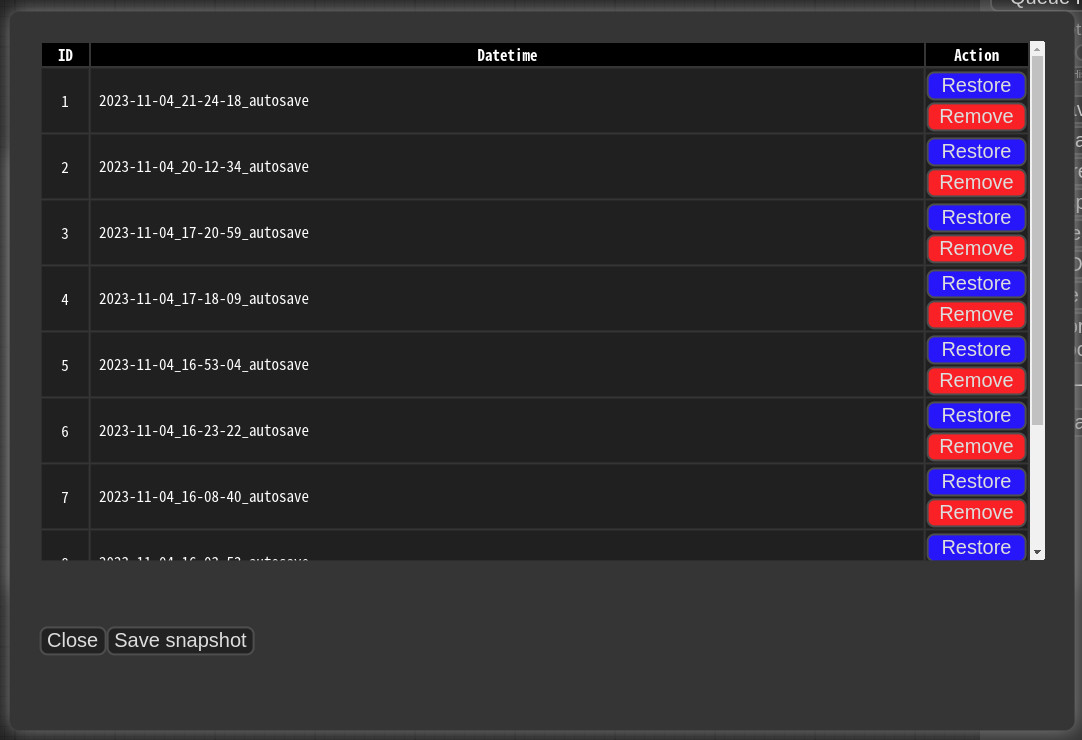
- When you press
Save snapshotor useUpdate AllonManager Menu, the current installation status snapshot is saved. - Snapshot file dir:
<USER_DIRECTORY>/__manager/snapshots - You can rename snapshot file.
- Press the "Restore" button to revert to the installation status of the respective snapshot.
- However, for custom nodes not managed by Git, snapshot support is incomplete.
- When you press
Restore, it will take effect on the next ComfyUI startup. - The selected snapshot file is saved in
<USER_DIRECTORY>/__manager/startup-scripts/restore-snapshot.json, and upon restarting ComfyUI, the snapshot is applied and then deleted.
cm-cli: command line tools for power users
- A tool is provided that allows you to use the features of ComfyUI-Manager without running ComfyUI.
- For more details, please refer to the cm-cli documentation.
How to register your custom node into ComfyUI-Manager
- Add an entry to
custom-node-list.jsonlocated in the root of ComfyUI-Manager and submit a Pull Request. - NOTE: Before submitting the PR after making changes, please check
Use local DBand ensure that the extension list loads without any issues in theInstall custom nodesdialog. Occasionally, missing or extra commas can lead to JSON syntax errors. - The remaining JSON will be updated through scripts in the future, so you don't need to worry about it.
Custom node support guide
-
NOTICE:
- You should no longer assume that the GitHub repository name will match the subdirectory name under
custom_nodes. The name of the subdirectory undercustom_nodeswill now use the normalized name from thenamefield inpyproject.toml. - Avoid relying on directory names for imports whenever possible.
- You should no longer assume that the GitHub repository name will match the subdirectory name under
-
https://docs.comfy.org/registry/overview
- https://github.com/Comfy-Org/rfcs
Special purpose files (optional)
* pyproject.toml - Spec file for comfyregistry.
* node_list.json - When your custom nodes pattern of NODE_CLASS_MAPPINGS is not conventional, it is used to manually provide a list of nodes for reference. (example)
* requirements.txt - When installing, this pip requirements will be installed automatically
* install.py - When installing, it is automatically called
* All scripts are executed from the root path of the corresponding custom node.
Component Sharing
- Copy & Paste
- Demo Page
- When pasting a component from the clipboard, it supports text in the following JSON format. (text/plain)
{
      "kind": "ComfyUI Components",
      "timestamp": <current timestamp>,
      "components":
        {
          <component name>: <component nodedata>
        }
    }
<current timestamp>Ensure that the timestamp is always unique.- "components" should have the same structure as the content of the file stored in
<USER_DIRECTORY>/__manager/components. <component name>: The name should be in the format<prefix>::<node name>.<component node data>: In the node data of the group node.<version>: Only two formats are allowed:major.minor.patchormajor.minor. (e.g.1.0,2.2.1)<datetime>: Saved time<packname>: If the packname is not empty, the category becomes packname/workflow, and it is saved in the .pack file in<USER_DIRECTORY>/__manager/components.<category>: If there is neither a category nor a packname, it is saved in the components category."version":"1.0", "datetime": 1705390656516, "packname": "mypack", "category": "util/pipe",
- "components" should have the same structure as the content of the file stored in
- Drag & Drop
- Dragging and dropping a
.packor.jsonfile will add the corresponding components. -
Example pack: Impact.pack
-
Dragging and dropping or pasting a single component will add a node. However, when adding multiple components, nodes will not be added.
Support for installing missing nodes
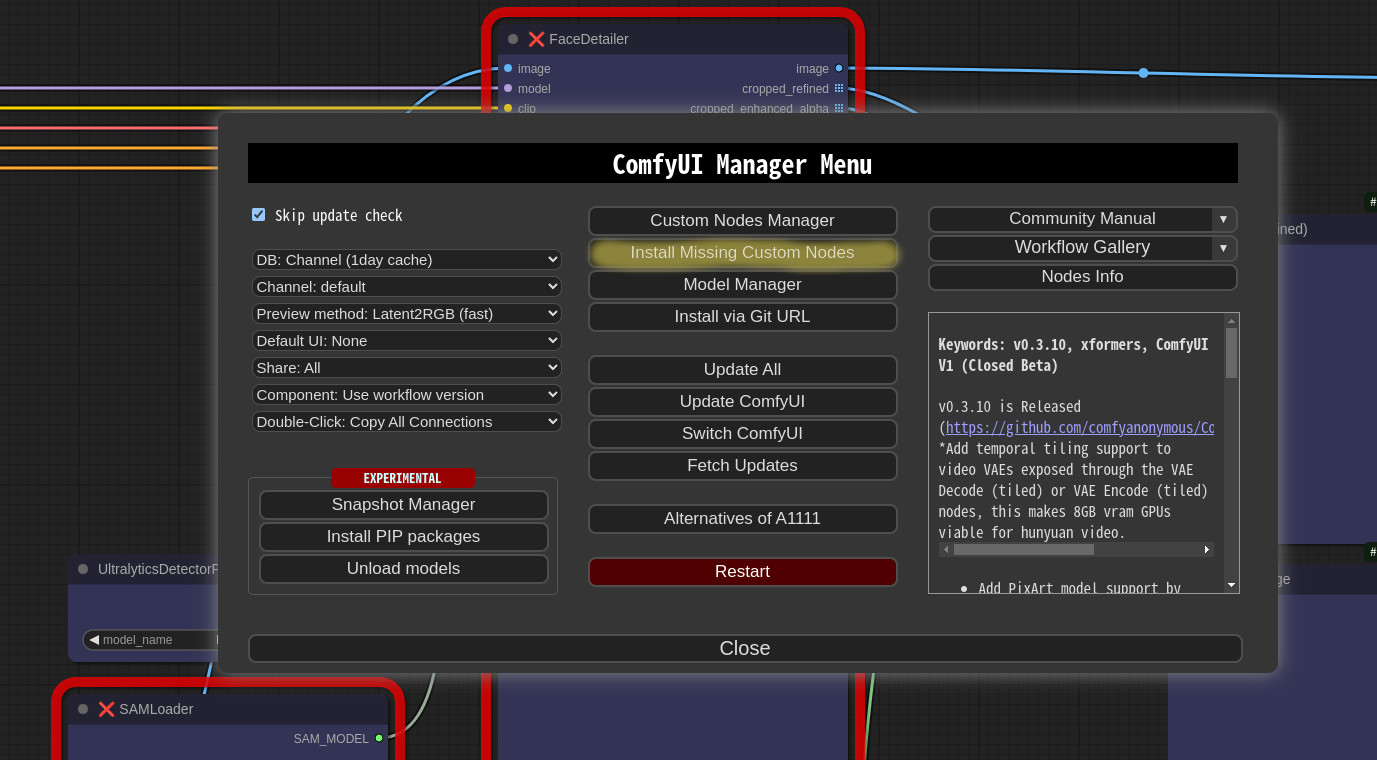
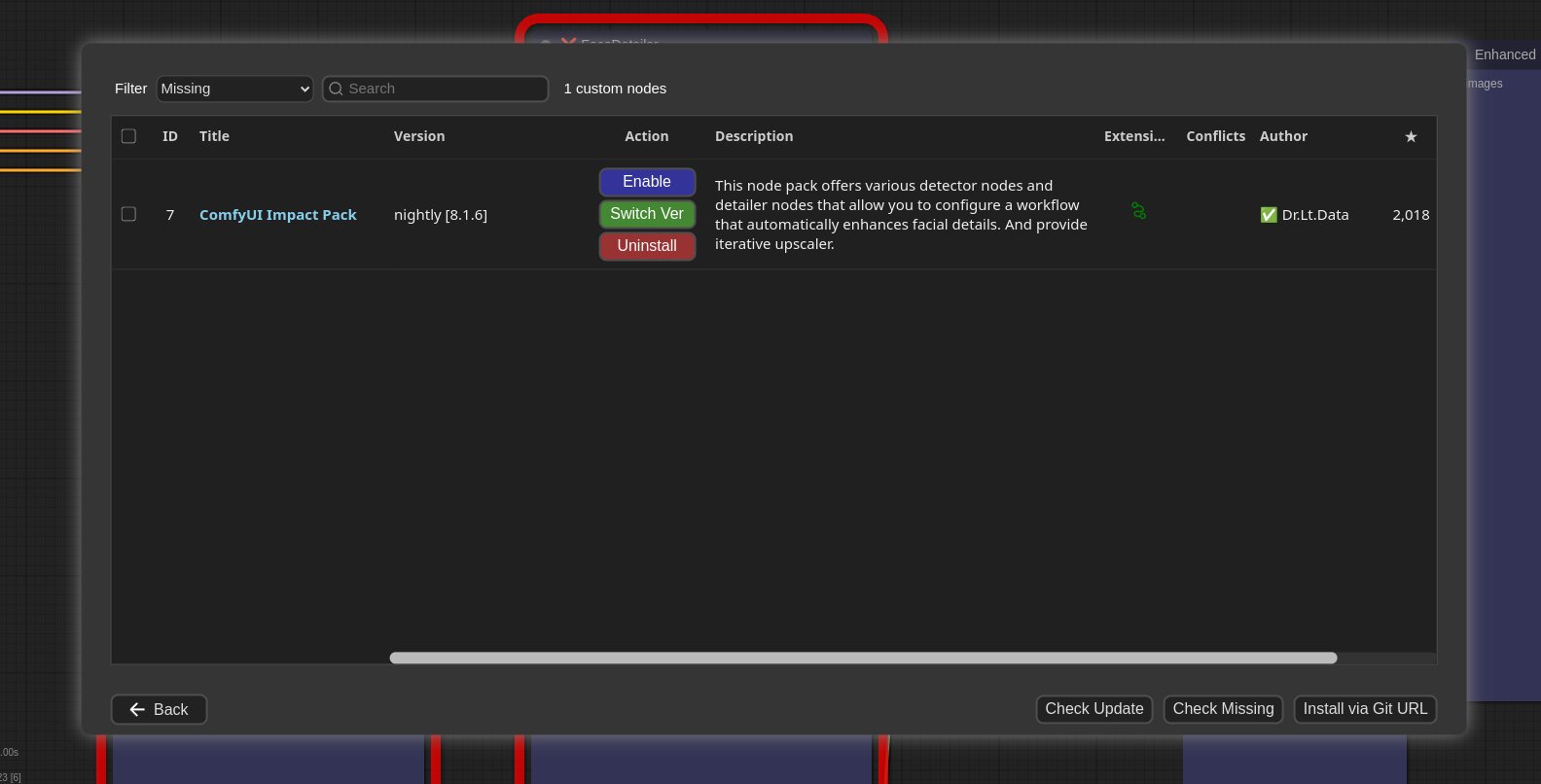
- When you click on the
Install Missing Custom Nodesbutton in the menu, it displays a list of extension nodes that contain nodes not currently present in the workflow.
Config
- You can modify the
config.inifile to apply the settings for ComfyUI-Manager.- The path to the
config.iniused by ComfyUI-Manager is displayed in the startup log messages. - See also: [https://github.com/ltdrdata/ComfyUI-Manager#paths]
- The path to the
-
Configuration options:
[default] git_exe = <Manually specify the path to the git executable. If left empty, the default git executable path will be used.> use_uv = <Use uv instead of pip for dependency installation.> default_cache_as_channel_url = <Determines whether to retrieve the DB designated as channel_url at startup> bypass_ssl = <Set to True if SSL errors occur to disable SSL.> file_logging = <Configure whether to create a log file used by ComfyUI-Manager.> windows_selector_event_loop_policy = <If an event loop error occurs on Windows, set this to True.> model_download_by_agent = <When downloading models, use an agent instead of torchvision_download_url.> downgrade_blacklist = <Set a list of packages to prevent downgrades. List them separated by commas.> security_level = <Set the security level => strong|normal|normal-|weak> allow_git_url_install = <Allow installing custom nodes from arbitrary git URLs. Independent of security_level. Default: False> allow_pip_install = <Allow installing arbitrary pip packages via the Manager. Independent of security_level. Default: False> always_lazy_install = <Whether to perform dependency installation on restart even in environments other than Windows.> network_mode = <Set the network mode => public|private|offline|personal_cloud>- network_mode:
- public: An environment that uses a typical public network.
- private: An environment that uses a closed network, where a private node DB is configured via
channel_url. (Uses cache if available) - offline: An environment that does not use any external connections when using an offline network. (Uses cache if available)
- personal_cloud: Applies relaxed security features in cloud environments such as Google Colab or Runpod, where strong security is not required.
Additional Feature
- Logging to file feature
- This feature is enabled by defa
Core symbols most depended-on inside this repo
getShape
Languages
Modules by API surface
Dependencies from manifests, versioned
For agents
$ claude mcp add ComfyUI-Manager \
  -- python -m otcore.mcp_server <graph>