github.com/Royalvice/DocDiff @main
Chat with this repoWhat it actually does AI analysis from the code graph — generated when you open this
README

DocDiff
This is the official repository for the paper DocDiff: Document Enhancement via Residual Diffusion Models. DocDiff is a document enhancement model (please refer to the paper) that can be used for tasks such as document deblurring, denoising, binarization, watermark and stamp removal, etc. DocDiff is a lightweight residual prediction-based diffusion model, that can be trained on a batch size of 64 with only 12GB of VRAM at a resolution of 128*128.
Not only for document enhancement, DocDiff can also be used for other img2img tasks, such as natural scene deblurring1, denoising, rain removal, super-resolution2, image inpainting, as well as high-level tasks such as semantic segmentation4.
News
- Pinned: Introducing our laboratory-developed versatile and cross-platform OCR software. It includes the automatic removal of watermarks and stamps using DocDiff (automatic watermark removal feature coming soon). It also encompasses various commonly used OCR functions such as PDF to Word conversion, PDF to Excel conversion, formula recognition, and table recognition. Feel free to give it a try!
- 2023.09.14: Uploaded watermark synthesis code
utils/marker.pyand seal dataset. Seal dataset Google Drive - 2023.08.02: Document binarization results for H-DIBCO 2018 6 and DIBCO 2019 7 have been uploaded. You can access them in the Google Drive
- 2023.08.01: Congratulations! DocDiff has been accepted by ACM Multimedia 2023!
- 2023.06.13: The inference notebook
demo/inference.ipynbis uploaded for convenient reproduction and pretrained modelschecksave/are uploaded. - 2023.05.08: The initial version of the code is uploaded. Please check the to-do list for future updates.
Guide
Whether it's for training or inference, you just need to modify the configuration parameters in conf.yml and run main.py. MODE=1 is for training, MODE=0 is for inference. The parameters in conf.yml have detailed annotations, so you can modify them as needed. Pre-trained weights for document deblurring Coarse Predictor and Denoiser can be found in checksave/, respectively.
Please note that the default parameters in conf.yml work best for document scenarios. If you want to apply DocDiff to natural scenes, please first read Notes! carefully. If you still have issues, welcome to submit an issue.
- Because downsampling is applied three times, the resolution of the input image must be a multiple of 8. If your image is not a multiple of 8, you can adjust the image to be a multiple of 8 using padding or cropping. Please do not directly resize, as it may cause image distortion. In particular, in the deblurring task, image distortion will increase the blur and result in poor performance. For example, the document deblurring dataset 5 used by DocDiff has a resolution of 300*300, which needs to be padded to 304*304 before inference.
Environment
- python >= 3.7
- pytorch >= 1.7.0
- torchvision >= 0.8.0
Watermark Synthesis and Seal Dataset
We provide watermark synthesis code utils/marker.py and a stamp dataset. Seal dataset Google Drive. Since the document background images used are our internal data, we did not provide the background images. If you want to use the watermark synthesis code, you need to find some document background images yourself. The watermark synthesis code is implemented based on OpenCV, so you need to install OpenCV.
Seal Dataset
The Seal Dataset belongs to the DocDiff project. It contains 1597 red seals in Chinese scenes, along with their corresponding binary masks. These seal data can be used for tasks such as seal synthesis and seal removal. Due to limited manpower, it is extremely difficult to extract seals from document images, so some seal images may contain noise. Most of the original seal images in the dataset are from the ICDAR 2023 Competition on Reading the Seal Title (https://rrc.cvc.uab.es/?ch=20) dataset, and a few are from our internal images. If you find this dataset helpful, please give our project a free star, thank you!!!
Notes!
- The default configuration parameters of DocDiff are designed for document images, and if you want to achieve better results when using it for natural scenes, you need to adjust the parameters. For example, you can scale up the model, add self-attention, etc. (because document images have relatively fixed patterns, but natural scenes have more diverse patterns and require more parameters). Additionally, you may need to modify the training and inference strategies.
- Training strategy: As described in the paper, in document scenarios, we do not pursue diverse results and we need to minimize the inference time as much as possible. Therefore, we set the diffusion step T to 100, and predict $x_0$ instead of predicting $\epsilon$. Based on the premise of using a channel-wise concatenation conditioning scheme, this strategy can recover a fine $x_0$ in the early steps of reverse diffusion. In natural scenes, in order to better reconstruct textures and pursue diverse results, the diffusion step T should be set as large as possible, and $\epsilon$ should be predicted. You just need to modify PRE_ORI="False" in
conf.ymlto use the scheme of predicting $\epsilon$, and modify TIMESTEPS=1000 to use a larger diffusion step. - Inference strategy: The images generated in document scenarios should not have randomness. (short-step stochastic sampling may cause text edges to be distorted), so DocDiff performs deterministic sampling as described in DDIM3. In natural scenes, stochastic sampling is essential for diverse results, so you can use stochastic sampling by modifying PRE_ORI="False" in
conf.yml. In other words, the scheme of predicting $\epsilon$ is bound to stochastic sampling, while the scheme of predicting $x_0$ is bound to deterministic sampling. If you want to predict $x_0$ and use stochastic sampling, or predict $\epsilon$ and use deterministic sampling, you need to modify the code yourself. In DocDiff, deterministic sampling is performed using the method in DDIM, while stochastic sampling is performed using the method in DDPM. You can modify the code to implement other sampling strategies yourself. - Summary: For tasks that do not require diverse results, such as semantic segmentation, document enhancement, predicting $x_0$ with a diffusion step of 100 is enough, and the performance is already good. For tasks that require diverse results, such as deblurring for natural scenes, super-resolution, image restoration, etc., predicting $\epsilon$ with a diffusion step of 1000 is recommended.
To-do Lists
- [x] Add training code
- [x] Add inference code
- [x] Upload pre-trained model
- [x] Upload watermark synthesis code and seal dataset.
- [x] Use DPM_solver to reduce inference step size (although the effect is not significant in practice)
- [x] Uploaded the inference notebook for convenient reproduction
- [ ] Synthesize document datasets with more noise, such as salt-and-pepper noise and noise generated from compression.
- [ ] Train on multiple GPUs
- [ ] Jump-step sampling for DDIM
- [ ] Use depth separable convolution to compress the model
- [ ] Train the model on natural scenes and provide results and pre-trained models
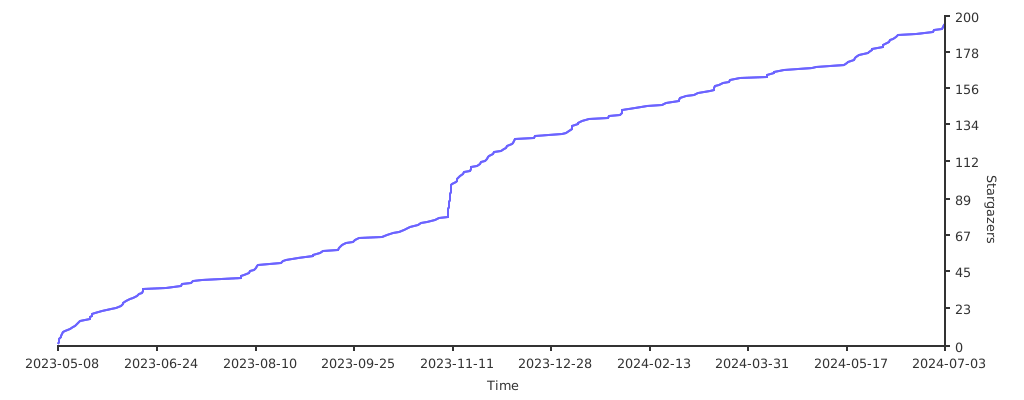
Stars over time
Acknowledgement
- If you find DocDiff helpful, please give us a star. Thank you! 🤞😘
- If you have any questions, please don't hesitate to open an issue. We will reply as soon as possible.
- If you want to communicate with us, please send an email to viceyzy@foxmail.com with the subject "DocDiff".
- If you want to use DocDiff as the baseline for your project, please cite our paper.
@inproceedings{yang2023docdiff,
  title={DocDiff: Document Enhancement via Residual Diffusion Models},
  author={Yang, Zongyuan and Liu, Baolin and Xxiong, Yongping and Yi, Lan and Wu, Guibin and Tang, Xiaojun and Liu, Ziqi and Zhou, Junjie and Zhang, Xing},
  booktitle={Proceedings of the 31st ACM International Conference on Multimedia},
  pages={2795--2806},
  year={2023}
}
References
-
[1] Whang J, Delbracio M, Talebi H, et al. Deblurring via stochastic refinement[C]//Proceedings of the IEEE/CVF Conference on Computer Vision and Pattern Recognition. 2022: 16293-16303.
-
[2] Shang S, Shan Z, Liu G, et al. ResDiff: Combining CNN and Diffusion Model for Image Super-Resolution[J]. arXiv preprint arXiv:2303.08714, 2023.
-
[3] Song J, Meng C, Ermon S. Denoising diffusion implicit models[J]. arXiv preprint arXiv:2010.02502, 2020.
-
[4] Wu J, Fang H, Zhang Y, et al. MedSegDiff: Medical Image Segmentation with Diffusion Probabilistic Model[J]. arXiv preprint arXiv:2211.00611, 2022.
-
[5] Michal Hradiš, Jan Kotera, Pavel Zemčík and Filip Šroubek. Convolutional Neural Networks for Direct Text Deblurring. In Xianghua Xie, Mark W. Jones, and Gary K. L. Tam, editors, Proceedings of the British Machine Vision Conference (BMVC), pages 6.1-6.13. BMVA Press, September 2015.
Core symbols most depended-on inside this repo
marginal_stdShape
Languages
Modules by API surface
For agents
$ claude mcp add DocDiff \
  -- python -m otcore.mcp_server <graph>